
 by
by 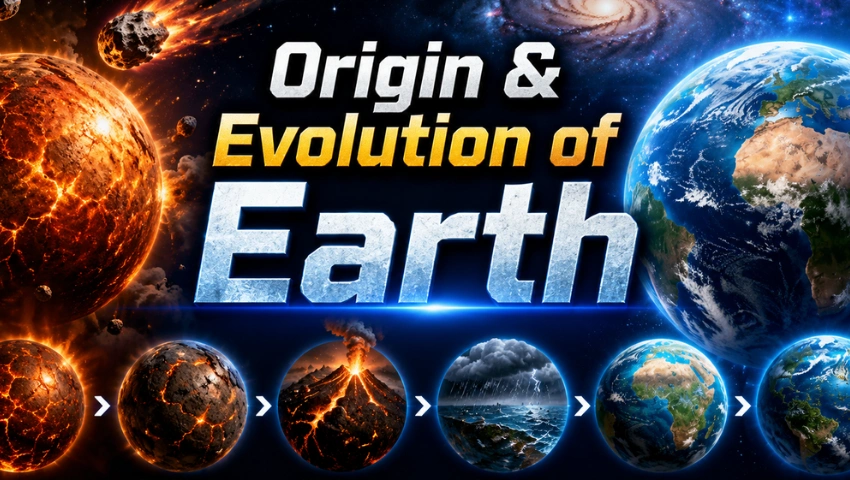
The Origin and Evolution of the Earth is a fundamental topic in physical geography and earth sciences. Understanding how Earth formed provides insights into the evolution of continents, oceans, atmosphere, life, and the geological structure we see today. It also explains why Earth is unique among all known planets supporting life due to its position, structure, and evolution.
Origin and Evolution of the Earth
The Earth formed about 4.6 billion years ago from the same solar nebula that created the rest of the Solar System. It began as a hot, molten mass, gradually cooling, differentiating into core, mantle and crust and forming an atmosphere and oceans through volcanic activity and comet impacts. Over time, tectonic and climatic changes shaped Earth into the dynamic planet we know today.
Origin and Evolution of the Earth Overview –
Earth’s formation is a result of astronomical, physical, and chemical processes over billions of years. The evolution includes not just physical changes but also the emergence of life and atmosphere.
| Overview – Origin and Evolution of the Earth | ||
| Stage | Time Period (Approx.) | Key Events |
| Solar Nebula Formation | ~4.6 billion years ago | Collapse of gas cloud, Sun formed |
| Accretion & Planet Formation | 4.6 – 4.5 billion years ago | Earth formed from planetesimals |
| Differentiation Phase | 4.5 – 4.4 billion years ago | Core, mantle, crust separation |
| Outgassing & Atmosphere Formed | 4.4 – 4.0 billion years ago | Volcanic gases form early atmosphere |
| Ocean Formation | ~4.0 billion years ago | Water vapor condenses, creating oceans |
| Origin of Life | ~3.5 – 3.8 billion years ago | First microbial life appears |
Theories of Origin of the Earth
Before modern scientific explanations, early theories of Earth’s origin were based on mythology or speculation. With scientific progress, several models were proposed to explain planetary formation. The Nebular Hypothesis by Immanuel Kant and Pierre Laplace is most widely accepted, explaining that the Solar System, including Earth, formed from a rotating cloud of gas and dust.
| Theories of Origin of the Earth | ||
| Theory | Proposer(s) | Key Idea |
| Nebular Hypothesis | Kant, Laplace | Earth formed from a rotating solar nebula |
| Planetesimal Theory | Chamberlin, Moulton | Earth formed by accretion of small rocky bodies |
| Tidal Hypothesis | James Jeans, Harold Jeffreys | Material torn from Sun formed planets |
| Modern Accretion Theory | Current Science | Earth formed by accretion of particles from solar nebula |
Earth’s Formation through Accretion
The formation of Earth began with the accretion of planetesimals in the early solar nebula. These rocky and metallic objects collided and merged under gravity, gradually forming a large planetary body. The early Earth was extremely hot due to collisions and radioactive decay.
As the planet grew, heavier elements sank toward the center, forming the core, while lighter materials floated outward, forming the crust. This process is known as differentiation.
Formation of Atmosphere and Oceans
The primitive Earth had no atmosphere or water initially. The early atmosphere was formed by outgassing the release of gases like water vapor, carbon dioxide, and nitrogen from volcanoes. As the planet cooled, water vapor condensed to form clouds, and rainfall over millions of years filled the oceans.
| Formation of Atmosphere and Oceans | ||
| Component | Early Atmosphere | Present Atmosphere |
| Oxygen (O₂) | Absent or very low | ~21% |
| Nitrogen (N₂) | Moderate | ~78% |
| Carbon Dioxide | Very high | Trace |
| Water Vapor | Very high | Variable |
Formation of Lithosphere, Hydrosphere & Biosphere
Once the Earth’s crust cooled and solidified, it formed the lithosphere the rocky outer shell. The condensation of water vapor created the hydrosphere, and over time, chemical reactions and microbial life gave rise to the biosphere. This interaction among Earth’s spheres created a self-sustaining environment, eventually capable of supporting complex life forms. Earth’s dynamic interior still drives plate tectonics, earthquakes, and volcanism.
Origin of Life on Earth
Life is believed to have started around 3.5 to 3.8 billion years ago, likely in oceanic hydrothermal vents or tidal pools. The first life forms were unicellular, anaerobic, and heterotrophic. Over time, photosynthetic organisms evolved, releasing oxygen and changing atmospheric composition.
| Origin of Life on Earth | |
| Time (Billion Years Ago) | Event |
| ~3.8 | First microbial life |
| ~3.5 | Photosynthetic cyanobacteria appear |
| ~2.4 | Great Oxygenation Event |
| ~1.5 | Eukaryotic cells emerge |
| ~0.6 | Multicellular life appears |
FAQs
When did Earth form?
Earth formed approximately 4.6 billion years ago from the solar nebula.
Which is the most accepted theory of Earth’s origin?
The Nebular Hypothesis is the most widely accepted theory.
What is planetary differentiation?
It refers to the separation of Earth’s layers core, mantle and crust due to gravity and density differences.
How did oceans form on Earth?
Oceans formed when water vapor from volcanic outgassing condensed and fell as rain, filling basins.
When did life begin on Earth?
Life began around 3.8 billion years ago as simple unicellular organisms.
Was oxygen always present in Earth’s atmosphere?
No, early atmosphere lacked oxygen. It became oxygen-rich after the rise of photosynthetic bacteria.
What is the significance of the Great Oxygenation Event?
It introduced free oxygen into the atmosphere, enabling the evolution of aerobic life and complex organisms.