 by
by 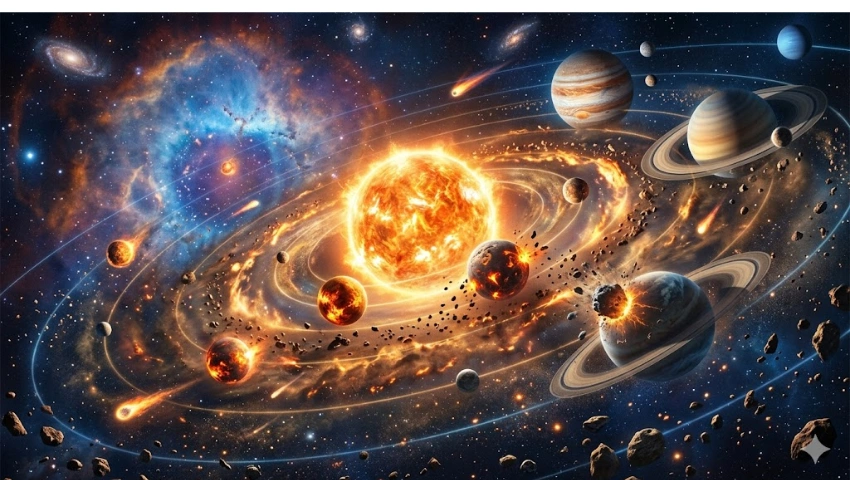
The Formation and Evolution of the Solar System is one of the most important chapters in understanding our cosmic origins. It tells the story of how the Sun, planets, moons, asteroids, and other celestial bodies were formed from a single cloud of gas and dust approximately 4.6 billion years ago. The process involves stages of collapse, accretion, and differentiation, leading to the structured system we see today.
The Solar System formed from a giant molecular cloud, which collapsed under gravity to create a rotating solar nebula. The Sun formed at the center, while planets and other bodies formed from the leftover dust and gas. This process involved various physical forces such as gravity, angular momentum, nuclear fusion, and chemical differentiation.
Formation and Evolution of the Solar System Overview
The formation of the Solar System was not a random event, but a complex process governed by physical laws and cosmic dynamics. From the collapse of a nebula to the formation of protoplanets, this process took millions of years and resulted in a diverse planetary system.
Formation and Evolution of the Solar System overview | ||
Stage | Timeframe (~years ago) | Description |
Solar Nebula Formation | ~4.6 billion | Collapse of molecular cloud |
| Protostar and Protoplanet | 4.6 – 4.5 billion | Sun and protoplanets begin forming |
Planetary Accretion | 4.5 – 4.4 billion | Dust and gas form planetesimals |
| Differentiation & Bombardment | 4.4 – 3.8 billion | Core-mantle formation; asteroid/comet impacts |
Stabilization & Evolution | 3.8 billion – Present | Orbital stability, moons, atmosphere development |
Solar Nebular Hypothesis – The Most Accepted Theory
The most widely accepted explanation for the formation of the Solar System is the Solar Nebular Hypothesis. According to this theory, the Solar System originated from a rotating cloud of gas and dust, known as the solar nebula. Gravity caused the nebula to collapse, and as it shrank, it spun faster and flattened into a disk.
Solar Nebular Hypothesis – The Most Accepted Theory | |
Feature | Description |
Initial Structure | Rotating cloud of hydrogen, helium, dust |
| Central Formation | Sun formed through fusion at center of disk |
Planet Formation | Planetesimals merged to form rocky & gas planets |
| Disk Shape | Due to conservation of angular momentum |
Key Support | Matches observed exoplanetary systems |
Formation of the Sun – Birth of a Star
The Sun formed first from the densest part of the solar nebula. As gravity pulled gas inward, the core’s temperature rose above 10 million Kelvin, triggering nuclear fusion. This reaction converted hydrogen into helium and released immense energy giving birth to our main-sequence star: the Sun.
Formation of the Sun – Birth of a Star | |
Stage | Key Characteristics |
Protostar Phase | Collapsing mass emits heat, no fusion yet |
Fusion Ignition | Hydrogen fuses into helium at 10 million K |
| Main Sequence Star | Balance between fusion pressure & gravity |
Solar Wind Impact | Sweeps away light gases from inner Solar System |
Formation of Planets – Accretion and Differentiation
Planets formed from small particles sticking together to create planetesimals, which further merged into protoplanets. The inner Solar System, being hotter, formed rocky planets (Mercury to Mars), while the outer, colder region allowed gas giants like Jupiter and Saturn to form.
Formation of Planets – Accretion and Differentiation | ||
Type | Examples | Key Features |
Terrestrial | Mercury, Venus, Earth, Mars | Rocky surface, thin/no atmosphere |
Jovian (Gas) | Jupiter, Saturn | Massive, hydrogen-helium composition |
| Ice Giants | Uranus, Neptune | Ice, water, methane, ammonia components |
Formation of Moons, Asteroids & Other Bodies
Moons formed in various ways some by accretion, others by capture, and some due to giant impacts (e.g., Earth’s Moon). Asteroids are rocky remnants of planet formation, mostly found in the asteroid belt between Mars and Jupiter. Comets, mostly icy, originate from the Kuiper Belt and Oort Cloud, and represent the outermost parts of our Solar System.
Formation of Moons, Asteroids & Other Bodies | ||
Body Type | Origin Location | Composition |
Moons | Planetary systems | Rock, ice, metal |
| Asteroids | Asteroid Belt | Rocky fragments |
Comets | Kuiper Belt, Oort Cloud | Ice, dust, rock |
Dwarf Planets | Pluto, Eris, Ceres | Mix of rock and ice |
Evolution of Solar System – From Chaos to Stability
After the major formation events, the Solar System went through a heavy bombardment period, where asteroids and comets crashed into planets. This likely delivered water and organic material to Earth. Over time, orbits stabilized, atmospheres evolved, and geological processes shape planetary surfaces.
Evolution of Solar System – From Chaos to Stability | |
Evolutionary Feature | Description |
Late Heavy Bombardment | Asteroid impacts 4.1–3.8 billion years ago |
Atmosphere Formation | Via volcanic outgassing, comet impacts |
| Plate Tectonics on Earth | Shaped continents, oceans, climate |
| Magnetic Fields | Protect planetary atmospheres |
Frequently Asked Questions (FAQs)
What is the most accepted theory of solar system formation?
The Solar Nebular Hypothesis is the most accepted model explaining the origin of the Solar System.
When did the Solar System form?
The Solar System formed around 4.6 billion years ago from a molecular cloud.
Why are terrestrial and gas planets different?
Due to temperature differences during formation inner regions formed rocky planets, while outer regions allowed gas accumulation.
What is a planetesimal?
A small body formed from dust particles that later merged to create protoplanets.
What caused Earth’s Moon to form?
A giant impact with a Mars-sized object likely led to the formation of the Moon.
Where are most asteroids found?
In the asteroid belt between Mars and Jupiter.
What is the Oort Cloud?
A distant spherical shell of icy bodies surrounding the Solar System, believed to be the source of long-period comets.
Check Out Related Articles | |
|---|---|
Star Formation: Stages in Nebulae and Stellar Life Explained | |
Indian River Systems, Classification, Tributaries, Maps, UPSC Geography Notes | |