
 by
by 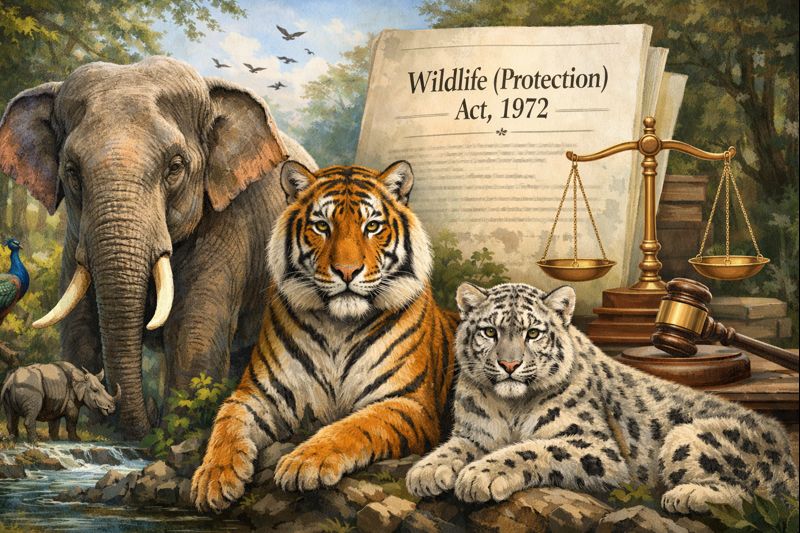
The Wildlife (Protection) Act, 1972 is India’s principal legislation for the protection, conservation, and management of wildlife and their habitats. Enacted at a time when India was witnessing a rapid decline in wildlife population due to hunting, deforestation, and illegal trade, the Act provides a strong legal framework to safeguard the country’s rich biological diversity.
Wildlife (Protection) Act, 1972
India is one of the world’s megadiverse countries, home to nearly 8% of global biodiversity. However, unchecked hunting, habitat loss, and commercial exploitation of wildlife during the colonial and post-independence period severely threatened many species. To address these concerns, the Parliament enacted the Wildlife (Protection) Act, 1972, with the following broad objectives:
- Protection of wild animals, birds, and plants
- Regulation of hunting and wildlife trade
- Conservation and management of wildlife habitats
- Prevention of extinction of endangered species
- Fulfilment of India’s international wildlife conservation obligations
The Act applies to the entire territory of India. Earlier, it did not extend to Jammu and Kashmir, but following the Jammu and Kashmir Reorganisation Act, 2019, the Wildlife Protection Act now applies uniformly across the country.
Constitutional Basis of Wildlife Protection in India
The protection of wildlife in India is firmly rooted in the Constitution, which places responsibility on both the State and citizens to conserve the natural environment. Through constitutional amendments and directive principles, wildlife conservation has been recognized as essential for ecological balance and sustainable development.
1. Article 48A – Directive Principles of State Policy
- Directive Principles of State Policy direct the State to protect and improve the environment.
- Mandates the safeguarding of forests and wildlife.
- Guides the government in framing environmental and wildlife-related laws.
2. Article 51A(g) – Fundamental Duty of Citizens
- Makes it a duty of every citizen to protect the natural environment.
- Encourages compassion for living creatures.
- Promotes public participation in wildlife conservation.
3. 42nd Constitutional Amendment Act, 1976
- Transferred Forests and Wildlife from the State List to the Concurrent List.
- Enabled both the Central and State Governments to legislate on wildlife protection.
- Strengthened uniform implementation of conservation laws across India.
4. Judicial Interpretation and Environmental Jurisprudence
- The Supreme Court has expanded the scope of Article 21 (Right to Life) to include the right to a healthy environment.
- Wildlife protection is treated as an essential part of environmental justice and sustainable development.
Objectives of the Wildlife (Protection) Act, 1972
The Wildlife (Protection) Act, 1972 was enacted to provide a comprehensive legal framework for the protection and conservation of wild animals, plants, and their habitats. It aims to prevent the decline of wildlife populations and ensure ecological balance through regulation, protection, and sustainable management.
1. Conservation of Wildlife
- To protect wild animals, birds, and plant species from extinction.
- To maintain ecological balance and biodiversity across ecosystems.
2. Prevention of Hunting and Poaching
- To prohibit hunting of endangered and protected species.
- To curb illegal killing, capturing, and trapping of wildlife.
3. Regulation of Wildlife Trade
- To control and monitor trade in wildlife and wildlife products.
- To prevent illegal domestic and international trafficking.
4. Protection of Endangered Species
- To provide the highest level of protection to threatened species.
- To ensure survival and recovery of critically endangered animals.
5. Establishment of Protected Areas
- To create National Parks, Wildlife Sanctuaries, Conservation Reserves, and Community Reserves.
- To ensure long-term habitat protection and species conservation.
6. Compliance with International Conventions
- To fulfill India’s obligations under international agreements such as CITES.
- To regulate international trade in endangered species.
7. Promotion of Scientific Management
- To encourage scientific research and monitoring of wildlife populations.
- To support evidence-based conservation policies.
8. Prevention of Habitat Destruction
- To regulate activities that degrade forests and wildlife habitats.
- To promote sustainable use of natural resources.
9. Strengthening Law Enforcement
- To provide legal authority to forest and wildlife officials.
- To impose penalties and punishment for wildlife crimes.
10. Public Awareness and Participation
- To encourage community involvement in conservation efforts.
- To promote awareness about wildlife protection and environmental responsibility.
Schedules Under the Wildlife (Protection) Act, 1972
The Wildlife (Protection) Act, 1972 classifies wild animals and plants into different Schedules to provide varying degrees of protection based on their conservation status. These schedules determine the level of legal protection, penalties, and restrictions on hunting, trade, and possession.
Schedule I:
- Includes rare, endangered, and critically endangered species.
- Hunting, capturing, or trade is strictly prohibited.
- Violations attract the highest penalties, including imprisonment and fines.
- Species are prioritized in conservation programs.
- Examples: Tiger, Asiatic Lion, Snow Leopard, Black Buck, Himalayan Brown Bear, Asiatic Cheetah
Schedule II:
- Covers vulnerable or threatened species not critically endangered.
- Hunting and trade are prohibited; penalties are slightly lower than Schedule I.
- Species are monitored for conservation and may be included in breeding programs.
- Examples: Indian Cobra, Himalayan Black Bear, Assamese Macaque, Indian Pangolin.
Schedule III:
- Includes species not endangered but requiring legal protection to prevent decline.
- Hunting is prohibited; penalties are lower than Schedules I and II.
- Maintains ecological balance and prevents species from becoming threatened.
- Examples: Chital (Spotted Deer), Bharal (Blue Sheep), Hyena, Sambhar Deer.
Schedule IV:
- Protects species that are common or less endangered.
- Hunting is restricted; penalties are lower than Schedules I–III.
- Ensures populations remain stable and contributes to biodiversity.
- Examples: Flamingo, Kingfisher, Falcon, Hare, Horseshoe Crab.
Schedule V:
- Lists vermin species considered harmful to crops, livestock, or humans.
- Hunting is legally permitted to control population.
- Helps protect agriculture and prevent disease spread.
- Examples: Common Crow, Fruit Bat, Rat, Mouse.
Schedule VI:
- Includes rare and endangered plant species.
- Cultivation, possession, and trade are regulated; prior permission required.
- Prevents over-exploitation and ensures sustainable use of plants.
- Examples: Beddomes’ Cycad, Blue Vanda, Red Vanda, Kuth (Saussurea lappa), Slipper Orchids, Pitcher Plant (Nepenthes khasiana).
| Schedule | Protection Level | Hunting | Trade | Examples |
|---|---|---|---|---|
| I | Highest | Prohibited | Prohibited | Tiger, Asiatic Lion, Snow Leopard |
| II | High | Prohibited | Prohibited | Indian Cobra, Assamese Macaque |
| III | Moderate | Prohibited | Restricted | Chital, Bharal, Hyena |
| IV | Lower | Restricted | Restricted | Flamingo, Kingfisher, Hare |
| V | Vermin | Permitted | N/A | Crow, Rat, Fruit Bat |
| VI | Protected Plants | Restricted | Restricted (Permission required) | Blue Vanda, Kuth, Pitcher Plant |
Authorities and Bodies Established Under the Act
The Wildlife (Protection) Act, 1972 established several key authorities to ensure wildlife conservation, enforce laws, and manage protected areas:
National Board for Wildlife (NBWL):
- Apex advisory body chaired by the Prime Minister.
- Reviews projects and developmental activities near protected areas.
- Provides recommendations for conservation policies, protection of endangered species, and establishment of new protected areas.
State Board for Wildlife (SBWL):
- Chaired by the Chief Minister of the respective state/UT.
- Advises state governments on matters related to wildlife conservation, habitat management, and enforcement of the WPA.
- Ensures coordination with forest and wildlife departments at the state level.
Central Zoo Authority (CZA):
- Regulates recognition and functioning of zoos across India.
- Lays down guidelines for the welfare, transfer, and exchange of animals.
- Ensures adherence to standards for animal care, health, and breeding programs.
National Tiger Conservation Authority (NTCA):
- Constituted in 2005 following the recommendations of the Tiger Task Force.
- Oversees Project Tiger and manages tiger reserves.
- Advises on tiger conservation, declares tiger reserves, and monitors anti-poaching measures.
Wildlife Crime Control Bureau (WCCB):
- Handles organized wildlife crime and illegal trade in animals, plants, and their products.
- Coordinates with enforcement agencies at state, national, and international levels.
- Maintains a database of wildlife crimes and prosecutions to improve law enforcement.
Protected Areas Under the Wildlife Protection Act, 1972
The Act provides for the creation and management of five types of protected areas to conserve biodiversity and habitats:
National Parks:
- Areas of ecological, faunal, floral, or landscape significance.
- Hunting and human activities are strictly prohibited.
- Boundaries cannot be altered without the approval of the State Legislature.
Also Read: National Parks in India
Wildlife Sanctuaries:
- Focused on protection of particular species and their habitat.
- Some regulated human activity may be permitted.
- Declared by the State Government.
Conservation Reserves:
- Serve as buffer zones between protected areas and human settlements.
- Encourage conservation with limited human interference.
- Often created on government-owned land.
Community Reserves:
- Created on private or community land with active local participation.
- Encourage community involvement in conservation and sustainable use of resources.
Tiger Reserves:
- Established to protect tiger habitats under Project Tiger.
- Managed under the NTCA with strict protection and monitoring measures.
Major Amendments to the Wildlife (Protection) Act
Several amendments have strengthened the Act and aligned it with emerging conservation needs:
Wildlife (Protection) Amendment Act, 1991:
- Strengthened penalties for hunting and wildlife crimes.
- Enhanced protection for endangered species.
Wildlife (Protection) Amendment Act, 2002:
- Introduced Conservation Reserves and Community Reserves.
- Encouraged participatory conservation involving local communities.
Wildlife (Protection) Amendment Act, 2006:
- Created NTCA and WCCB.
- Addressed human-wildlife conflict and strengthened tiger conservation.
- Enhanced provisions for dealing with wildlife-related crimes.
Wildlife (Protection) Amendment Act, 2022:
- Reduced the number of schedules from six to four for easier management.
- Aligned with CITES for international wildlife trade regulation.
- Increased penalties for wildlife crimes.
- Allowed regulated use of elephants for religious and cultural purposes.
Wildlife Conservation Initiatives Under the Act
India has implemented several programs and initiatives under the Act to ensure effective wildlife conservation:
Project Tiger (1973):
- Focused on tiger population recovery and habitat protection.
- India has the largest tiger population in the world.
- Involves monitoring, anti-poaching measures, and ecological restoration.
Project Elephant (1992):
- Protects elephant populations and their corridors.
- Identified 88 elephant corridors to facilitate safe movement.
- Addresses human-elephant conflict and ensures long-term survival.
Wildlife Corridors:
- Connect protected areas to allow free movement of animals.
- Reduce habitat fragmentation and human-animal conflict.
- Example: India’s first urban wildlife corridor planned between Delhi and Haryana near the Asola-Bhatti Wildlife Sanctuary.
Community Participation Programs:
- Local communities are involved in habitat protection, anti-poaching, and awareness programs.
- Encourages sustainable coexistence of humans and wildlife.
Challenges in Implementation of the Act
The Wildlife (Protection) Act, 1972 faces several significant challenges in implementation that hinder its effectiveness in conserving wildlife and preventing biodiversity loss across India. Despite being a strong legal framework, gaps in enforcement, social pressures, and emerging threats have limited its real‑world impact.
- Wildlife crime remains widespread even with legal safeguards; from 2020 to 2024 India recorded over 2,700 wildlife crime cases under the Act, although reported cases declined year‑by‑year, indicating persistent illegal hunting, trade, and trafficking issues.
- Conviction rates for wildlife offences are alarmingly low (historically around 2‑3%), underscoring weak prosecution and limited deterrence against organised poaching and trafficking.
- Enforcement agencies often suffer from inadequate training, manpower, and resources, limiting their ability to patrol large habitats or investigate complex crime networks.
- Poor inter‑agency coordination among forest departments, police, customs, and judiciary leads to delayed or ineffective action against offenders.
- Human‑wildlife conflict has escalated due to habitat fragmentation and expanding human settlements, resulting in crop loss, livestock predation, and human casualties that fuel retaliatory killings of wildlife.
- Habitat degradation from infrastructure projects and land diversion continues, complicating conservation goals and pushing animals into human‑dominated landscapes.
- Under‑reporting of crimes is a significant issue; enforcement bodies estimate that 30–40% of wildlife crime incidents remain unreported, as rural communities fear retaliation or lack awareness of legal protections.
Way Forward
- Strengthen enforcement: Over 2,700 wildlife crime cases (2020–2024) reported, but conviction rates remain 2–3%; improve prosecution and deterrence.
- Increase trained personnel and resources for forest departments and enforcement agencies.
- Deploy technology: Use drones, AI cameras, and sensor networks for real-time monitoring and anti-poaching.
- Improve inter-agency coordination between forest departments, police, customs, and judiciary.
- Expand and restore habitats: Create and maintain wildlife corridors to reduce fragmentation and human–wildlife conflict.
- Promote community participation through education, awareness campaigns, incentives, and ecotourism initiatives.
- Incorporate climate-resilient conservation strategies to protect ecosystems from changing environmental conditions.
- Update schedules periodically and increase penalties to strengthen legal protection.
- Align domestic laws with CITES to curb illegal international wildlife trade.
- Encourage scientific research and data-driven policies for habitat management, species recovery, and monitoring.
Wildlife (Protection) Act, 1972 FAQs
What is the Wildlife (Protection) Act, 1972?
The Wildlife (Protection) Act, 1972 is India’s primary law for the protection, conservation, and management of wild animals, birds, plants, and their habitats.What are the main objectives of the Wildlife (Protection) Act, 1972?
Its main objectives are to conserve wildlife, prevent hunting and illegal trade, establish protected areas, and promote scientific management and community participation.What are the schedules under the Wildlife (Protection) Act, 1972?
The Act classifies species into schedules to provide varying levels of protection, including Schedule I for critically endangered species and Schedule VI for protected plants.Which authorities are constituted under the Act?
Authorities under the Act include the National Board for Wildlife, State Boards for Wildlife, Central Zoo Authority, National Tiger Conservation Authority, and Wildlife Crime Control Bureau.What types of protected areas are recognized under the Act?
Protected areas recognized under the Act are National Parks, Wildlife Sanctuaries, Conservation Reserves, Community Reserves, and Tiger Reserves.What are the major amendments to the Wildlife (Protection) Act?
Major amendments include the 1991 Act strengthening penalties, the 2002 Act introducing reserves, the 2006 Act creating NTCA and WCCB, and the 2022 Act aligning with CITES and increasing penalties.What are the major wildlife conservation initiatives under the Act?
Conservation initiatives under the Act include Project Tiger, Project Elephant, development of wildlife corridors, and community-based conservation programs.What are the main challenges in implementing the Act?
Challenges in implementing the Act include low public awareness, human-wildlife conflict, poaching, illegal trade, inadequate resources, low conviction rates, and climate change impacts.What measures are suggested for the way forward?
The way forward involves strengthening enforcement, using technology, restoring habitats, engaging communities, updating schedules, aligning with CITES, and adopting climate-resilient conservation strategies.How does the Act align with international conventions?
The Act aligns with international conventions like CITES by regulating trade in endangered species and ensuring India’s compliance with global wildlife protection standards.