 by
by 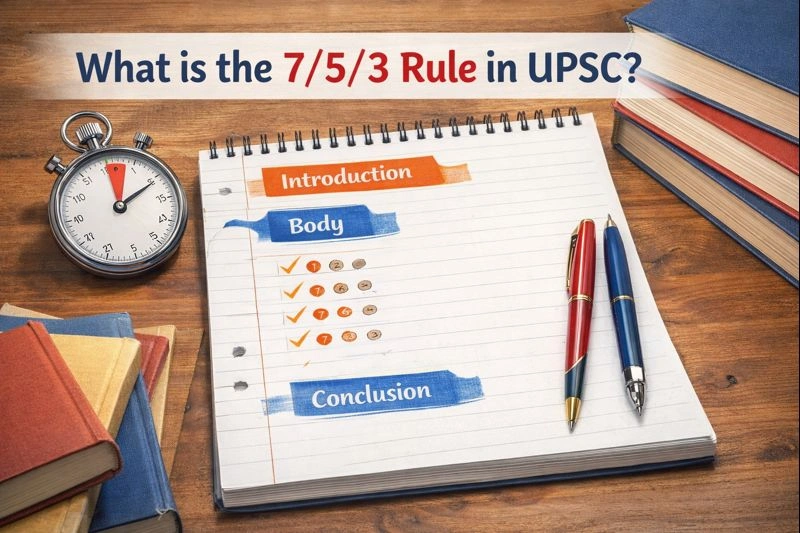
The 7/5/3 Rule is a strategic, non‑official framework widely used by UPSC aspirants to write effective and high‑scoring answers in the Mains examination. It helps in managing time, ensuring structured content, and maintaining clarity and relevance in descriptive answers.
This technique is especially useful for General Studies and Essay papers, where candidates must balance depth of knowledge with crisp presentation under strict time limits.
Core Components of the 7/5/3 Rule
7 Minutes per Answer (Time Management)
- Candidates should aim to complete one question within 7–8 minutes.
- Ensures all questions are attempted within the 3-hour exam limit.
- Promotes speed and focus, preventing over-analysis of any single question.
- Encourages a balanced approach between quality and quantity.
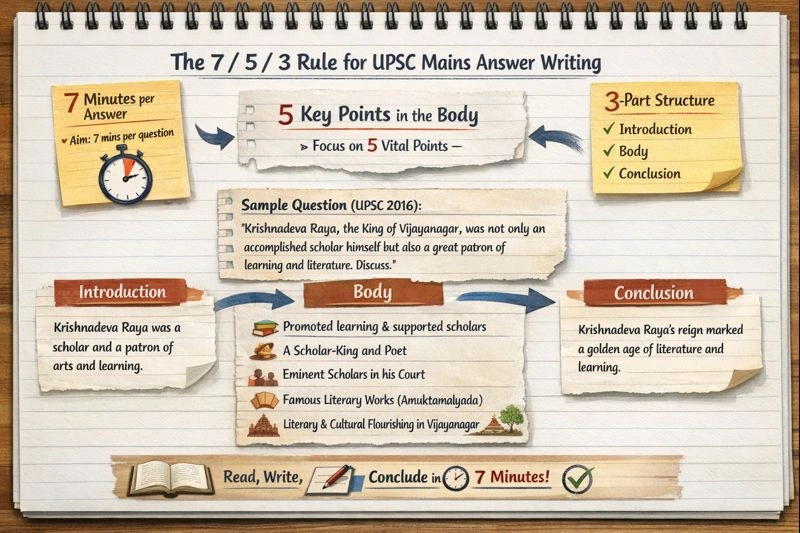
5 Key Points in the Body (Content Structure)
- Each answer should contain around five relevant and distinct points.
- Points can include definitions, facts, analysis, examples, or solutions.
- Using subheadings or bullet points improves readability and presentation.
- Helps maintain conciseness while covering all essential aspects of the question.
3-Part Structure: Introduction, Body, Conclusion (Answer Organization)
- Introduction: Brief definition, background, or context (1–2 lines).
- Body: Main content with five key points presented logically.
- Conclusion: Summary, evaluation, or way forward (1–2 lines).
- Provides a cohesive flow and leaves a strong impression on the examiner.
Additional Advantages
- Avoids irrelevant long paragraphs that reduce marks.
- Ensures answers are analytical, structured, and concise.
- Improves time discipline, helping aspirants manage the full paper effectively.
Examples of Applying the 7/5/3 Rule in UPSC Mains Answer Writing
To effectively use the 7/5/3 Rule, aspirants must first read the question carefully at least twice, identify the type of question, and highlight the keywords. This step ensures that the answer stays focused, relevant, and analytical.
Step-by-Step Application Example
Sample Question (UPSC 2016 Civil Services Mains):
“Krishnadeva Raya, the King of Vijayanagar, was not only an accomplished scholar himself but also a great patron of learning and literature. Discuss.”
Step 1: Identify Keywords
The primary keyword is Krishnadeva Raya as a scholar and patron of learning.
Step 2: Introduction
Write a brief introduction giving context about Krishnadeva Raya and his significance in the Vijayanagar Empire.
Step 3: Five Key Points in the Body
Using the 5-point body structure:
- Patronage of Learning and Literature: How Krishnadeva Raya encouraged scholars and writers.
- Personal Contribution: His own achievements as a scholar and intellectual.
- Court Scholars: Important scholars in his court and their works.
- Famous Literary Works: Notable books and literature produced during his reign.
- Cultural Flourishing: How literature and learning flourished during the Vijayanagar period.
Step 4: Detailed Discussion
- Expand each of the five points with concise explanations, examples, or relevant facts.
- Use bullet points or subheadings for clarity and easy readability.
Step 5: Conclusion
- End with a summary or way forward, highlighting the overall impact of Krishnadeva Raya on literature and learning.
- Ensure the entire answer is completed in approximately 7 minutes, following the 7/5/3 framework.
Tips for Applying the Rule in Different Question Types
- Bullet or Point-Based Questions: Use the 5-point body structure to cover all aspects clearly.
- Essay-Type Questions: Integrate supporting facts, charts, diagrams, or flowcharts as required.
- Revision Practice: Go through sample UPSC answers to understand high-scoring templates. Compare them with your practice answers to identify improvement areas.
Benefits of Using the 7/5/3 Rule in UPSC Mains
The 7/5/3 Rule helps UPSC aspirants write structured, concise, and analytical answers while managing time effectively. By following this framework, candidates can enhance clarity, focus, and exam performance.
- Ensures answers are well-structured, following a clear Introduction → Body → Conclusion format that is easier for examiners to read and evaluate.
- Helps aspirants manage time efficiently, allowing them to complete all questions within the 3-hour exam duration.
- Focuses on keywords and relevant points, keeping answers concise and preventing inclusion of irrelevant content.
- Encourages concise presentation through bullets or numbered points while maintaining analytical depth.
- Improves accuracy by systematically covering all important aspects of a question, reducing chances of omitting key points.
- Builds speed and confidence through regular timed practice, making candidates comfortable in time-bound exam conditions.
- Produces examiner-friendly answers that are clear, structured, and more likely to score higher marks.
- Facilitates revision and practice, as the 5-point structure makes it easy to identify strengths and weaknesses for improvement.