 by
by 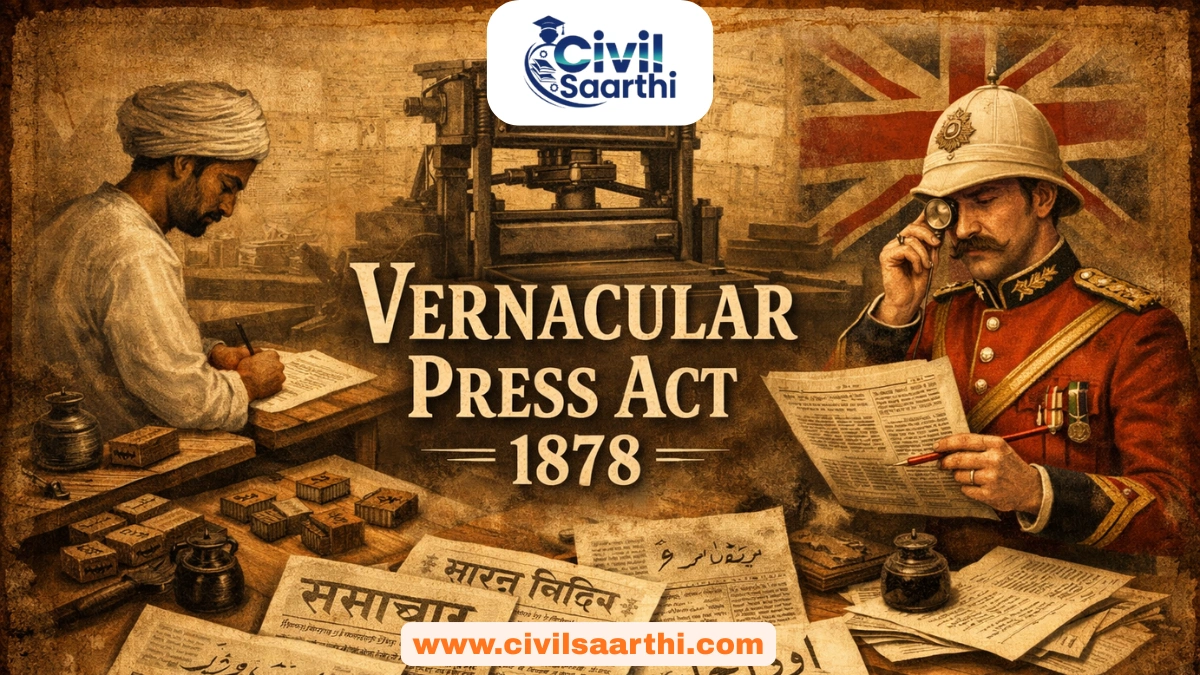
The Vernacular Press Act of 1878 was a law passed by the British government in India to control Indian newspapers and reduce their freedom. The main aim of this Act was to stop newspapers from criticizing British policies, especially during the time of the Second Anglo-Afghan War (1878–80) when opposition against British rule was increasing. The Act was introduced by Lord Lytton, who was the Viceroy of India, and it was approved by the Viceroy’s Council on 14 March 1878.
The British government passed this law to keep strict control over newspapers published in Indian languages. They wanted to punish newspapers that published content against British rule or encouraged public dissatisfaction. Because of this Act, newspapers written in regional languages were treated very harshly compared to English newspapers.
Vernacular Press Act 1878 Background
- After the Revolt of 1857, relations between the British rulers and Indians became very bitter. The British started distrusting Indians and treated them with racial superiority.
- After 1858, European (English) newspapers mostly supported the British government during political issues. On the other hand, Indian language newspapers openly criticized British policies and highlighted public problems.
- Lord Lytton followed several imperialist and unpopular policies, which created anger among Indians. This anger increased further because of the severe famine of 1876–77, which caused heavy suffering, while the British spent huge money on the grand Delhi Durbar celebration.
- In the second half of the 19th century, the number of newspapers published in Indian languages increased rapidly. These newspapers helped in spreading social and political awareness among Indians.
- Earlier, newspapers were mainly published in big cities like Calcutta, Madras, Bombay, and Allahabad.
- Later, newspapers started being published in smaller towns and rural areas.
- Since most of these newspapers were published in small towns, they were written mainly in regional or vernacular languages.
- By the time the Vernacular Press Act was passed in 1878, there were about 20 English newspapers and nearly 200 newspapers in Indian languages.
- These vernacular newspapers helped people understand political issues and encouraged them to question British rule and demand their rights.
- Due to the growing influence of these newspapers, Lord Lytton introduced the Vernacular Press Act in 1878 to control them and protect British government interests.
Vernacular Press Act 1878 Provisions
- The Act gave district magistrates the power to force printers and publishers to sign a legal agreement (bond).
- In this bond, publishers had to promise that they would not publish any content that created anger or dissatisfaction against the British government without taking prior permission.
- Magistrates could also ask newspapers to deposit security money.
- If a newspaper published anything against the government, this money could be confiscated.
- If the newspaper repeated the same mistake, the government had the power to seize or close the printing press.
- The decision taken by the magistrate was considered final.
- Newspapers and publishers were not allowed to challenge the decision in court.
- A newspaper published in an Indian language could avoid punishment if it agreed to allow government officials to check its content before publication.
Vernacular Press Act 1878 Impact
- The Vernacular Press Act became popularly known as the “Gagging Act” because it tried to silence Indian newspapers.
- The Act was highly unfair because it treated English newspapers and Indian language newspapers differently.
- Another major problem was that newspapers had no right to appeal against government decisions.
- Several newspapers such as Som Prakash, Bharat Mihir, Dacca Prakash, and Samachar were punished under this law.
- A famous newspaper called Amrita Bazar Patrika escaped punishment by quickly changing from a regional language newspaper to an English newspaper.
- Later, the British government removed the rule of checking newspapers before publication.
- A Press Commissioner was appointed to provide official and correct news to newspapers.
- The Act faced strong criticism and opposition from Indian leaders and journalists.
- Finally, Lord Ripon repealed the Vernacular Press Act in 1882.
Also Read: Advent of Europeans in India
Acts Targeting Freedom of the Press
During the Swadeshi and Boycott Movement, nationalist feelings among Indians became stronger. Many newspapers started supporting freedom and criticizing British rule. To stop this, the British government introduced several strict laws to control the press and suppress nationalist ideas. Apart from the Vernacular Press Act, other important laws were also passed.
Press Act of 1835
- This Act placed restrictions on newspapers in India.
- It allowed the British government to control what newspapers could publish.
- The government could censor articles and stop newspapers that it believed were spreading anti-government ideas.
- This limited freedom of speech during a time when printing and newspapers were expanding.
Press Act of 1857 (Gagging Act)
- This Act was introduced after the Revolt of 1857.
- It allowed the British government to stop newspapers from publishing content against British rule.
- The government could impose heavy fines on newspapers.
- Editors and publishers could also be arrested and jailed.
- The main aim was to control nationalist ideas and prevent future revolts.
Sedition Act of 1870
- This law made sedition (encouraging rebellion against the government) a criminal offence.
- Any speech, writing, or activity that created hatred or rebellion against the British government was punishable.
- The British used this law mainly to silence nationalist leaders, activists, and newspapers.
- Many freedom fighters were later charged under this law.
Indian Press Act of 1910
- This Act gave the British government greater control over newspapers.
- Newspaper publishers were required to deposit security money with the government.
- If a newspaper published anti-government content, the money could be confiscated.
- The government could also ban newspapers or seize printing presses.
- This law was mainly used to stop newspapers that supported the freedom movement.
Official Secrets Act of 1923
- This law restricted the sharing of government and confidential information.
- Journalists and citizens could be punished for publishing or sharing sensitive government data.
- It limited investigative journalism and reduced transparency in government matters.
- The Act aimed to protect British government secrets and prevent information from reaching the public.
Also Read: Decline of Mughal Empire in India