 by
by 
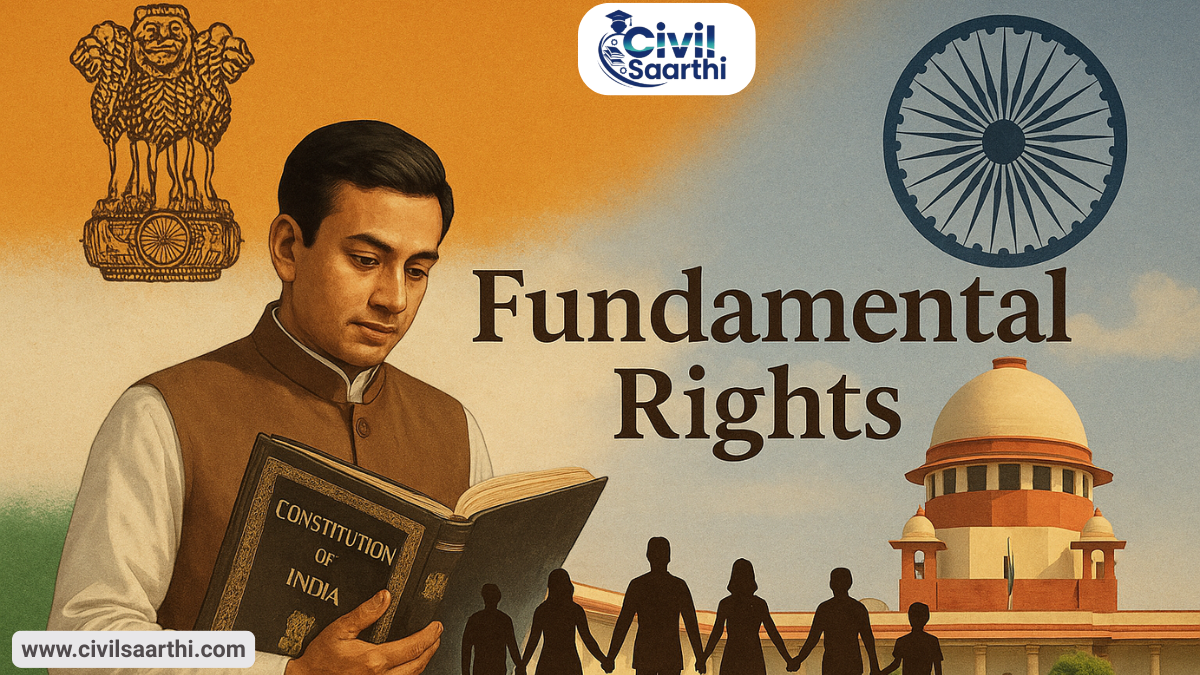
Fundamental Rights (Part III) remain one of the most consistently asked areas in UPSC Prelims. Questions are highly conceptual, statement-based, and judgment-oriented, often linking Articles with amendments and landmark Supreme Court cases. The trend shows increasing focus on judicial interpretation, constitutional doctrines, and amendment impact, rather than direct factual recall.
Trend Analysis of UPSC Prelims PYQs on Fundamental Rights (1995–2025)
Based on the PYQs provided above, here is the structured analysis:
Read more: Fundamental Rights
| Year | Core Theme Asked | Nature of Question | Difficulty Level | Concept Type |
|---|---|---|---|---|
| 2024 | Right to Privacy (Art 21) | Direct Article-based | Moderate | Judicial expansion |
| 2023 | Reservation & Article 335 | Statement-based | Difficult | FR + Administrative efficiency |
| 2022 | Writs (Mandamus, Quo Warranto) | Multi-statement | Difficult | Judicial remedies |
| 2021 | Article 14, Judicial custody, Parole, Right to Property | Mixed | Moderate–Difficult | Procedural rights |
| 2020 | UDHR, Untouchability | Conceptual linkage | Moderate | FR + International law |
| 2019 | Right to marry (Art 21) | Applied conceptual | Moderate | Personal liberty |
| 2018 | Ninth Schedule, Rule of Law, Privacy | Analytical | Difficult | Basic Structure |
| 2017 | Rights vs Duties, Exploitation | Philosophical + Article | Moderate | Constitutional theory |
| 2011 | Minority rights, Human rights | Applied | Moderate | FR + Policy |
| 2005 | Right to Property | Amendment-based | Easy–Moderate | 44th Amendment |
| 2004 | Article matching | Static + conceptual | Moderate | Equality code |
| 2002 | Heart & Soul (Art 32), Equality | Direct | Easy–Moderate | Core FR |
| 1999 | Rights of foreigners | Conceptual | Moderate | Citizens vs Non-citizens |
| 1996 | National Anthem & FR | Applied rights | Difficult | Freedom of expression |
High Focus Areas (Frequently Repeated)
| Topic | Frequency | Nature |
|---|---|---|
| Article 21 & Privacy | Very High | Judicial expansion |
| Reservation (Art 16, 335) | High | Statement-based |
| Writs (Art 32 & 226) | High | Conceptual traps |
| Right to Property | Moderate | Amendment history |
| Minority Rights (Art 29–30) | Moderate | Application-based |
| Untouchability (Art 17) | Repeated | Direct conceptual |
UPSC Prelims Practice Questions on Fundamental Rights
Q1. Consider the following statements regarding Article 13:
- It declares that laws inconsistent with Fundamental Rights are void.
- It includes Constitutional Amendments within the definition of “law”.
- It applies to both pre-constitutional and post-constitutional laws.
Which of the statements are correct?
(a) 1 and 3 only
(b) 1 only
(c) 1, 2 and 3
(d) 2 and 3 only
Answer: (a)
Explanation:
- Statement 1 ✔ Correct – Article 13(2) voids inconsistent laws.
- Statement 2 ❌ Incorrect – In Shankari Prasad v. Union of India and later in Kesavananda Bharati v. State of Kerala, Constitutional Amendments were held not to be “law” under Article 13 (though subject to Basic Structure).
- Statement 3 ✔ Correct – Article 13(1) deals with pre-constitutional laws; 13(2) with post-constitutional laws.
- Concept: Doctrine of Eclipse (pre-constitutional laws) flows from Article 13.
Q2. With reference to the Basic Structure Doctrine:
- It restricts Parliament’s amending power under Article 368.
- It was first propounded in Golaknath v. State of Punjab.
- Judicial Review forms part of the Basic Structure.
(a) 1 and 3 only
(b) 1 only
(c) 2 and 3 only
(d) 1, 2 and 3
Answer: (a)
Explanation:
- Statement 1 ✔ – Parliament cannot alter basic structure.
- Statement 2 ❌ – Doctrine was propounded in Kesavananda Bharati v. State of Kerala.
- Statement 3 ✔ – Judicial Review is part of Basic Structure (affirmed in Minerva Mills v. Union of India).
Q3. Consider the following regarding Article 19:
- It is available only to citizens.
- Corporations can claim Article 19 rights.
- “Security of State” is a ground of restriction.
(a) 1 and 3 only
(b) 1 only
(c) 1, 2 and 3
(d) 3 only
Answer: (a)
Explanation:
- Article 19 applies only to citizens ✔
- Corporations ❌ cannot directly claim it (though shareholders may indirectly).
- Security of State ✔ is a restriction ground under Article 19(2).
Q4. The Right to Privacy was declared a Fundamental Right in:
(a) ADM Jabalpur v. Shivkant Shukla
(b) Justice K.S. Puttaswamy v. Union of India
(c) Maneka Gandhi v. Union of India
(d) Indra Sawhney v. Union of India
Answer: (b)
Explanation: In 2017 (9-judge bench), Supreme Court unanimously held privacy as intrinsic to Article 21 and part of dignity and liberty.
Q5. Consider the following:
- Article 20 protects against ex post facto criminal laws.
- Article 20 protects against civil retrospective laws.
- Double jeopardy is prohibited under Article 20.
(a) 1 and 3 only
(b) 1 only
(c) 2 and 3 only
(d) 1, 2 and 3
Answer: (a)
Explanation:
- Article 20 applies only to criminal laws ✔
- Civil retrospective laws ❌ allowed.
- Double jeopardy protected under Article 20(2).
Q6. Which rights cannot be suspended even during National Emergency?
- Article 19
- Article 20
- Article 21
(a) 2 and 3 only
(b) 1 and 2 only
(c) 3 only
(d) 1, 2 and 3
Answer: (a)
Explanation: After 44th Amendment:
- Articles 20 & 21 cannot be suspended ✔
- Article 19 can be suspended during war/external aggression.
Q7. The Ninth Schedule was inserted by:
(a) 42nd Amendment
(b) 1st Amendment
(c) 24th Amendment
(d) 44th Amendment
Answer: (b)
Explanation: Inserted in 1951 to protect land reform laws. But in I.R. Coelho v. State of Tamil Nadu, SC held laws inserted after 24 April 1973 are subject to Basic Structure review.
Q8. Reservation for Economically Weaker Sections was upheld in:
(a) Indra Sawhney v. Union of India
(b) Janhit Abhiyan v. Union of India
(c) Minerva Mills v. Union of India
(d) M. Nagaraj v. Union of India
Answer: (b)
Explanation: 103rd Amendment providing 10% EWS quota upheld in 2022.
Q9. Article 21A was inserted by:
(a) 42nd Amendment
(b) 86th Amendment
(c) 44th Amendment
(d) 103rd Amendment
Answer: (b)
Explanation: 86th Amendment (2002) inserted Right to Education (6–14 years).
Q10. The “Golden Triangle” refers to:
(a) Articles 14, 19, 21
(b) Articles 15, 16, 17
(c) Articles 20, 21, 22
(d) Articles 32, 226, 136
Answer: (a)
Explanation: In Maneka Gandhi v. Union of India, SC held Articles 14, 19, 21 are interlinked.
Q11. Consider the following statements regarding Article 32 of the Constitution of India:
- The Supreme Court is bound to issue writs whenever a Fundamental Right is violated.
- Parliament can empower any other court to exercise powers under Article 32.
- The right to move the Supreme Court under Article 32 forms part of the Basic Structure.
Which of the statements given above is/are correct?
(a) 1 and 2 only
(b) 2 only
(c) 1 and 3 only
(d) 1, 2 and 3
Answer: (c) 1 and 3 only
Explanation: Article 32 guarantees the right to move the Supreme Court for enforcement of Fundamental Rights and the Court is obligated to issue appropriate writs when such rights are violated, making Statement 1 correct. Statement 2 is incorrect because Parliament may empower other courts to exercise similar powers, but it cannot transfer or dilute the Supreme Court’s original jurisdiction under Article 32. The Supreme Court has repeatedly held that judicial review and the right to constitutional remedies form part of the Basic Structure, particularly affirmed in L. Chandra Kumar v. Union of India, making Statement 3 correct.
Q12. Consider the following statements regarding preventive detention under Article 22:
- Preventive detention laws do not require communication of grounds of detention.
- The detainee has the right to consult and be defended by a legal practitioner of his choice.
- An Advisory Board must review detention beyond three months.
Which of the statements given above is/are correct?
(a) 1 and 2 only
(b) 1 and 3 only
(c) 3 only
(d) 1, 2 and 3
Answer: (c) 3 only
Explanation: Under Article 22, preventive detention requires that the detainee be informed of the grounds of detention as soon as possible, although facts considered against public interest may be withheld, making Statement 1 incorrect. Statement 2 is incorrect because the right to consult a legal practitioner is not guaranteed in preventive detention cases. However, detention beyond three months requires review by an Advisory Board consisting of persons qualified to be High Court judges, making Statement 3 correct.
Q13. Consider the following statements regarding Article 20:
- Protection against ex post facto laws applies to both civil and criminal laws.
- Protection against self-incrimination extends to compelled production of documents.
- Double jeopardy applies only when prosecution and punishment have both occurred.
Which of the statements given above is/are correct?
(a) 1 and 2 only
(b) 1 and 3 only
(c) 3 only
(d) 1, 2 and 3
Answer: (c) 3 only
Explanation: Article 20 applies only to criminal laws and not civil laws, making Statement 1 incorrect. The protection against self-incrimination under Article 20(3) applies to testimonial compulsion and does not automatically extend to all compelled production of documents, hence Statement 2 is incorrect. Double jeopardy protection applies only where a person has been prosecuted and punished previously for the same offence, making Statement 3 correct.
Q14. Consider the following statements regarding the Right to Equality:
- Article 14 guarantees absolute equality in all circumstances.
- The principle of equality before law is borrowed from the British Constitution.
- Equal protection of laws is derived from the U.S. Constitution.
Which of the statements given above is/are correct?
(a) 1 and 2 only
(b) 2 and 3 only
(c) 1 and 3 only
(d) 1, 2 and 3
Answer: (b) 2 and 3 only
Explanation: Article 14 does not guarantee absolute equality but permits reasonable classification based on intelligible differentia, making Statement 1 incorrect. The concept of “equality before law” is borrowed from the British constitutional principle of Rule of Law propounded by A.V. Dicey, while “equal protection of laws” is derived from the Fourteenth Amendment of the U.S. Constitution, making Statements 2 and 3 correct.
Q15. Consider the following statements regarding Article 19:
- The State can impose restrictions on Article 19 rights through executive orders.
- Restrictions must be reasonable and imposed by law.
- The burden of proving reasonableness lies on the State.
Which of the statements given above is/are correct?
(a) 1 and 2 only
(b) 2 only
(c) 2 and 3 only
(d) 1, 2 and 3
Answer: (c) 2 and 3 only
Explanation: Restrictions on Article 19 freedoms must be imposed by law and cannot merely be through executive instructions, making Statement 1 incorrect. The Constitution explicitly requires that restrictions be reasonable, and courts examine proportionality and nexus. The burden of proving that a restriction is reasonable lies on the State, making Statements 2 and 3 correct.
Q16. Consider the following statements regarding Article 17:
- It abolishes untouchability in all forms.
- It is enforceable against private individuals.
- Parliament enacted the Protection of Civil Rights Act to enforce it.
Which of the statements given above is/are correct?
(a) 1 and 2 only
(b) 2 only
(c) 2 and 3 only
(d) 1, 2 and 3
Answer: (d) 1, 2 and 3
Explanation: Article 17 abolishes untouchability and forbids its practice in any form, making it absolute in nature. Unlike many Fundamental Rights, it has horizontal application and is enforceable against private individuals as well. Parliament enacted the Protection of Civil Rights Act, 1955, to give effect to Article 17, making all three statements correct.
Q17. Consider the following statements regarding the Ninth Schedule:
- It was inserted to protect agrarian reform laws.
- All laws in Ninth Schedule are immune from judicial review.
- Judicial review of Ninth Schedule laws is permitted if they violate Basic Structure.
Which of the statements given above is/are correct?
(a) 1 and 2 only
(b) 2 only
(c) 1 and 3 only
(d) 1, 2 and 3
Answer: (c) 1 and 3 only
Explanation: The Ninth Schedule was inserted by the First Constitutional Amendment, 1951, primarily to protect land reform legislation. Initially, such laws were immune from judicial review, but in I.R. Coelho v. State of Tamil Nadu, the Supreme Court held that laws inserted after 24 April 1973 can be reviewed if they violate the Basic Structure. Hence Statement 2 is incorrect, while Statements 1 and 3 are correct.
Q18. Consider the following statements regarding Article 21:
- It includes the right to livelihood.
- It includes the right to die.
- It applies only to citizens.
Which of the statements given above is/are correct?
(a) 1 only
(b) 1 and 2 only
(c) 1 and 3 only
(d) 2 and 3 only
Answer: (a) 1 only
Explanation: The Supreme Court has interpreted Article 21 broadly to include the right to livelihood in cases such as Olga Tellis. However, the right to die is not a fundamental right, though passive euthanasia has been permitted under strict safeguards. Article 21 applies to all persons, not only citizens, making Statements 2 and 3 incorrect.
Q19. Consider the following statements regarding Article 25:
- Freedom of religion is subject to public order, morality and health.
- The State cannot regulate secular activities associated with religion.
- It applies to both citizens and non-citizens.
Which of the statements given above is/are correct?
(a) 1 and 2 only
(b) 1 and 3 only
(c) 3 only
(d) 1, 2 and 3
Answer: (b) 1 and 3 only
Explanation: Article 25 guarantees freedom of conscience subject to public order, morality and health, making Statement 1 correct. The State can regulate secular activities associated with religious practice, making Statement 2 incorrect. The right applies to all persons, including non-citizens, making Statement 3 correct.
Q20. Consider the following statements regarding the Basic Structure Doctrine:
- It limits Parliament’s power under Article 368.
- It includes Fundamental Rights as a whole as part of Basic Structure.
- It was reaffirmed in Minerva Mills v. Union of India.
Which of the statements given above is/are correct?
(a) Only one
(b) Only two
(c) All the three
(d) None
Answer: (b) Only two
Explanation: The Basic Structure Doctrine, propounded in Kesavananda Bharati v. State of Kerala, limits Parliament’s amending power under Article 368, making Statement 1 correct. While some Fundamental Rights are part of the Basic Structure, the entire Part III is not automatically immune from amendment, making Statement 2 incorrect. The doctrine was reaffirmed and strengthened in Minerva Mills, making Statement 3 correct.
21. Consider the following statements regarding Article 14 of the Constitution of India:
- Article 14 permits reasonable classification but prohibits class legislation.
- The doctrine of intelligible differentia and rational nexus is applied to test validity under Article 14.
- Article 14 applies only to citizens of India.
Which of the statements given above is/are correct?
(a) 1 and 2 only
(b) 2 and 3 only
(c) 1 only
(d) 1, 2 and 3
Answer: (a)
Explanation: Article 14 guarantees equality before law and equal protection of laws to “any person,” hence it applies to both citizens and non-citizens, making statement 3 incorrect. The Supreme Court has evolved the test of reasonable classification based on intelligible differentia and rational nexus, and it prohibits class legislation while allowing reasonable classification. Therefore, statements 1 and 2 are correct.
22. With reference to Article 19, consider the following statements:
- All six freedoms under Article 19 are available to both citizens and foreigners.
- The State can impose reasonable restrictions on grounds mentioned in Article 19 clauses (2) to (6).
- The right to form associations includes the right to achieve the objectives of the association.
Which of the statements is/are correct?
(a) 2 only
(b) 2 and 3 only
(c) 1 and 2 only
(d) 1, 2 and 3
Answer: (a)
Explanation: Article 19 freedoms are available only to citizens, so statement 1 is incorrect. The State can impose reasonable restrictions on specific grounds like sovereignty, integrity, public order, etc., making statement 2 correct. However, the Supreme Court has clarified that the right to form associations does not necessarily include the right to achieve every objective of that association; hence statement 3 is incorrect.
23. Consider the following statements regarding Article 20:
- Protection against ex post facto laws applies to both civil and criminal laws.
- Protection against double jeopardy applies only to prosecution and punishment.
- Protection against self-incrimination extends to giving thumb impressions.
Which of the statements given above is/are correct?
(a) 2 only
(b) 1 and 2 only
(c) 2 and 3 only
(d) 1, 2 and 3
Answer: (a)
Explanation: Article 20 protection against ex post facto laws applies only to criminal laws, not civil laws, so statement 1 is incorrect. Double jeopardy protects against prosecution and punishment for the same offence more than once, making statement 2 correct. The Supreme Court has held that physical evidence like thumb impressions does not amount to self-incrimination, hence statement 3 is incorrect.
24. Consider the following statements regarding Article 21:
- The right to life includes the right to live with human dignity.
- Procedure established by law under Article 21 must be fair, just, and reasonable.
- Preventive detention laws are immune from judicial review under Article 21.
Which of the statements given above is/are correct?
(a) 1 only
(b) 1 and 2 only
(c) 2 and 3 only
(d) 1, 2 and 3
Answer: (b)
Explanation: The Supreme Court in Maneka Gandhi expanded Article 21 to include fairness, reasonableness, and due process elements, making statements 1 and 2 correct. Preventive detention laws are subject to judicial review, so statement 3 is incorrect.
25. Match the following Articles with their provisions:
List I | List II
A. Article 23 | 1. Abolition of untouchability
B. Article 24 | 2. Prohibition of traffic in human beings
C. Article 17 | 3. Prohibition of child labour in factories
Select the correct answer:
(a) A-2, B-3, C-1
(b) A-3, B-2, C-1
(c) A-2, B-1, C-3
(d) A-1, B-3, C-2
Answer: (a)
Explanation: Article 23 prohibits traffic in human beings and forced labour; Article 24 prohibits employment of children below 14 years in hazardous employment; Article 17 abolishes untouchability. Hence, A-2, B-3, C-1 is correct.
26. Consider the following statements regarding the Right to Constitutional Remedies:
- It is contained in Article 32.
- The Supreme Court can issue writs only for enforcement of Fundamental Rights.
- Article 32 is itself a Fundamental Right.
Which of the statements given above is/are correct?
(a) 1 and 3 only
(b) 1 and 2 only
(c) 2 and 3 only
(d) 1, 2 and 3
Answer: (d)
Explanation: Article 32 provides the right to move the Supreme Court for enforcement of Fundamental Rights and is itself a Fundamental Right. The Supreme Court issues writs specifically for enforcement of FRs under Article 32. Hence, all three statements are correct.
27. Consider the following statements about Article 300A:
- It guarantees the right to property as a Fundamental Right.
- It provides that no person shall be deprived of property save by authority of law.
- It was inserted by the 44th Constitutional Amendment Act.
Which of the statements given above is/are correct?
(a) 2 and 3 only
(b) 1 and 2 only
(c) 3 only
(d) 1, 2 and 3
Answer: (a)
Explanation: Article 300A makes the right to property a legal right, not a Fundamental Right, so statement 1 is incorrect. It states that deprivation of property must be by authority of law, and it was inserted by the 44th Amendment. Therefore, statements 2 and 3 are correct.
28. With reference to Minority Educational Institutions under Article 30, consider the following statements:
- Both religious and linguistic minorities can establish educational institutions.
- The State cannot regulate minority institutions in any manner.
- The right under Article 30 is subject to reasonable regulations for academic standards.
Which of the statements given above is/are correct?
(a) 1 only
(b) 1 and 3 only
(c) 2 and 3 only
(d) 1, 2 and 3
Answer: (b)
Explanation: Article 30 grants minorities the right to establish and administer educational institutions. However, the State can impose reasonable regulations to maintain standards, so statement 2 is incorrect while statement 3 is correct. Hence, 1 and 3 are correct.
29. Consider the following statements regarding suspension of Fundamental Rights during Emergency:
- Article 19 is automatically suspended during National Emergency declared on grounds of war or external aggression.
- Article 20 and 21 can be suspended during Emergency.
- Article 359 empowers the President to suspend the right to move courts for enforcement of FRs.
Which of the statements given above is/are correct?
(a) 1 and 3 only
(b) 2 and 3 only
(c) 1 only
(d) 1, 2 and 3
Answer: (a)
Explanation: Article 19 is automatically suspended during Emergency declared on grounds of war or external aggression (Article 358). After the 44th Amendment, Articles 20 and 21 cannot be suspended, making statement 2 incorrect. Article 359 allows the President to suspend the right to move courts for enforcement of specified FRs. Hence, 1 and 3 are correct.
30. Consider the following statements regarding the doctrine of severability and eclipse:
- The doctrine of severability applies when only part of a law is unconstitutional.
- The doctrine of eclipse applies only to post-Constitutional laws.
- Under eclipse, a law becomes dormant and can revive if the constitutional bar is removed.
Which of the statements given above is/are correct?
(a) 1 and 3 only
(b) 1 only
(c) 2 and 3 only
(d) 1, 2 and 3
Answer: (a)
Explanation: The doctrine of severability ensures that only the unconstitutional portion of a law is struck down. The doctrine of eclipse applies mainly to pre-Constitutional laws that violate FRs and become dormant, not void, and can revive if the inconsistency is removed. Thus, statement 2 is incorrect while 1 and 3 are correct.
31. Consider the following statements regarding Article 13 of the Constitution of India:
- Laws inconsistent with Fundamental Rights are void to the extent of inconsistency.
- Pre-Constitutional laws violating Fundamental Rights are void ab initio.
- Article 13 applies to ordinances issued by the President.
Which of the statements given above is/are correct?
(a) 1 and 3 only
(b) 1 only
(c) 2 and 3 only
(d) 1, 2 and 3
Answer: (a)
Explanation: Article 13 provides that laws inconsistent with Fundamental Rights are void only to the extent of inconsistency (doctrine of severability), making statement 1 correct. Pre-Constitutional laws are not void ab initio but become inoperative to the extent of inconsistency (doctrine of eclipse), so statement 2 is incorrect. Ordinances are included within the definition of “law” under Article 13; hence statement 3 is correct.
32. With reference to Article 12, consider the following statements:
- The term “State” includes Government and Parliament of India.
- It includes local authorities and statutory bodies.
- All private companies automatically fall under the definition of “State.”
Which of the statements given above is/are correct?
(a) 1 and 2 only
(b) 1, 2 and 3
(c) 2 only
(d) 1 only
Answer: (a)
Explanation: Article 12 defines “State” to include Government and Parliament of India, State legislatures, and local authorities, including statutory bodies. However, private companies do not automatically fall within its ambit unless they perform public functions under judicial tests. Therefore, statements 1 and 2 are correct, while statement 3 is incorrect.
33. Consider the following statements regarding Article 31 (as originally enacted):
- It guaranteed the right to property as a Fundamental Right.
- It provided for compulsory acquisition of property with compensation.
- It continues to operate in its original form today.
Which of the statements given above is/are correct?
(a) 1 and 2 only
(b) 2 only
(c) 1 only
(d) 1, 2 and 3
Answer: (a)
Explanation: Article 31 originally guaranteed the right to property and required compensation for compulsory acquisition. However, it was repealed by the 44th Constitutional Amendment Act, 1978, and replaced by Article 300A. Hence statements 1 and 2 are correct, while statement 3 is incorrect.
34. Consider the following statements regarding Article 31C:
- It protects laws implementing Article 39(b) and (c) from challenge under Articles 14 and 19.
- Its scope was expanded by the 42nd Amendment to include all Directive Principles.
- The Supreme Court upheld the expanded scope completely.
Which of the statements given above is/are correct?
(a) 1 and 2 only
(b) 1 only
(c) 2 and 3 only
(d) 1, 2 and 3
Answer: (a)
Explanation: Article 31C originally protected laws implementing Article 39(b) and (c). The 42nd Amendment extended it to all Directive Principles. However, the Supreme Court struck down this broader expansion as unconstitutional. Therefore, statements 1 and 2 are correct, and statement 3 is incorrect.
35. Assertion (A): Article 226 has a wider scope than Article 32.
Reason (R): High Courts can issue writs for enforcement of Fundamental Rights as well as for any other legal right.
(a) Both A and R are correct and R is the correct explanation of A
(b) Both A and R are correct but R is not the correct explanation of A
(c) A is correct but R is incorrect
(d) A is incorrect but R is correct
Answer: (a)
Explanation: Article 226 empowers High Courts to issue writs not only for enforcement of Fundamental Rights but also for other legal rights. Article 32 is confined to enforcement of Fundamental Rights only. Therefore, Article 226 has a wider ambit, and the reason correctly explains the assertion.
36. Consider the following statements regarding Article 33:
- Parliament can restrict Fundamental Rights of armed forces personnel.
- Such restriction can be made through executive notification.
- The objective is to maintain discipline and ensure proper discharge of duties.
Which of the statements given above is/are correct?
(a) 1 and 3 only
(b) 1 only
(c) 2 and 3 only
(d) 1, 2 and 3
Answer: (a)
Explanation: Article 33 empowers Parliament—not the Executive—to restrict or modify the application of Fundamental Rights to armed forces and similar forces. The purpose is to maintain discipline and efficiency. Hence statements 1 and 3 are correct, while statement 2 is incorrect.
37. Consider the following statements regarding Article 34:
- It deals with restriction of Fundamental Rights while martial law is in force.
- Parliament may indemnify persons for acts done under martial law.
- Martial law is defined in detail in the Constitution.
Which of the statements given above is/are correct?
(a) 1 and 2 only
(b) 1 only
(c) 2 and 3 only
(d) 1, 2 and 3
Answer: (a)
Explanation: Article 34 deals with restrictions on Fundamental Rights during martial law and allows Parliament to indemnify actions taken during such period. However, the Constitution does not define “martial law” in detail. Thus statements 1 and 2 are correct, while statement 3 is incorrect.
38. With reference to Article 35, consider the following statements:
- It gives exclusive power to Parliament to legislate on certain matters in Part III.
- It relates to prescribing punishment for offences under Articles 17 and 23.
- State Legislatures may legislate on these matters unless Parliament acts.
Which of the statements given above is/are correct?
(a) 1 and 2 only
(b) 2 only
(c) 1 only
(d) 1, 2 and 3
Answer: (a)
Explanation: Article 35 gives Parliament exclusive authority to legislate on certain matters relating to Fundamental Rights, including prescribing punishment under Articles 17 and 23. State Legislatures do not have concurrent power in these areas. Therefore, statements 1 and 2 are correct, while statement 3 is incorrect.
39. Consider the following statements regarding Article 300A:
- It guarantees the right to property as a Fundamental Right.
- No person shall be deprived of property except by authority of law.
- The adequacy of compensation cannot be questioned in any court.
Which of the statements given above is/are correct?
(a) 2 only
(b) 1 and 3 only
(c) 2 and 3 only
(d) 1, 2 and 3
Answer: (a)
Explanation: Article 300A makes the right to property a constitutional legal right, not a Fundamental Right, so statement 1 is incorrect. It mandates deprivation only by authority of law, making statement 2 correct. Courts can review arbitrariness in compensation in certain cases; thus statement 3 is incorrect.
40. Consider the following statements regarding suspension of Fundamental Rights during Emergency:
- Article 19 is suspended automatically only when Emergency is declared on grounds of war or external aggression.
- Articles 20 and 21 cannot be suspended even during Emergency.
- Article 359 suspends the rights themselves.
Which of the statements given above is/are correct?
(a) 1 and 2 only
(b) 2 and 3 only
(c) 1 only
(d) 1, 2 and 3
Answer: (a)
Explanation: Article 19 is automatically suspended only in case of Emergency declared on grounds of war or external aggression (not armed rebellion). After the 44th Amendment, Articles 20 and 21 cannot be suspended. Article 359 suspends the right to move courts for enforcement of certain rights, not the rights themselves. Therefore, statements 1 and 2 are correct, while statement 3 is incorrect.
41. Consider the following statements regarding the Basic Structure Doctrine:
- It was first propounded in Kesavananda Bharati case.
- It limits Parliament’s power under Article 368.
- It prevents Parliament from amending Fundamental Rights altogether.
Which of the statements given above is/are correct?
(a) 1 and 2 only
(b) 2 only
(c) 1 and 3 only
(d) 1, 2 and 3
Answer: (a)
Explanation: The Basic Structure doctrine was propounded in the Kesavananda Bharati case (1973). It limits Parliament’s amending power under Article 368 but does not completely prohibit amendment of Fundamental Rights. Parliament can amend FRs so long as the amendment does not destroy the basic structure. Therefore, statements 1 and 2 are correct, while statement 3 is incorrect.
42. Assertion (A): Judicial Review is part of the Basic Structure of the Constitution.
Reason (R): Parliament can exclude judicial review by amending the Constitution under Article 368.
(a) Both A and R are correct and R is the correct explanation of A
(b) Both A and R are correct but R is not the correct explanation of A
(c) A is correct but R is incorrect
(d) A is incorrect but R is correct
Answer: (c)
Explanation: Judicial review has been held to be part of the Basic Structure in multiple judgments. However, Parliament cannot exclude judicial review even through constitutional amendment, as that would violate the Basic Structure. Therefore, the assertion is correct but the reason is incorrect.
43. Consider the following statements regarding the Doctrine of Eclipse:
- It applies primarily to pre-Constitutional laws.
- A law eclipsed due to inconsistency with FRs is void ab initio.
- Such a law can revive if the constitutional bar is removed.
Which of the statements given above is/are correct?
(a) 1 and 3 only
(b) 2 only
(c) 1 only
(d) 1, 2 and 3
Answer: (a)
Explanation: The Doctrine of Eclipse mainly applies to pre-Constitutional laws that become inoperative to the extent of inconsistency with Fundamental Rights. They are not void ab initio but remain dormant and can revive if the inconsistency is removed. Thus statements 1 and 3 are correct, while statement 2 is incorrect.
44. Consider the following statements regarding the Doctrine of Severability:
- If part of a statute is unconstitutional, the entire statute must be struck down.
- Only the unconstitutional portion of the law is void if it is separable.
- Legislative intent is relevant in applying this doctrine.
Which of the statements given above is/are correct?
(a) 2 and 3 only
(b) 1 only
(c) 1 and 3 only
(d) 2 only
Answer: (a)
Explanation: Under the Doctrine of Severability, only the unconstitutional portion of a statute is struck down if it can be separated from the valid part. Courts examine legislative intent while applying this principle. Therefore, statements 2 and 3 are correct, while statement 1 is incorrect.
45. With reference to preventive detention laws, consider the following statements:
- Preventive detention is permitted under the Constitution.
- The maximum period of detention without Advisory Board review is three months.
- Preventive detention laws cannot be challenged in courts.
Which of the statements given above is/are correct?
(a) 1 and 2 only
(b) 2 only
(c) 1 only
(d) 1, 2 and 3
Answer: (a)
Explanation: The Constitution permits preventive detention under Article 22. A person cannot be detained beyond three months without review by an Advisory Board. However, preventive detention laws are subject to judicial review on procedural and constitutional grounds. Thus statements 1 and 2 are correct, while statement 3 is incorrect.
46. Consider the following statements regarding Article 359:
- It empowers the President to suspend Fundamental Rights.
- It suspends the right to move courts for enforcement of certain FRs.
- Articles 20 and 21 cannot be suspended even under Article 359.
Which of the statements given above is/are correct?
(a) 2 and 3 only
(b) 1 and 2 only
(c) 1 only
(d) 1, 2 and 3
Answer: (a)
Explanation: Article 359 allows suspension of the right to move courts for enforcement of specified Fundamental Rights during Emergency, not suspension of the rights themselves. After the 44th Amendment, Articles 20 and 21 cannot be suspended. Hence statements 2 and 3 are correct, while statement 1 is incorrect.
47. Assertion (A): Article 21 has the widest scope among all Fundamental Rights.
Reason (R): The Supreme Court has expanded Article 21 to include rights such as privacy, livelihood, and clean environment.
(a) Both A and R are correct and R is the correct explanation of A
(b) Both A and R are correct but R is not the correct explanation of A
(c) A is correct but R is incorrect
(d) A is incorrect but R is correct
Answer: (a)
Explanation: Article 21 has been expansively interpreted to include various derivative rights such as right to privacy, livelihood, dignity, and clean environment. This wide judicial interpretation makes it the most expansive Fundamental Right. Therefore, both assertion and reason are correct, and the reason explains the assertion.
48. Consider the following statements regarding Article 14:
- It embodies both equality before law and equal protection of laws.
- Equality before law is a negative concept.
- Equal protection of laws permits reasonable classification.
Which of the statements given above is/are correct?
(a) 1 and 3 only
(b) 1, 2 and 3
(c) 2 and 3 only
(d) 1 only
Answer: (b)
Explanation: Article 14 incorporates the British concept of equality before law (negative concept) and the American concept of equal protection of laws (positive concept). The latter allows reasonable classification based on intelligible differentia and rational nexus. Hence all three statements are correct.
49. Consider the following statements regarding Constitutional Remedies:
- Public Interest Litigation (PIL) is explicitly mentioned in the Constitution.
- Locus standi has been liberalized in matters involving Fundamental Rights.
- Epistolary jurisdiction allows courts to treat letters as writ petitions.
Which of the statements given above is/are correct?
(a) 2 and 3 only
(b) 1 only
(c) 1 and 2 only
(d) 1, 2 and 3
Answer: (a)
Explanation: PIL is not explicitly mentioned in the Constitution; it evolved through judicial interpretation. The Supreme Court liberalized locus standi and developed epistolary jurisdiction to allow even letters to be treated as writ petitions in appropriate cases. Therefore, statements 2 and 3 are correct, while statement 1 is incorrect.
50. Consider the following statements regarding suspension of Article 19:
- It is automatically suspended during any National Emergency.
- It is suspended only when Emergency is declared on grounds of war or external aggression.
- It remains suspended even after Emergency ends unless Parliament restores it.
Which of the statements given above is/are correct?
(a) 2 only
(b) 1 and 2 only
(c) 2 and 3 only
(d) 1, 2 and 3
Answer: (a)
Explanation: Article 19 is automatically suspended only when Emergency is declared on grounds of war or external aggression, not armed rebellion. It revives automatically after the Emergency ends. Therefore, only statement 2 is correct.