 by
by 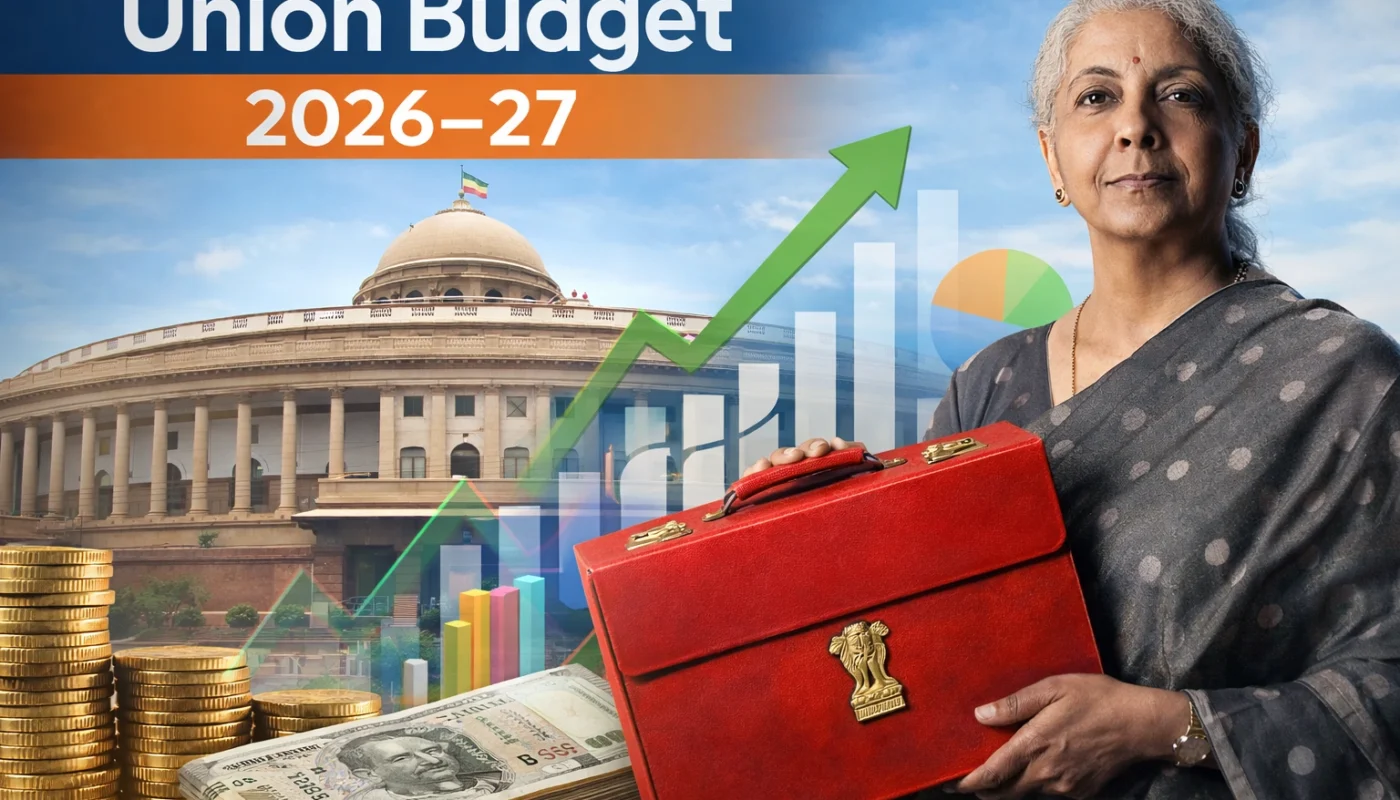
The Union Budget 2026–27 is a key document that shows how the Government of India plans to earn money and spend it in the coming financial year. It reflects the government’s economic thinking, development priorities, and governance approach. For UPSC and State PCS aspirants, the Union Budget is important for Prelims, Mains, Essay, and Interview, especially in GS Paper II and GS Paper III.
What is the Union Budget?
The Union Budget is the annual financial statement of the Government of India that shows how much money the government expects to earn and spend in a financial year. It presents details of income, expenditure, taxes, and borrowing. The budget reflects the government’s economic priorities and policy goals. It is presented in Parliament by the Finance Minister for approval.
Union Budget 2026–27 PDF Download
The Union Budget 2026–27 PDF provides the complete official document of the government’s planned income, expenditure, and policy priorities for the financial year. It is a valuable resource for students, researchers, and anyone interested in India’s economic planning and fiscal policy. The PDF includes details of allocations to ministries, revenue and capital expenditure, and taxation proposals.
Click here to download Union Budget 2026–27 PDF
Union Budget 2026–27 Key Highlights
The Union Budget 2026–27 was presented by the Finance Minister of India, Nirmala Sitharaman, on 1 February 2026 in Parliament. This Budget explains how the government plans to collect money (income) and spend money (expenditure) from April 2026 to March 2027.
The main focus of this Budget is economic growth, job creation, infrastructure development, support to farmers and businesses, better healthcare, and fiscal discipline.
1. Overall Size and Growth Focus
The total estimated size of the Budget for 2026–27 is around ₹54.1 lakh crore, which is larger than the last year’s budget.
This shows that the government plans to spend more on development and public services.
2. Fiscal Deficit and Debt Targets
- The fiscal deficit (the gap between what the government earns and spends) is targeted at 4.3% of GDP for 2026–27.
This is a continuation of efforts to reduce government borrowing gradually. - The government aims to reduce its debt-to-GDP ratio to around 55.6% and is working toward a medium-term target of around 50% by 2030.
3. Record Infrastructure Spending (Capital Expenditure)
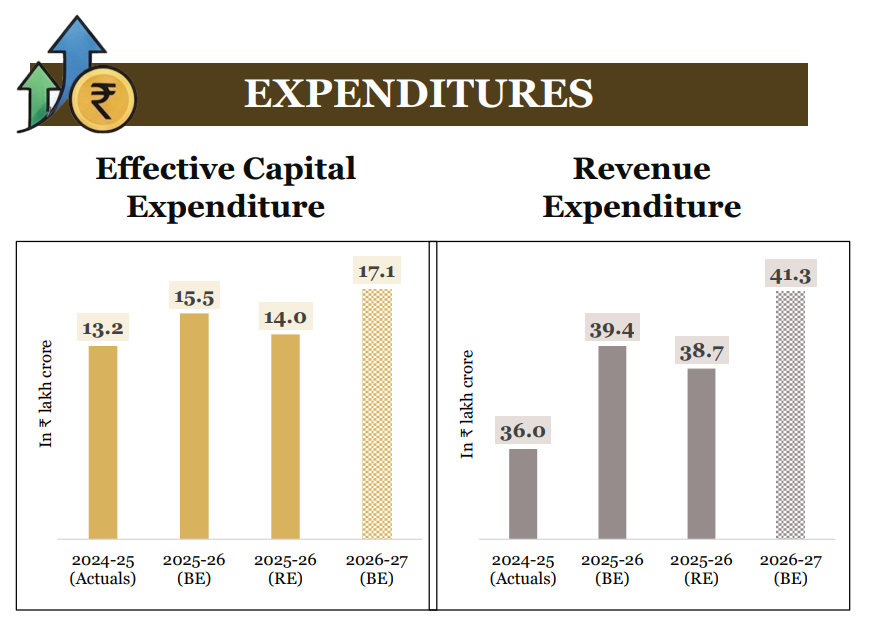
- The Budget allocates ₹12.2 lakh crore for capital expenditure (capex), which is money spent on building new infrastructure such as roads, bridges, railways, ports, airports, and public buildings.
This is a record high allocation and around 9–11% higher than the previous year. - This capex increase shows the government’s priority to boost infrastructure, generate jobs, and strengthen economic growth.
4. Government Borrowing
- For 2026–27, the government plans to borrow around ₹17.2 trillion (₹17,20,000 crore) to fund its programs and budget requirements.
This borrowing is around 17% higher than last year’s borrowings. - Net borrowing (after repayments) will be around ₹11.73 trillion.
5. Divestment and Asset Monetisation
The government aims to raise ₹80,000 crore through disinvestment and asset sales (selling stakes in public companies and monetising assets such as highways, airports, etc.).
This target is much higher than last year’s revised estimate of ₹34,000 crore.
6. Support for States
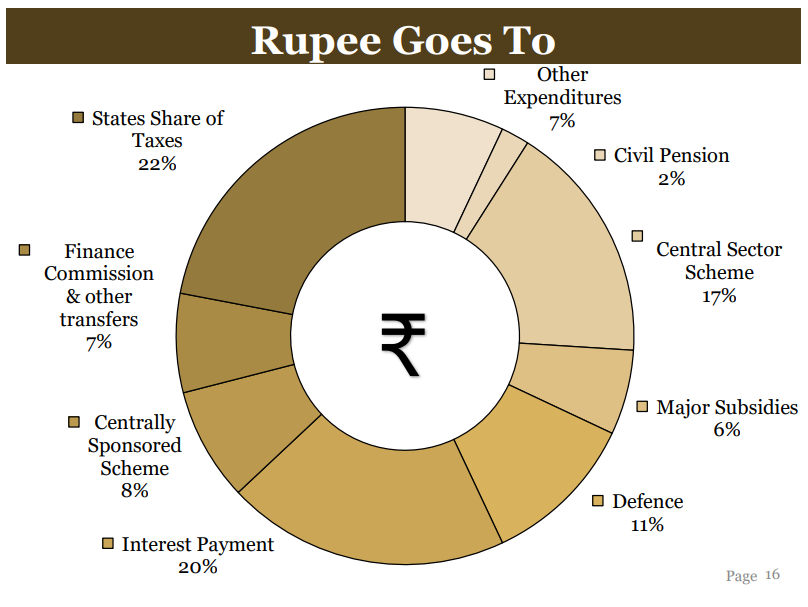
The centre has allocated ₹1.4 lakh crore as Finance Commission grants to states for development and welfare.
The standard share of states in central taxes (called devolution) continues at 41%.
7. Major Infrastructure and Transport Announcements
- Seven new High-Speed Rail Corridors were announced to connect major cities with faster trains and reduce travel time.
Routes include corridors such as Mumbai–Pune, Pune–Hyderabad, Hyderabad–Bengaluru, Delhi–Varanasi, etc. - Expansion of 20 new National Waterways over the next few years to improve river transport and logistics.
- Development of a freight corridor from east to west (such as Dankuni to Surat) to boost cargo movement efficiency.
8. Push for Manufacturing and Technology
The Budget gives major support to making India a global manufacturing hub:
- India Semiconductor Mission 2.0 with a ₹40,000 crore allocation to boost chip manufacturing and technology development in India.
This will help in creating supply chains for electronic devices and advanced tech industries. - Support schemes for electronics components, container manufacturing, chemicals parks, rare earth mineral corridors, and textile parks.
- Expanded Biopharma SHAKTI and pharmaceutical manufacturing support to strengthen domestic drug production.
9. Support for MSMEs (Small and Medium Businesses)
- A ₹10,000 crore SME Growth Fund to help small and medium businesses expand, create jobs, and improve competitiveness.
- A ₹2,000 crore top-up to the Self-Reliant India Fund to support micro enterprises.
- Mandatory use of TReDS platform to ensure timely payments to MSMEs.
10. Agriculture, Rural & Allied Sectors
- Continued investment in agricultural infrastructure, cold chains, and farm tech platforms.
- Increased focus on integrated agri-projects, fisheries development, horticulture, and livestock markets to raise farmers’ income and rural productivity.
- Use of AI and digital solutions (like Bharat-VISTAAR) to connect farmers to markets and services.
11. Healthcare and Pharmaceuticals
- Increased support for healthcare infrastructure and manufacturing capacity.
- Duty exemptions on several essential drugs and medicines to make them more affordable.
- Expansion of diagnostic facilities and healthcare access in rural areas.
12. Tax Measures and Reforms
For Individuals and Common People
- Income tax slabs remain largely unchanged for most taxpayers.
- More relief and simplified return filing processes.
- Reduced TCS (Tax Collected at Source) on foreign education and travel remittances under LRS to ease burden on students and patients abroad.
For Businesses
- Minimum Alternate Tax (MAT) reduced from 15% to 14% and made a final tax in certain cases.
- Tax holiday till 2047 for foreign firms providing cloud services using Indian data centres.
13. Social and Inclusive Growth Initiatives
- New support schemes for women entrepreneurs and enterprises (like SHE-Marts).
- Special skills and employment schemes for Divyangjan (differently-abled individuals).
- Incentives for municipal bonds to help cities raise funds for development.
Union Budget 2026–27 Constitutional Provisions
The Union Budget 2026–27 is prepared and presented according to the Constitution of India, which gives Parliament full control over government finances. These constitutional provisions ensure that taxes are levied lawfully and public money is spent only after approval. They uphold transparency, accountability, and democratic governance.
- Article 112 – Annual Financial Statement: Mandates the government to present the Union Budget annually, showing estimated receipts and expenditures for the upcoming financial year. It forms the foundation of all central financial planning.
- Article 113 – Voting on Demands for Grants: Requires Lok Sabha approval for all expenditure proposals of ministries and departments through voting on Demands for Grants. The Rajya Sabha can discuss the proposals but cannot reject or vote on them.
- Article 116 – Vote on Account: Allows the government to seek temporary approval for expenditure if the full budget is not passed before the new financial year. This ensures that government operations continue without disruption.
- Article 114 – Appropriation Bill: Authorizes the government to withdraw money from the Consolidated Fund of India after the demands for grants are passed. No government spending is legal without this bill.
- Article 110 – Finance Bill (Money Bill): Governs the Finance Bill, which includes proposals related to taxation, borrowing, and revenue. It can only be introduced in Lok Sabha and cannot be rejected by Rajya Sabha, though suggestions for amendments are allowed.
- Article 117 – Financial Bills Other Than Money Bills: Covers financial bills involving expenditure from the Consolidated Fund that are not classified as Money Bills. Both Houses of Parliament can discuss and amend these bills.
- Article 266 – Consolidated Fund of India: All government revenues, loans, and repayments are credited to this fund. Withdrawals are allowed only after Parliamentary approval, ensuring accountability.
- Article 267 – Contingency Fund of India: Used to meet unforeseen or emergency expenditures. The fund is at the disposal of the President, who can authorize temporary spending before Parliament approves it.
- Article 109 – Role of Rajya Sabha: Rajya Sabha can discuss the budget and Money Bills, but Money Bills must be returned to Lok Sabha within 14 days. It has no power to reject Money Bills.
- Article 111 – Presidential Assent: The Appropriation and Finance Bills become law only after President’s assent, making the budget legally enforceable.
Union Budget 2026–27 Structure
The Union Budget 2026–27 is a comprehensive document that presents the government’s income, expenditure, and fiscal strategy for the financial year. It is not a single document but a set of interconnected papers that provide a full picture of India’s finances.
- Budget Speech: Delivered by the Finance Minister, explaining the budget highlights, priorities, and policy direction.
- Annual Financial Statement (AFS): Detailed account of revenue and capital receipts and proposed expenditures for the year.
- Finance Bill: Legal document that includes tax proposals and amendments; must be passed as a Money Bill.
- Demand for Grants: Lists the expenditure proposed for each Ministry and Department; approved by Parliament.
- Receipts Budget: Details all sources of government income, including taxes and non-tax revenue.
- Expenditure Budget: Shows planned spending under revenue and capital expenditure heads.
- Economic Survey: Presented before the budget; reviews past year’s economic performance and outlines future strategies.
Stages of the Budget Session 2026-27
The Budget Session of the Indian Parliament is the period when the Union Budget is presented, discussed, and approved. It usually begins with the Finance Minister’s budget speech and concludes with the passing of the Appropriation and Finance Bills.
- Presentation of the Budget: The Finance Minister presents the Annual Financial Statement in the Lok Sabha, outlining receipts, expenditures, and key proposals.
- General Discussion: Members of Parliament discuss the overall budget and policy directions, raising questions and suggestions without going into detailed allocations.
- Scrutiny of Demands for Grants: Each ministry’s proposed expenditure is examined by Parliament, and approval is granted through voting on Demands for Grants.
- Passing of the Appropriation Bill: This bill authorizes the government to withdraw money from the Consolidated Fund of India to meet its expenditures.
- Passing of the Finance Bill: The Finance Bill, which contains taxation and revenue proposals, is passed, usually as a Money Bill in the Lok Sabha.
- Implementation and Monitoring: After approval, funds are released according to the allocations, and Parliament monitors budget execution and outcomes during the year.
Also Read: Difference Between Lok Sabha and Rajya Sabha
Types of Government Receipts
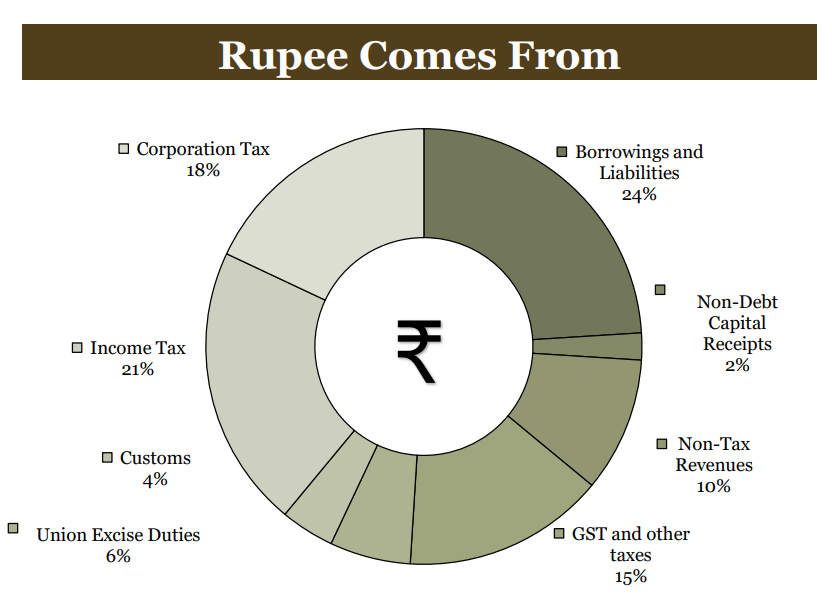
Government receipts are the sources of income for the government, which it uses to fund its activities and development programs. These receipts are essential for running the country, implementing schemes, and building infrastructure.
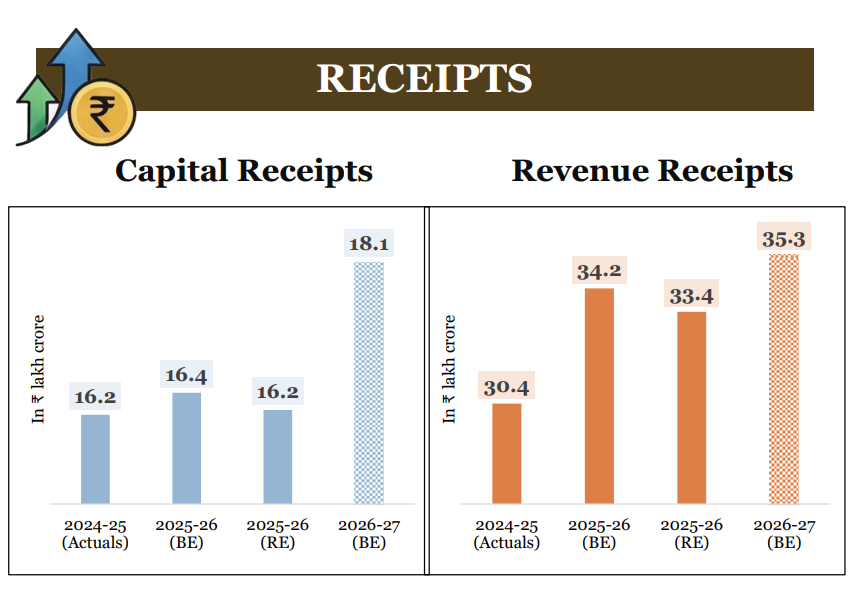
1. Revenue Receipts
- These are the regular income of the government that do not create a liability.
- Tax Revenue: Income from taxes collected by the government, such as: Income Tax, Corporate Tax, Goods and Services Tax (GST),Customs and Excise Duties
- Non-Tax Revenue: Income from non-tax sources, such as: Fees and fines, Dividends and profits from public sector enterprises and Interest receipts from loans given
2. Capital Receipts
- These are receipts that either create a liability or reduce assets.
- Borrowings and Loans: Money raised from the market or international agencies.
- Recovery of Loans: Money repaid by states or public enterprises.
- Disinvestment Proceeds: Income from selling stakes in public sector companies.
Revenue receipts are recurring and predictable, while capital receipts are often one-time or irregular. Both are crucial for planning government expenditure and maintaining fiscal balance.
Types of Government Expenditure
Government Expenditure refers to the money spent by the government to run the country, provide services, and implement development programs. It shows the priorities of the government and how public resources are allocated for welfare, infrastructure, and administration. Revenue expenditure is recurring and does not create assets, whereas capital expenditure is invested in projects or assets that benefit the economy long-term.
1. Revenue Expenditure
- Spent to maintain day-to-day functioning of the government. Examples include:
- Salaries and pensions of government employees
- Subsidies on food, fuel, and fertilizers
- Interest payments on government debt
- Administrative and operational expenses
2. Capital Expenditure
- Spent on creating long-term assets and infrastructure. Examples include:
- Construction of roads, bridges, and railways
- Investments in power plants, airports, and ports
- Defence equipment purchases
- Loans given to state governments or public sector enterprises
What to Expect from Union Budget 2026-27?
The Union Budget 2026–27 is expected to focus on promoting economic growth, job creation, and social welfare while maintaining fiscal discipline. It will guide government priorities in sectors like infrastructure, agriculture, education, health, and technology.
- The budget is likely to promote sustainable economic growth through increased investment in industries, MSMEs, and startups, helping generate jobs and boost production.
- There may be significant spending on infrastructure, including roads, railways, ports, airports, and urban development, to improve connectivity and facilitate economic activity.
- Agriculture and rural development are expected to receive emphasis, with initiatives for farmer income support, irrigation, crop insurance, and rural employment programs.
- Social sector programs could see enhanced funding for education, healthcare, nutrition, and skill development, improving human capital and quality of life.
- Employment generation may be supported through vocational training, entrepreneurship programs, and labor-intensive projects, addressing the challenge of youth unemployment.
- Tax reforms are expected to simplify the system, improve compliance, broaden the tax base, and promote ease of doing business.
- The budget may invest in digital governance, technology, and e-governance projects, enhancing transparency, efficiency, and citizen services.
- Centre–State relations could be strengthened through tax devolution and grants-in-aid, supporting cooperative federalism and balanced regional development.
- Fiscal discipline will likely be a key focus, with measures to manage deficits, optimize expenditure, and ensure long-term financial sustainability.
Economic Survey 2026 vs Union Budget 2026-27
The Economic Survey 2026 is a detailed report that reviews the past year’s economic performance and outlines challenges and strategies for the future. In contrast, the Union Budget 2026–27 is a financial statement that presents the government’s planned income and expenditure for the upcoming financial year.
| Feature | Economic Survey 2026 | Union Budget 2026–27 |
|---|---|---|
| Purpose | Reviews past economic performance and provides policy recommendations | Details estimated receipts, expenditures, and government priorities for the year |
| Nature | Analytical and advisory document | Legal and financial document |
| Presented by | Chief Economic Advisor (CEA) | Finance Minister |
| Timing | Usually a day before the Budget | February 1, 2026 |
| Content | Macro-economic trends, sectoral analysis, challenges, and recommendations | Tax proposals, revenue, expenditure, allocation to ministries, fiscal deficit |
| Parliamentary Approval | Not required | Requires approval through Finance Bill and Appropriation Bill |
| Focus | Analysis and strategy for economic policy | Implementation and allocation of government resources |
| Use in Exams | Helps in understanding economic trends, policies, and reforms | Helps in current affairs, Prelims, Mains answers, and interviews |
Union Budget 2026-27 FAQs
1. What is the Union Budget?
The Union Budget is the annual financial statement of the Government of India showing its estimated income and expenditure for the financial year.
2. When will the Union Budget 2026–27 be presented?
The Union Budget 2026–27 will be presented on 1st February 2026 in Parliament by the Finance Minister.
3. Who presents the Union Budget in India?
The Finance Minister of India presents the Union Budget in the Lok Sabha.
4. Which constitutional article mandates the presentation of the Union Budget?
Article 112 of the Constitution mandates the presentation of the Annual Financial Statement or Union Budget.
5. What are the main components of the Union Budget?
The main components of the Union Budget include the Budget Speech, Annual Financial Statement, Finance Bill, Demands for Grants, Receipts and Expenditure Budget, and Economic Survey.
6. What is the difference between Revenue Receipts and Capital Receipts?
Revenue Receipts are regular income like taxes and non-tax revenue that do not create liability, while Capital Receipts create liability or reduce assets, such as loans or disinvestment proceeds.
7. What is Revenue Expenditure?
Revenue Expenditure is the money spent on daily government operations like salaries, pensions, subsidies, and interest payments.
8. What is Capital Expenditure?
Capital Expenditure is the money spent on long-term assets such as infrastructure, defence equipment, and loans to states.
9. What is a Vote on Account?
A Vote on Account is temporary approval granted by Parliament to allow government spending if the full budget is not passed on time.
10. What is the Finance Bill?
The Finance Bill is a bill containing proposals related to taxation, borrowing, and government revenue, introduced only in Lok Sabha as a Money Bill.
11. What is the role of Lok Sabha in the Union Budget?
The Lok Sabha approves Demands for Grants and passes the Finance and Appropriation Bills.
12. What is the role of Rajya Sabha in the Union Budget?
The Rajya Sabha can discuss the budget and Money Bill but cannot reject it and must return Money Bills within 14 days.
13. What is the Consolidated Fund of India?
The Consolidated Fund of India is the main government fund where all revenues, loans, and repayments are deposited, and money can be withdrawn only after parliamentary approval.
14. What is the Contingency Fund of India?
The Contingency Fund of India is used to meet unforeseen or emergency expenditure and is at the disposal of the President.
15. What is the Appropriation Bill?
The Appropriation Bill authorizes the government to withdraw money from the Consolidated Fund of India after Demands for Grants are passed.
16. What is the significance of the Union Budget for India?
The Union Budget is significant as it guides economic policy, allocates resources for development, and reflects government priorities.
17. What is the importance of the Union Budget for UPSC and State PCS exams?
It is important because it provides current affairs content, economic data, and policy insights for Prelims, Mains, essays, and interviews.
18. What is the role of the President in the Union Budget?
The President gives assent to the Appropriation and Finance Bills, making the budget legally enforceable.
19. What is the Economic Survey?
The Economic Survey is a report presented before the Budget that reviews past economic performance and outlines strategies for the future.
20. How does the Union Budget impact cooperative federalism?
The Budget impacts cooperative federalism by providing tax devolution and grants-in-aid to states for balanced regional development.