 by
by 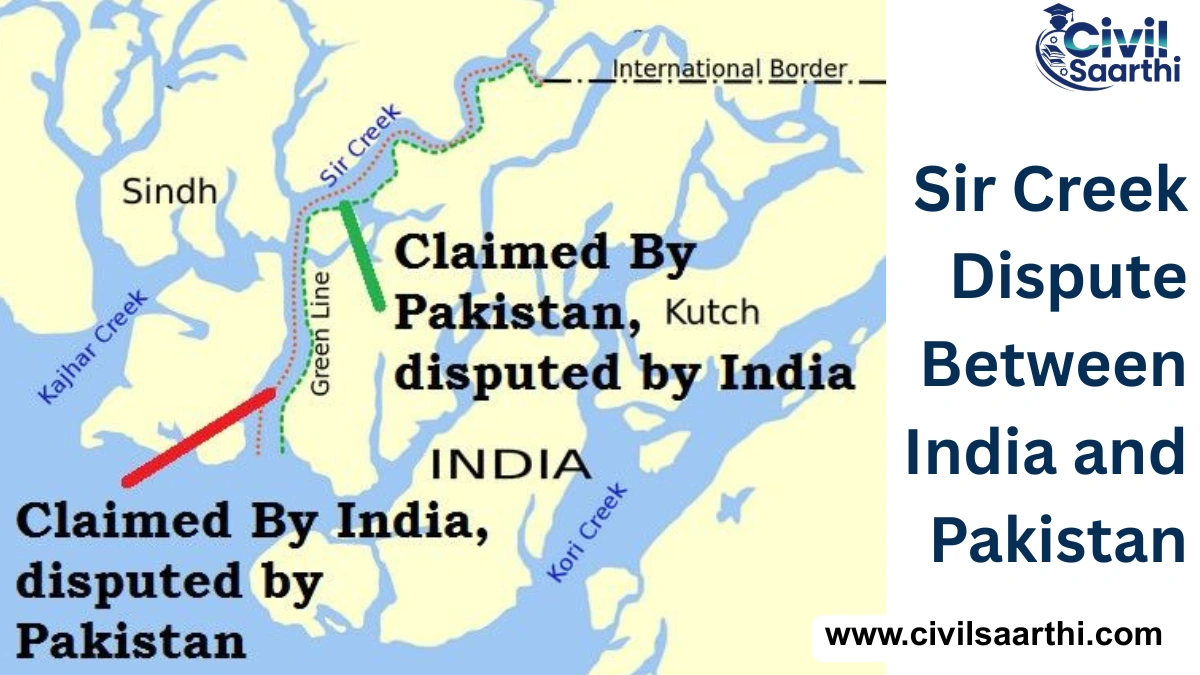
The Sir Creek dispute between India and Pakistan is one of the lesser-known but strategically important border issues in South Asia. It is linked to maritime boundaries, resource rights, and military strategy. For UPSC aspirants, understanding the India–Pakistan Sir Creek issue is crucial because it involves geopolitics, international law, and national security.
What is Sir Creek?
Sir Creek is a 96-km long tidal estuary located in the marshes of the Rann of Kutch region, between Gujarat (India) and Sindh (Pakistan).
It opens into the Arabian Sea and is significant for fisheries, coastal security, and Exclusive Economic Zones (EEZs).
Originally part of the Indus River delta, Sir Creek shifts with tidal flows, making border demarcation complex.
Historical Background of the Sir Creek Dispute
The roots of the dispute go back to the colonial era:
1899 Bombay Government Resolution – Defined the boundary between Sindh (then under Bombay Presidency) and Kutch (a princely state).
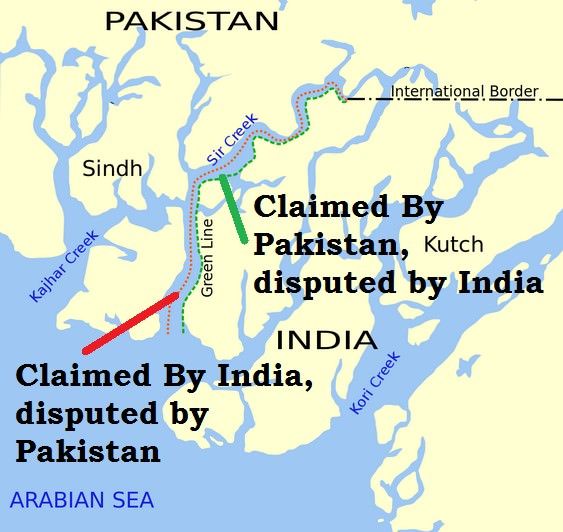
India’s Claim – The boundary lies mid-channel of Sir Creek, based on the 1914 map attached to the 1899 resolution.
Pakistan’s Claim – The boundary lies along the eastern bank of Sir Creek, giving it more maritime area in the Arabian Sea.
Thus, the issue is not only territorial but also affects maritime sovereignty and resource allocation.
Sir Creek Dispute Map
The Sir Creek dispute map highlights the conflicting claims of India and Pakistan in the Rann of Kutch, showing India’s mid-channel boundary versus Pakistan’s eastern bank claim. It is crucial for understanding how the dispute affects maritime boundaries, EEZs, and security interests in the Arabian Sea.
Why is the Sir Creek Dispute Important?
1. Strategic Importance
It directly affects India–Pakistan maritime boundary demarcation.
Affects naval and military operations in the Arabian Sea.
The Pakistan military in Sir Creek region uses its position to monitor Indian coastal activities.
2. Economic Importance
Determines the Exclusive Economic Zone (EEZ) of both countries under UNCLOS (United Nations Convention on the Law of the Sea).
EEZ gives rights over fisheries, hydrocarbons, and seabed resources.
India stands to lose around 250 sq. km of maritime territory if Pakistan’s claim is accepted.
3. Security Importance
Region prone to illegal fishing and cross-border infiltration.
Sir Creek was used as an entry route for terrorists, raising coastal security concerns post-26/11.
Also Read: GST 2.0 Reforms
India’s Stand on Sir Creek
India argues that the 1914 map supports its position of mid-channel boundary.
Accepting Pakistan’s claim would shrink India’s EEZ, impacting energy security and naval strategy.
India emphasizes international maritime law (UNCLOS) to settle the issue.
Pakistan’s Stand on Sir Creek
Pakistan insists that the eastern bank should be treated as the boundary.
This gives Pakistan a larger EEZ in the Arabian Sea, useful for economic resources and naval deployment.
The Pakistan military in Sir Creek considers it a key defense zone, maintaining strong surveillance in the area.
Attempts at Resolution
1965 Rann of Kutch Arbitration – India and Pakistan fought a brief conflict in Rann of Kutch. Tribunal awarded 90% territory to India, 10% to Pakistan, but Sir Creek remained unresolved.
Indira–Bhutto Agreement (1972) – Focused on Line of Control (J&K), did not address Sir Creek.
1990s Talks – Technical discussions held, but no conclusion.
2005 Proposal – India suggested joint survey; Pakistan initially agreed but later stalled.
Current Status – Dispute remains unresolved, but both sides avoid escalation due to nuclear deterrence.
Role of International Law
UNCLOS (1982) defines EEZ rights based on equidistance principle.
Resolution of Sir Creek dispute is necessary for proper demarcation of India–Pakistan maritime boundary.
If referred to international arbitration, the decision may impact both nations’ sovereignty claims.
UPSC Relevance of Sir Creek Dispute
For UPSC Prelims and Mains, the Sir Creek issue is linked to:
Geography – Estuaries, EEZ, Rann of Kutch.
Polity & International Relations – Boundary disputes, treaties, arbitration.
Security Issues – Coastal security, infiltration, terrorism.
Environment & Economy – Fisheries, mangroves, hydrocarbons.
Sir Creek Dispute – Quick Comparison Table
| Aspect | India’s Position | Pakistan’s Position |
|---|---|---|
| Boundary Claim | Mid-channel line | Eastern bank |
| Legal Basis | 1914 map with 1899 resolution | Different interpretation of same resolution |
| EEZ Impact | Preserves India’s EEZ | Expands Pakistan’s EEZ |
| Strategic View | Coastal security, naval access | Military advantage in Arabian Sea |
| Resolution Efforts | Surveys, technical talks | Pushes for eastern-bank recognition |
Challenges in Resolving the Sir Creek Issue
Shifting geography due to tides and silting.
Trust deficit between India and Pakistan.
Linkage with Kashmir dispute complicates negotiations.
Pakistan military’s Sir Creek deployment sees it as a bargaining chip against India.
Both nations reluctant to involve international arbitration, fearing loss of territory.
Way Forward
Confidence-Building Measures (CBMs) like joint surveys, hotlines for fishermen.
Joint management of fisheries and mangroves to reduce conflict.
Use of technical solutions like GPS mapping for clear demarcation.
Decoupling Sir Creek from other disputes like Kashmir for quicker resolution.
Strengthening coastal security to prevent infiltration and illegal activities.
Conclusion
The India–Pakistan Sir Creek dispute is a classic example of how minor colonial-era ambiguities can escalate into major geopolitical concerns. For UPSC preparation, aspirants must analyze it not only as a border issue but also in the context of international law, coastal security, and Indo-Pak relations. While Pakistan military in Sir Creek sees it as a tactical advantage, India emphasizes international norms. A peaceful resolution can enhance regional stability and ensure better utilization of maritime resources.
FAQs on Sir Creek Dispute
Q1. What is Sir Creek and why is it disputed?
Sir Creek is a 96-km tidal estuary in Rann of Kutch. India and Pakistan dispute its boundary, which affects their maritime EEZ rights.
Q2. What is India’s stand on Sir Creek?
India considers the mid-channel line as the boundary, as per the 1914 map.
Q3. Why does Pakistan want Sir Creek?
Pakistan wants the eastern bank boundary, giving it more maritime territory and resources.
Q4. Has Sir Creek dispute been resolved?
No. Despite multiple talks, the dispute remains unresolved due to strategic and political differences.