 by
by 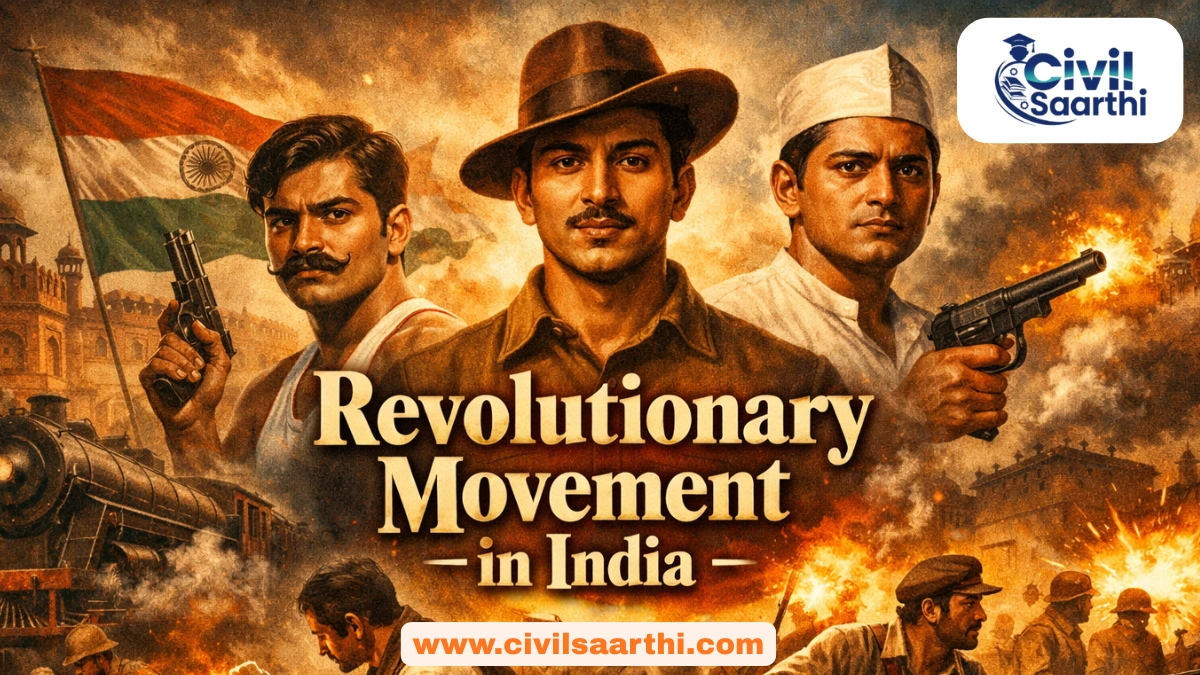
Although the Indian freedom struggle after the Revolt of 1857 was largely non-violent, a revolutionary movement emerged with the aim of securing India’s independence. This movement attracted many young Indians who believed that an armed struggle against the British government was necessary to free the country.
They often adopted radical and forceful methods to challenge colonial rule. Although the British authorities suppressed their efforts, the revolutionaries were successful in inspiring countless Indians to join the freedom struggle. Their stories of courage, sacrifice, and dedication to the nation continue to motivate people to serve and even lay down their lives for the country. We have discussed in detail the Important Revolutionary Movement in India.
The First Case: Chapekar Brothers (1897)
- Marked the first political assassination of a British officer in India after the 1857 Revolt.
- Brothers Damodar, Balkrishna, and Vasudeo Chapekar shot at W.C. Rand, ICS, Chairman of the Special Plague Committee in Pune.
- Rand’s military escort, Lieutenant Ayers, died on the spot; Rand succumbed a few days later due to injuries.
- The brothers acted against the atrocities committed by British authorities under Rand during the plague pandemic.
- British measures to control the plague included harassment and extreme punishments for Indians.
- All three brothers were hanged to death for their actions.
Alipore Bomb Conspiracy Case (1908)
- Also called the Muraripukur scheme or Manicktolla bomb conspiracy.
- Targeted Douglas Kingsford, a disliked British Chief Magistrate, during a visit to Muzaffarpur, Northern Bihar.
- Unfortunately, the bomb killed two English women instead of Kingsford.
- Revolutionaries involved: Prafulla Chaki and Khudiram Bose.
- Chaki committed suicide, while 18-year-old Bose was arrested and hanged.
- Other accused included Aurobindo Ghosh, Barin Ghosh, Kanailal Dutt, Satyendranath Bose, and over 30 others from Anushilan Samiti, Calcutta.
- Aurobindo Ghosh was acquitted due to lack of evidence; others received life imprisonment.
Curzon Wyllie’s Assassination (1909)
- India House, London, was a hub of revolutionary activities targeting Indian freedom.
- It attracted Indian students and was supported by Shyamji Krishna Varma and Bhikaiji Cama.
- Became the center of revolutionary activity abroad.
- The association gained attention after Madan Lal Dhingra assassinated British officer Curzon Wyllie in 1909.
Howrah Gang Case (1910)
- Also called the Howrah-Shibpur Conspiracy Case.
- 47 revolutionaries from Anushilan Samiti were arrested for the murder of Inspector Shamsul Alam.
- Alam was investigating the Samiti’s activities and linking multiple crimes.
- The case was organized by revolutionary Jatindranath Mukherjee.
- The decentralized structure of the Samiti prevented the authorities from proving all connections.
- Only Jatindranath Mukherjee and Narendranath Bhattacharjee were sentenced to one year in prison.
Also Read: Revolt of 1857
Delhi-Lahore Conspiracy Case (1912)
- Also called the Delhi Conspiracy Case.
- Aimed to assassinate Lord Hardinge, the Viceroy of India.
- Led by Rashbehari Bose; involved throwing a bomb into the Viceroy’s howdah (elephant carriage) during a parade.
- Incident coincided with the transfer of British capital from Calcutta to Delhi.
- Lord Hardinge was injured, while an Indian attendant was killed.
- Bose escaped conviction, while others were prosecuted.
Kakori Conspiracy Case (1925)
- A train robbery near Kakori, Uttar Pradesh.
- Led by young revolutionaries of Hindustan Republican Association, later Hindustan Socialist Republican Association (HSRA).
- Key members: Ram Prasad Bismil, Ashfaqulla Khan, Chandrashekhar Azad, Rajendra Lahiri, Thakur Roshan Singh, among others.
- Targeted a train believed to carry British government money.
- One person died during the robbery.
- The revolutionaries were tried in court.
- Bismil, Khan, Lahiri, and Roshan Singh were sentenced to death, others received life imprisonment or deportation.
Chittagong Armory Raid (1930)
- Also called Chittagong Uprising.
- Revolutionaries attempted to attack the police armory and government forces arsenal in Chittagong (now in Bangladesh).
- Led by Surya Sen; others included Ganesh Ghosh, Lokenath Bal, Pritilata Waddedar, Kalpana Dutta, Ambika Chakraborty, Subodh Roy, and more.
- Though unable to find arms, they cut telephone and telegraph wires.
- Surya Sen hoisted the Indian flag at the arsenal.
- Many revolutionaries escaped, but some were arrested.
- Government crackdown led to imprisonment, deportation to Andaman, and Surya Sen’s execution after torture.
Central Assembly Bomb Case (1929) and Lahore Conspiracy Case (1931)
- Bhagat Singh and Batukeshwar Dutt threw a bomb in Delhi Assembly to protest against British rule, distributing pamphlets.
- No one was harmed; they were arrested and imprisoned intentionally to publicize their revolutionary ideology.
- Bhagat Singh was later re-arrested for murder of British officer J.P. Saunders in the Lahore Conspiracy Case.
- Saunders was killed mistakenly; intended target was James Scott, responsible for Lala Lajpat Rai’s death.
- Others involved: Sukhdev, Rajguru, Chandrashekhar Azad from HSRA.
- In jail, Bhagat Singh, Rajguru, and Sukhdev led a hunger strike demanding better conditions for political prisoners.
- After trial, Bhagat Singh, Rajguru, and Sukhdev were executed in March 1931; Azad martyred in February 1931 during a police encounter in Allahabad.