 by
by 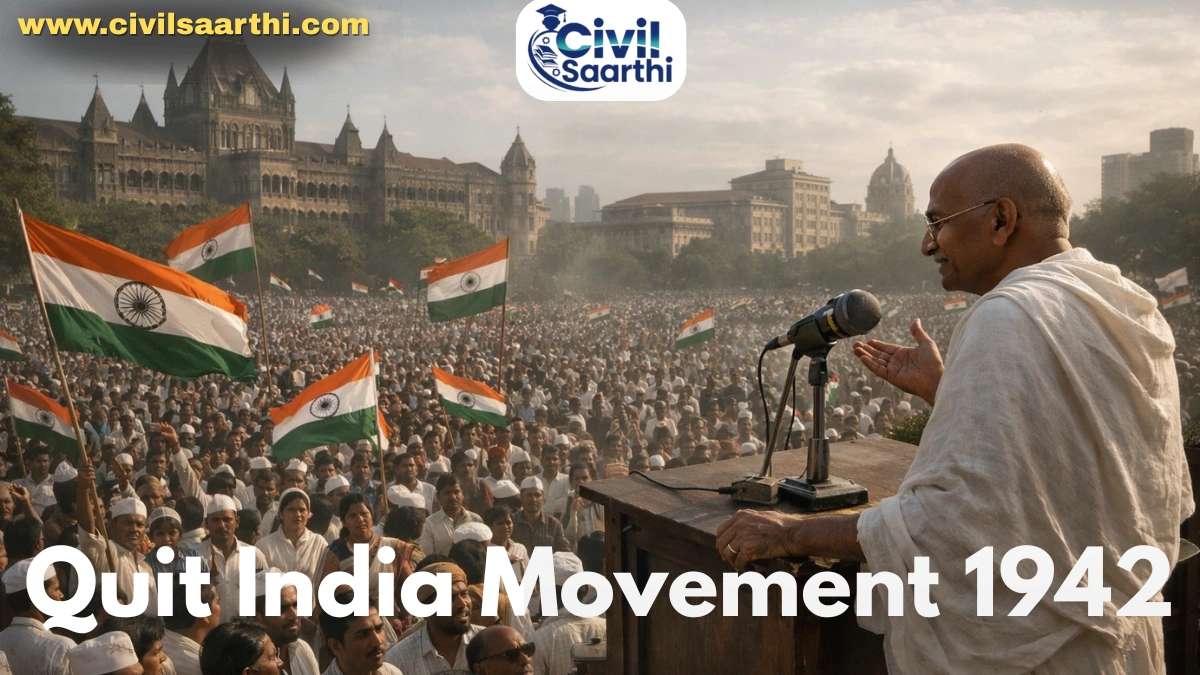
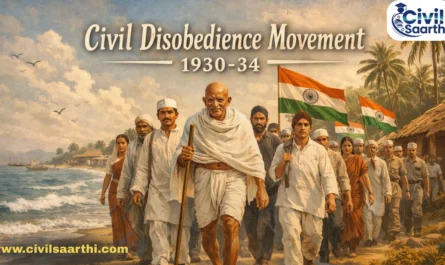
The Quit India Movement, also called the August Movement or August Kranti, was a mass protest launched by Mahatma Gandhi from the Bombay session of the All-India Congress Committee (AICC) on August 8, 1942. It formed a key part of Gandhi’s larger Civil Disobedience Movement, aiming to end British colonial rule in India. This article explores the background, phases, impact, and significance of the Quit India Movement, providing detailed insights helpful for UPSC and other competitive exams.
Quit India Movement – Background
- After the failure of the Cripps Mission, Gandhi drafted a resolution demanding the withdrawal of the British and proposed a nonviolent, non-cooperation movement if Japan invaded India.
- The idea of initiating a struggle was approved at the Congress Working Committee (CWC) meeting in Wardha on July 14, 1942.
- Gandhi was given command of the movement by the CWC.
- The resolution became popularly known as the ‘Quit India’ resolution.
- Approval for the resolution was sought at the All India Congress Committee meeting in Bombay, proposed by Jawaharlal Nehru and seconded by Sardar Vallabhbhai Patel.
- The movement officially began at Gowalia Tank Maidan in Mumbai, now called August Kranti Maidan.
- Popular slogans included “Quit India” and “Bharat Chodo”, while Gandhi urged the people to “Do or die.”
- The movement was meant to be peaceful and nonviolent, following Congress doctrine, to convince the British to grant India independence.
Resolution of Quit India Movement
On August 8, 1942, the Congress meeting at Gowalia Tank, Bombay ratified the Quit India Resolution, agreeing to:
- Demand the immediate end of British rule in India.
- Declare that a free India would oppose all forms of fascism and imperialism.
- Form a provisional Government of India after British withdrawal.
- Launch a civil disobedience movement against British authorities.
Instructions of Mahatma Gandhi
Mahatma Gandhi Ji provided specific instructions to different groups:
- Government employees: Don’t resign; pledge loyalty to the Indian National Congress.
- Soldiers: Remain in the army but don’t fire on comrades.
- Landlords/Zamindars: Pay rent if anti-government; refuse if pro-government.
- Students: Confident students could leave studies to join the movement.
- Princes: Stand with the people and recognize their sovereignty.
- People in princely states: Support monarchs only if anti-British; otherwise, declare yourselves Indian citizens.
Reasons for Quit India Movement
- World War II had begun in 1939, and Japan, an Axis power, was gaining ground in India’s northeastern frontiers.
- The British had abandoned colonies in Southeast Asia, showing their inability to defend India, which frustrated the public.
- Gandhi believed that British withdrawal would remove Japan’s reason to invade India.
- Wartime hardships like high prices, shortages, and British defeats fueled public anger.
- The Cripps Mission failed to provide a viable constitutional solution, prompting the INC to launch civil disobedience.
Phases of Quit India Movement 1942
The movement unfolded in three major phases:
The First Phase – Public Rampage
- People attacked government symbols and hoisted national flags on public buildings.
- Bridges were blown, railway tracks removed, and telegraph lines severed.
- Most unrest occurred in the eastern United Provinces (UP) and Bihar.
- Students staged strikes, processions, distributed illegal newspapers, and acted as underground couriers.
- Workers in Ahmedabad, Bombay, Jamshedpur, Ahmednagar, and Poona went on strike.
The Second Phase – Underground Activities
- Many leaders and nationalists went underground to avoid arrest.
- Groups including socialists, Forward Bloc members, Gandhi ashramites, and revolutionary nationalists from Bombay, Poona, Satara, Baroda, Gujarat, Karnataka, Kerala, Andhra Pradesh, UP, Bihar, and Delhi participated.
- Key figures included Rammanohar Lohia, Jayaprakash Narayan, Aruna Asaf Ali, Usha Mehta, Biju Patnaik, Chhotubhai Puranik, Achyut Patwardhan, Sucheta Kripalani, and R.P. Goenka.
- Usha Mehta ran an underground radio station in Bombay.
- This phase helped maintain public morale and coordinated distribution of arms and ammunition.
The Third Phase – Parallel Governments
- Ballia (UP): Under Chittu Pandey for one week in August 1942; many Congress members were freed.
- Tamluk (Midnapore, West Bengal): Jatiya Sarkar operated from Dec 1942 to Sep 1944, provided cyclone relief, school grants, and redistributed food.
- Satara (Maharashtra): “Prati Sarkar” from 1943 to 1945, led by Y.B. Chavan, Nana Patil, ran libraries, Nyayadan Mandals, prohibition campaigns, and promoted “Gandhi marriages.”
- Support came from villagers, students, businessmen, pilots, train drivers, and even government officials who assisted underground activists.
Participation in the Quit India Movement
The Quit India Movement witnessed mass participation from various sections of Indian society, making it a truly nationwide struggle for independence. Key participants included:
- Students: Students, along with workers and middle-class activists, were heavily involved across the country. The movement also reached rural areas, spreading nationalist ideas to villages. In Bihar and eastern Uttar Pradesh, student participation was especially strong, with militant students from Patna and Benares playing crucial roles in protests, strikes, and underground activities.
- Peasants: While the movement primarily focused on nationalist goals rather than agrarian issues, peasants still actively participated, particularly in Bihar and eastern UP, showing their support for the anti-British struggle.
- Tribals: Tribal communities, especially in Bengal and Orissa, joined the movement, contributing to local protests and resistance against British authority.
- Government officials: Many government employees, especially lower-ranking police and administrative staff, took part in the movement. Their participation weakened loyalty to the British government, and some officials even provided secret information to activists, aiding the underground struggle.
- Women: Women played a remarkable role during the Quit India Movement. They organized and led protests, strikes, and demonstrations, mobilized local communities, and supported the movement through both leadership and grassroots participation.
Overall, the movement brought together students, workers, peasants, tribals, government employees, and women, reflecting the broad-based support for India’s demand for independence.
Quit India Movement 1942 Impact
- The British immediately arrested key Congress leaders including Gandhi, Nehru, and Patel.
- New leaders like Jayaprakash Narayan and Ram Manohar Lohia emerged.
- Aruna Asaf Ali became a prominent figure during the leadership vacuum.
- Around 100,000 people were detained; police used violence, lathi charges, and shootings, killing about 10,000 people, including women and children.
- The INC was declared illegal, and its leaders were imprisoned for most of the war; Gandhi was released in 1944 due to ill health.
- Public unrest included property damage, burning of structures, and disruption of transport and communication.
- Some groups opposed the movement:
- Muslim League: Against British leaving without partition.
- Communist Party of India: Supported British due to alliance with the Soviet Union.
- Hindu Mahasabha: Did not support the campaign.
- From abroad, Subhas Chandra Bose organized the Indian National Army and the Azad Hind Government.
- Strikes and demonstrations continued, mainly in Uttar Pradesh, Bihar, Maharashtra, Midnapore, and Karnataka, lasting until 1944.
Quit India Movement 1942 Limitations
While the Quit India Movement was a pivotal step in India’s struggle for independence, it faced several limitations that affected its overall impact:
- Failed to achieve immediate freedom: The movement did not lead to India’s independence right away; years of struggle and negotiations followed.
- Lack of central leadership: With Gandhi and top leaders arrested, coordination suffered, causing confusion and fragmentation within the movement.
- No political consensus: Some parties and leaders opposed the movement, including the Muslim League, Communist Party of India, Hindu Mahasabha, B.R. Ambedkar, and Periyar.
- Communal divide: Muslim participation was lower than in previous movements. Jinnah encouraged Muslims to join the armed forces, while the Muslim League used this period to strengthen its political position for the 1945–46 elections, eventually supporting the demand for Pakistan.
- Communal violence: Certain regions witnessed communal clashes during the movement, which weakened its nationwide unity.
Despite these limitations, the Quit India Movement significantly mobilized the Indian masses, intensified the demand for freedom, and paved the way for India’s independence in 1947.
Quit India Movement 1942 Significance
- Movement continued without Gandhi or top leaders due to mass imprisonment.
- People from all walks of life participated; students, workers, and peasants were the backbone.
- Government loyalty deteriorated, highlighting the rise of nationalism.
- Demonstrated that India could not be ruled without the consent of its people.
- Allowed spontaneous mass participation, increasing the intensity of public resistance.
- Congress was ideologically and organizationally prepared, making the movement highly effective.
- Post-uprising, the British began seriously considering Indian independence.
- By the 1940s, it influenced political negotiations with Britain and paved the way for freedom in 1947.
- The movement ensured that Indian independence became an immediate goal for the national movement.
Conclusion
The Quit India Movement of 1942 marked a turning point in India’s freedom struggle. It mobilized ordinary citizens and transformed the independence movement into a mass-led campaign. Despite harsh repression, including mass arrests and killings, the courage and determination of the people ensured the movement left a lasting legacy. It set the stage for India’s eventual independence in 1947, proving that freedom was a struggle for ‘We the People’, not just political leaders.
Quit India Movement 1942 UPSC Prelims PYQs
Question 1: With reference to 8th August 1942 in Indian history, which one of the following statements is correct? (UPSC Prelims 2021)
(a) The Quit India Resolution was adopted by the AICC.
(b) The Viceroy’s Executive Council was expanded to include more Indians.
(c) The Congress ministries resigned in seven provinces.
(d) Cripps proposed an Indian Union with full Dominion status once the Second World War was over.
Answer: (a)
Question 2: With reference to Indian freedom struggle, consider the following events: (UPSC Prelims 2017)
- Mutiny in Royal Indian Navy
- Quit India Movement launched
- Second Round Table Conference
What is the correct chronological sequence of the above events?
1 – 2– 3
2 – 1 – 3
3 – 2 – 1
3 – 1 – 2
Answer: (c)
Question 3: Quit India Movement was launched in response to (UPSC Prelims 2013)
(a) Cabinet Mission Plan
(b) Cripps Proposals
(c) Simon Commission Report
(d) Wavell Plan
Answer: (b)