 by
by 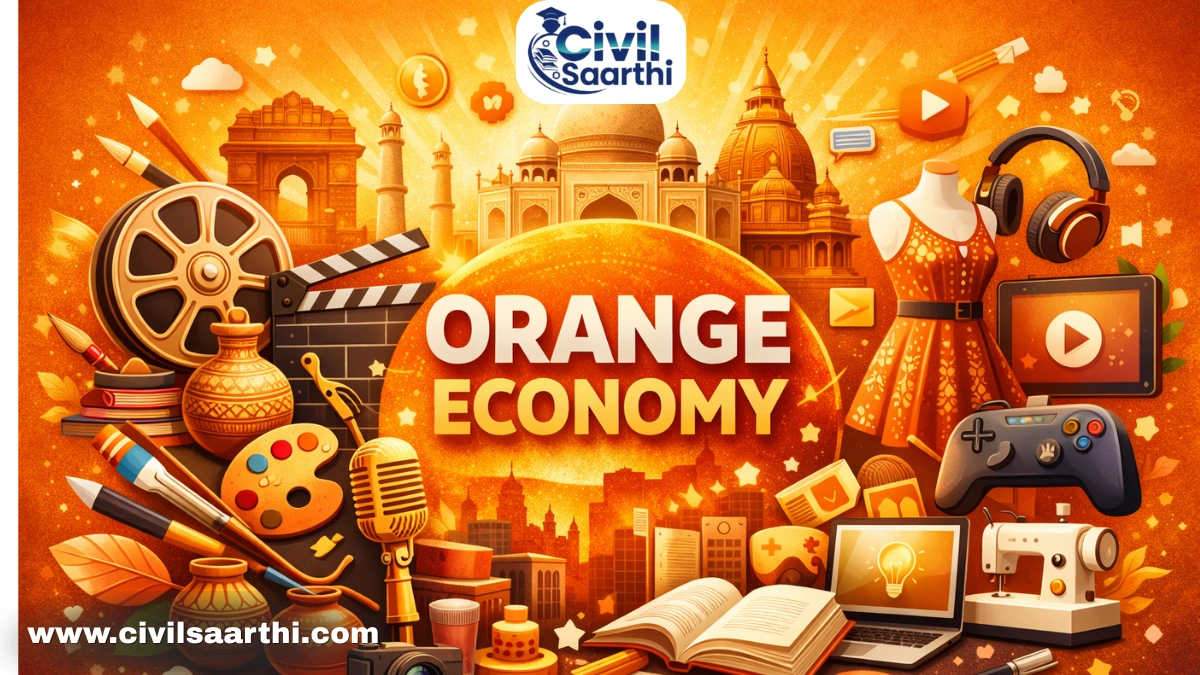
Orange Economy Latest News
At the World Audio Visual Entertainment Summit (WAVES) in Mumbai, the Prime Minister of India recently highlighted India’s booming Orange Economy, powered by content, creativity, and culture. The term Orange Economy is also mentioned in the current Union Budget 2026-27.
What is Orange Economy?
The Orange Economy, also called the Creative Economy, refers to sectors driven by creativity, culture, and innovation.
- Focuses on economic growth and cultural development.
- Integrates economic, social, and cultural aspects with technology, intellectual property, and tourism.
- Based on individual talent, skill, and creativity, producing wealth, jobs, and cultural value.
According to UNESCO, the Orange Economy accounts for 3% of global GDP and supports 30 million jobs worldwide.
Features of the Orange Economy
- Creativity at the Core – The economy thrives on original ideas, art, and innovation.
- Cultural Integration – Connects traditional and modern cultural expressions.
- Knowledge-Based Industries – Relies on skills, talent, and intellectual property rather than physical resources.
- Job Creation Potential – Offers employment opportunities across creative sectors.
- Economic and Social Impact – Contributes to GDP while promoting social development.
According to UNESCO, the Orange Economy contributes 3% of global GDP and provides 30 million jobs worldwide, proving that creativity can drive both wealth and social progress.
Sectors Included in the Orange Economy
The Orange Economy encompasses a wide range of industries. Each sector contributes uniquely to culture and commerce.
| Sector | Examples | Opportunities & Benefits |
|---|---|---|
| Advertising & Architecture | Creative campaigns, structural design | Jobs in marketing, branding, and design |
| Arts & Crafts | Traditional art, sculpture, handicrafts | Artists, craft entrepreneurship, cultural tourism |
| Design & Fashion | Apparel, industrial design, jewelry | Fashion designers, product innovators |
| Film, Video & Photography | Movies, documentaries, digital content | Filmmakers, editors, cinematographers |
| Music & Performing Arts | Music production, theater, dance performances | Musicians, choreographers, event management |
| Publishing | Books, e-publishing, magazines | Writers, editors, digital publishing startups |
| Research & Development | Creative solutions, tech innovation | Entrepreneurs, R&D specialists |
| Software, Gaming & Digital Media | Video games, animation, apps | Game developers, animators, UX designers |
| TV & Radio | Broadcasting, streaming, digital channels | Anchors, producers, content creators |
These industries are interconnected, creating synergies between traditional and modern sectors. For example, gaming can integrate music, art, and storytelling, while fashion can incorporate digital media for global marketing.
Orange Economy Importance
The Orange Economy plays a vital role in economic, cultural, and social development.
Economic Importance:
- Boosts GDP – Creative industries contribute significantly to national and global economies.
- Employment Generation – Offers diverse opportunities for youth, freelancers, and entrepreneurs.
- Supports Startups – Encourages innovation and new business models in digital and traditional sectors.
Cultural Importance:
- Preserves Heritage – Crafts, arts, and cultural tourism help maintain local traditions.
- Promotes Diversity – Encourages multicultural expressions and global cultural exchanges.
- Enhances Global Influence – Creative exports increase a country’s soft power worldwide.
Technological Importance:
- Digitization – Online platforms allow artists and startups to reach global audiences.
- Innovation Driver – Encourages integration of AI, AR/VR, and animation in creative work.
In short, the Orange Economy is a multifaceted engine that drives wealth creation, social inclusion, and technological innovation simultaneously.
Origins and Global Perspective
The term “Orange Economy” was popularized by Felipe Buitrago and Iván Duque from Colombia, symbolizing creativity and cultural identity. It emphasizes that culture and economic growth can go hand in hand.
Globally:
- Colombia – Promotes creative industries for GDP growth and cultural promotion.
- South Korea – Uses K-pop, films, and gaming as cultural export strategies.
- India – Film, music, gaming, and digital content are rapidly expanding sectors.
- The Orange Economy is seen as a driver of sustainable development, balancing economic performance with cultural preservation.
Challenges Facing the Orange Economy
- Despite its potential, the Orange Economy faces several hurdles:
- Limited Access to Funding – Creative projects often struggle to find investment.
- Intellectual Property Concerns – Piracy and copyright violations reduce revenue for creators.
- Market Access – Small-scale artists and startups may struggle to reach global markets.
- Digital Divide – Lack of technology can limit innovation and outreach.
- Recognition & Valuation – Creative work is sometimes undervalued compared to traditional sectors.
- Governments, NGOs, and private players are now creating policies, grants, and digital platforms to overcome these challenges.
How India Can Expand Its Orange Economy
- To fully leverage its potential, India can focus on:
- Supporting Creative Startups – Funding, mentorship, and incubation centers.
- Promoting Cultural Tourism – Integrate arts, crafts, and local culture into tourism packages.
- Leveraging Digital Platforms – Distribute content globally via streaming, e-commerce, and social media.
- Skill Development – Provide training for artists, designers, and digital content creators.
- Strengthening IP Laws – Protect creators’ rights and incentivize innovation.
Opportunities for Youth
- The Orange Economy is particularly youth-friendly, offering diverse career and entrepreneurial paths:
- Freelancing in graphic design, content writing, video editing, and digital marketing.
- Entrepreneurship in fashion, crafts, gaming, or digital media startups.
- Careers in film, music, animation, and broadcasting.
- Innovation in tech-based creative solutions, including AI, AR/VR, and interactive content.
- This sector allows young people to turn passion into profit while contributing to national growth.
Future of the Orange Economy
- The Orange Economy is expected to expand rapidly due to:
- Digital Transformation – Technology allows creators to reach global audiences.
- Rising Demand for Creative Content – Music, films, gaming, and art consumption is growing.
- Government & International Support – Policies and funding are encouraging sector growth.
- Cultural Tourism Boost – Interest in local crafts, heritage, and creative experiences is increasing.
- Experts predict that by 2030, the Orange Economy will become a major contributor to global GDP while driving innovation, employment, and cultural exchange.