 by
by 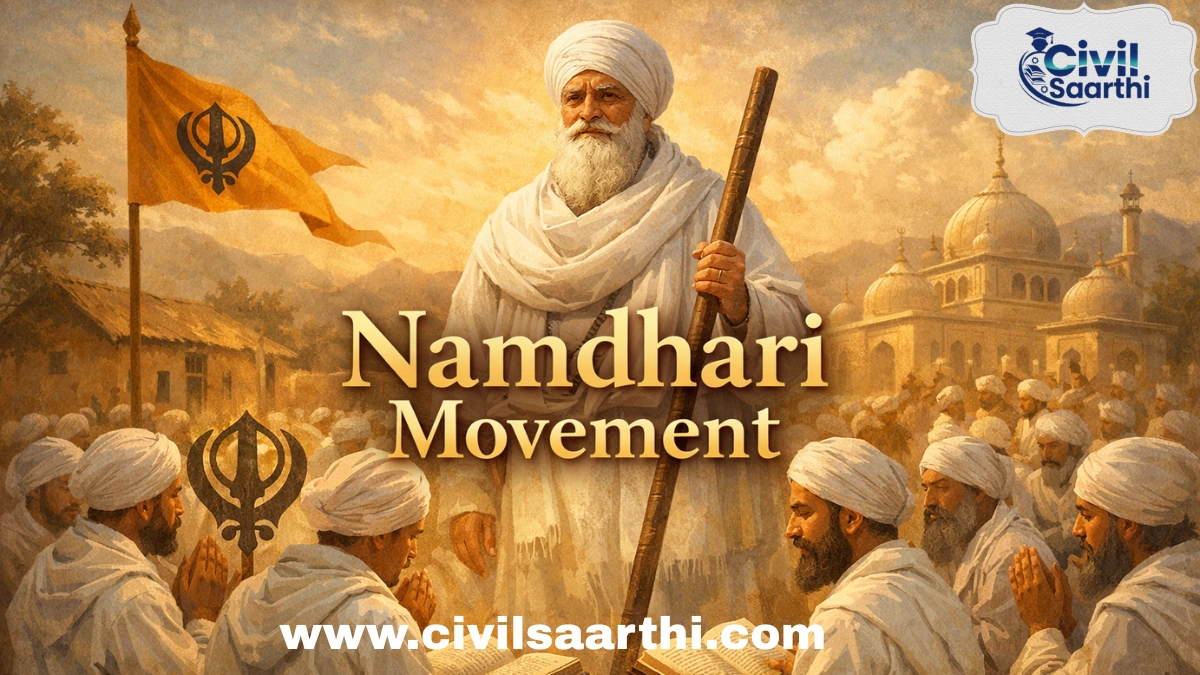
The Namdhari Movement, also known as the Kuka Movement, was a significant socio-religious reform in Punjab during the mid-19th century. It was founded by Baba Ram Singh (1816-1885) in 1857, after he became a disciple of Balak Singh of the Kuka Movement in 1841. The movement aimed to revive the true spirit of Sikhism, removing corrupt practices, idol worship, and immoral behaviors that had crept into society. Followers emphasized simplicity, piety, vegetarianism, and strict moral conduct. Apart from religious reforms, the movement played a notable role in early resistance against British rule, making it an important chapter in modern Indian history.
Namdhari Movement Backgroud
- After the fall of Maharaja Ranjit Singh’s kingdom, there were efforts to restore the Khalsa’s former glory.
- Baba Ram Singh, a former Khalsa soldier, founded the Namdhari Movement following the Anglo-Sikh wars.
- The movement emerged in the north-western regions of the former Sikh kingdom, away from royal centers of power.
- Its main goal was to promote Sikhism free from superstitions, excessive rituals, and corrupt practices.
- The Namdhari movement emphasized a simple, pious life combined with national pride inspired by the Sikh military tradition.
- Followers were called Kukas due to their unique high-pitched recitation of Gurbani, known as Kook in Punjabi.
Namdhari Movement Origin and Foundation
- The Namdhari sect was officially established on Baisakhi in 1857 in the village of Bheni.
- Baba Ram Singh set up 22 preaching centers across India, each supervised by a deputy called Suba.
- These Subas spread the teachings to regions such as Gwalior, Lucknow, Kabul, Hyderabad, and others.
- By the 1860s, the movement began to take on a political dimension, attracting not only Sikhs but also Hindus.
- The movement gained popularity across Punjab and Sindh, and its followers numbered in lakhs.
- Some supporters viewed Baba Ram Singh as the spiritual successor of Guru Nanak Dev, though he himself rejected these claims.
- A “Pothi” or text was created by followers claiming a prophecy about Baba Ram Singh, which he later denounced during his exile in Rangoon.
Namdhari Movement Key Features
- The Namdhari Movement was modeled on Guru Gobind Singh’s founding of the Khalsa, emphasizing ritual purity and moral discipline.
- Entry rituals included recitation of Gurbani, performing Ardas (prayer), raising a flag, and taking baptism.
- Followers wore the five symbols of Sikhism but carried a Lathi (stick) instead of a sword.
- Idol worship, reverence for saints, graves, trees, snakes, and authority of hereditary Sikh priests were rejected.
- Strict ethical conduct was enforced: no drinking, theft, adultery, lying, slander, or backbiting.
- Beef consumption was prohibited, and protection of cattle was a central principle.
- Women were treated equally: they could be baptized, widows could remarry, dowries were prohibited, and child marriage was forbidden.
- Martial qualities were emphasized for men, reflecting Guru Gobind Singh’s teachings.
The ultimate vision was to transform Sikh society into a morally upright, militant, and religious-political community.
Beliefs of the Namdhari Sect
- The Adi Granth was recognized as the only true holy scripture.
- Guru Gobind Singh was the sole Guru, and no other spiritual leader or hereditary custodian held authority.
- Anyone, irrespective of caste or religion, could become a Namdhari convert.
- Idols, temples, and ritual offerings were considered exploitative and unacceptable.
- Strict vegetarianism was observed, and water had to be sourced from natural sources like lakes, rain, or wells. Tap water was prohibited.
- Only white clothing was allowed; no other colors were permitted.
- There was no caste discrimination within the sect.
- Converts were restricted to reading Gobind Singh’s Grantha only.
Also Read: Advent of Europeans in India
Role of Namdharis in the Indian Freedom Movement
- Namdharis actively opposed cow slaughter, which led to clashes with British authorities.
- In 1871, Namdhari Sikhs attacked slaughterhouses in Amritsar and Ludhiana, resulting in the deaths of several Muslims involved in slaughtering.
- Key figures included Bhai Lehna Singh, Bhai Fateh Singh, Bhai Hakam Singh Patwari, and Bhai Beehla Singh, who were executed by hanging.
- On 17–18 January 1872, 66 Namdhari Sikhs were executed by cannon for murdering two British policemen and a soldier; memorials exist in Amritsar and Malerkotla.
- Baba Ram Singh and his aide Nanu Singh were exiled to Allahabad and later to Rangoon, Burma, where he continued to support anti-British efforts.
- Suba Bishan Singh attempted to gain international support from Czar Nicholas II of Russia and Maharaja Duleep Singh to oust the British, but global conflicts prevented assistance.
Conclusion
The Namdhari Movement was a remarkable socio-religious reform that promoted moral living, equality, and devotion. While Baba Ram Singh advocated tolerance and righteousness, some zealous followers committed acts of violence in response to cow slaughter, leading to British reprisals. Nevertheless, the movement left a lasting legacy by inspiring anti-British sentiment in Punjab and setting the stage for later Sikh socio-political movements like the Akali struggle in the early 20th century.