 by
by 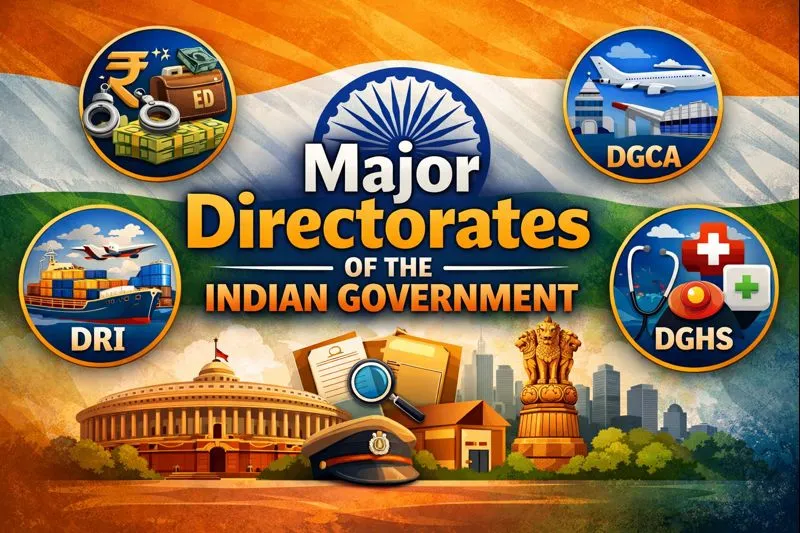
The major directorates of the Indian government are specialized administrative units under various ministries, created to enforce laws, regulate sectors, and implement policies efficiently. They include bodies like the Enforcement Directorate, Directorate of Revenue Intelligence, DGCA, DGHS, and DGFT. These directorates perform functions such as law enforcement, intelligence gathering, health administration, trade regulation, and skill development. Each directorate is headed by a senior officer, usually a Director or Director General, appointed by the Government of India, and reports to the respective ministry. All the major directorates of the Indian governement have been discussed below in brief.
1. Enforcement Directorate (ED)
- Ministry: Finance (Department of Revenue)
- Governing Acts: FEMA 1999, PMLA 2002
- Functions & Powers:
Investigates money laundering and foreign exchange violations.
Attaches and confiscates proceeds of crime under PMLA.
Conducts searches, surveys, and raids under statutory provisions.
Coordinates with CBI, DRI, SEBI, RBI, and international financial agencies.
Files prosecution complaints in special courts.
Monitors suspicious transactions and financial flows.
Advises government on policy amendments to strengthen enforcement.
- Head & Appointment: Director, appointed by GOI from IRS or enforcement cadre.
- Reporting: Revenue Secretary
2. Directorate of Revenue Intelligence (DRI)
- Ministry: Finance (Department of Revenue)
- Governing Acts: Customs Act 1962, Central Excise Act 1944, NDPS Act 1985
- Functions & Powers:
Investigates smuggling and economic offenses.
Prevents customs duty evasion.
Collects intelligence on illegal trade of contraband/narcotics.
Coordinates with coast guard, police, and INTERPOL.
Powers of search, seizure, arrest, and prosecution.
Advises on tariff policy and anti-smuggling legislation.
Conducts risk profiling and intelligence analysis on trade.
- Head & Appointment: Director General, appointed by GOI from IRS (Customs & Central Excise).
- Reporting: Revenue Secretary
3. Directorate General of Analytics and Data Management (DGADM)
- Ministry: Finance (Department of Revenue)
- Governing Act/Order: Department of Revenue Order
- Functions & Powers:
Integrates data from Income Tax, GST, and Customs.
Detects tax evasion and financial frauds using analytics.
Provides intelligence to ED, DRI, DGGI.
Develops predictive models for risk assessment.
Powers to access government databases for enforcement purposes.
Advises on policy formulation based on data insights.
Coordinates with NITI Aayog and NIC for digital governance projects.
- Head & Appointment: Director General, appointed by GOI.
- Reporting: Revenue Secretary
4. Directorate General of Civil Aviation (DGCA)
- Ministry: Civil Aviation
- Governing Act: Aircraft Act 1934
- Functions & Powers:
Regulates airworthiness, air safety, and licensing of pilots.
Conducts air accident investigation and recommends safety measures.
Enforces civil aviation rules and guidelines.
Powers to inspect airlines, suspend licenses, and enforce penalties.
Monitors training standards in aviation institutions.
Coordinates with international regulators (ICAO).
Advises Ministry on policy and regulatory reforms.
- Head & Appointment: Director General, appointed by GOI.
- Reporting: Civil Aviation Minister
5. Directorate General of Foreign Trade (DGFT)
- Ministry: Commerce & Industry
- Governing Act: Foreign Trade (Development and Regulation) Act, 1992
- Functions & Powers:
Implements foreign trade policy.
Issues import-export licenses and regulates trade procedures.
Promotes exports and controls restricted items.
Powers to inspect exporters/importers and enforce penalties.
Monitors compliance with international trade agreements.
Advises government on export promotion and trade strategy.
Coordinates with customs and commerce ministries for trade intelligence.
- Head & Appointment: Director General, appointed by GOI.
- Reporting: Commerce Secretary
6. Directorate General of Health Services (DGHS)
- Ministry: Health and Family Welfare
- Governing Rules: DGHS Rules & Ministry notifications
- Functions & Powers:
Implements national health programs (immunization, disease control).
Supervises public health infrastructure, hospitals, and manpower planning.
Powers to issue guidelines and directives to medical institutions.
Coordinates with WHO, UN, and other international agencies.
Advises government on health policy and emergency preparedness.
Conducts health research and epidemiological studies.
Oversees medical education and training.
- Head & Appointment: Director General, appointed by GOI.
- Reporting: Health Secretary
7. Directorate General of Armed Forces Medical Services (DGAFMS)
- Ministry: Defence
- Governing Act: Defence Services Medical Regulations & executive orders
- Functions & Powers:
Manages medical services for armed forces personnel.
Oversees military hospitals and medical research facilities.
Advises Defence Ministry on health policy for armed forces.
Powers to implement medical training and standards for armed forces.
Coordinates with DGHS for joint medical programs.
Maintains medical records and epidemiological data for armed forces.
Supervises field medical services during operations.
- Head & Appointment: Director General, appointed by Defence Ministry.
- Reporting: Defence Secretary
8. Directorate General of Income Tax (Investigation)
- Ministry: Finance (Department of Revenue)
- Governing Act: Income Tax Act 1961
Functions & Powers:
Investigates tax evasion and high-value cases.
Powers to search, survey, and seize under IT Act.
Coordinates with ED, DRI, and DGGI for economic intelligence.
Advises CBDT on policy changes to prevent tax evasion.
Maintains intelligence on high net-worth taxpayers and corporates.
Files prosecution in ITAT or other special courts.
Conducts risk analysis and compliance monitoring.
- Head & Appointment: Director General of Income Tax, appointed by CBDT.
- Reporting: Revenue Secretary
9. Directorate General of GST Intelligence (DGGI)
- Ministry: Finance (Department of Revenue)
- Governing Acts: CGST Act, SGST Acts, IGST Act
- Functions & Powers:
Investigates GST frauds, fake invoicing, and evasion.
Conducts audits, inspections, and surveys.
Powers to summon, search, and seize under GST law.
Coordinates with state tax authorities and central agencies.
Advises government on policy reforms in GST.
Develops risk management and data analytics models.
Participates in international tax intelligence networks.
- Head & Appointment: Director General, appointed by GOI.
- Reporting: Revenue Secretary
10. Research & Analysis Wing (R&AW – Analysis Directorate)
- Ministry: PMO
- Governing Act/Order: Executive order under PMO
- Functions & Powers:
Gathers intelligence on foreign threats and strategic developments.
Conducts data analysis and interpretation for security policy.
Coordinates with IB, DRI, ED, and international intelligence agencies.
Advises government on national security and foreign policy decisions.
Powers include accessing intelligence databases and monitoring foreign communications.
Prepares analytical reports for PM and National Security Council.
Conducts covert operations in coordination with field officers.
Head & Appointment: Secretary (R&AW), appointed by ACC.
Reporting: Prime Minister
11. Directorate General of Civil Supplies
Ministry: Consumer Affairs, Food & Public Distribution
Governing Act: Essential Commodities Act 1955
Functions & Powers:
Monitors foodgrain distribution and public distribution system (PDS).
Powers to inspect warehouses and seize hoarded commodities.
Advises government on food security policy.
Coordinates with state civil supplies departments.
Implements price stabilization schemes.
Conducts audits and surveys to prevent black marketing.
Maintains data for planning allocation of essential commodities.
- Head & Appointment: Director General, appointed by GOI.
- Reporting: Secretary, Consumer Affairs
12. Directorate General of Training (DGT)
- Ministry: Skill Development & Entrepreneurship
- Governing Act: Industrial Training Institutes Act & Ministry Orders
- Functions & Powers:
Implements vocational training and skill development programs.
Monitors Industrial Training Institutes (ITIs) across the country.
Powers to inspect ITIs and enforce training standards.
Advises government on policy for skill development.
Develops curriculum and certification standards.
Coordinates with state skill development departments.
Conducts evaluation and assessment of training programs.
- Head & Appointment: Director General, appointed by GOI.
- Reporting: Secretary, Skill Development
13. Directorate General of Hydrocarbons (DGH)
- Ministry: Petroleum & Natural Gas
- Governing Acts: Oilfields (Regulation & Development) Act, 1948; Hydrocarbon Exploration Rules
- Functions & Powers:
Monitors exploration and production of oil and natural gas.
Ensures technical and financial compliance by operators.
Powers to inspect contracts, fields, and operations.
Advises government on policy and investment in hydrocarbons.
Maintains exploration data and production statistics.
Coordinates with state governments and international partners.
Conducts research and analysis for energy planning.
- Head & Appointment: Director General, appointed by GOI.
- Reporting: Secretary, Petroleum
14. Directorate General of Indian Standards (BIS – Certification Wing)
- Ministry: Consumer Affairs
- Governing Act: BIS Act, 2016
- Functions & Powers:
Standardization of products and quality certification.
Conducts inspections and certification audits.
Powers to enforce penalties for non-compliance.
Advises government on product standards and consumer protection.
Coordinates with international standardization bodies.
Develops technical specifications for industry.
Conducts training and awareness programs on quality standards.
- Head & Appointment: Director General, appointed by GOI.
- Reporting: Secretary, Consumer Affairs
15. Directorate General of Mines Safety (DGMS)
- Ministry: Ministry of Labour and Employment
- Governing Act: Mines Act, 1952
- Functions & Powers:
Ensures safety standards in mining operations.
Conducts inspections of mines and enforces compliance.
Investigates mining accidents and recommends safety measures.
Powers to issue notices, suspend operations, and prosecute violations.
Advises government on mining safety regulations.
Develops training and capacity-building programs for mine workers.
Coordinates with state governments for implementation of mining safety rules.
- Head & Appointment: Director General, appointed by GOI.
- Reporting: Secretary, Labour & Employment
Major Directorates of the Indian Government FAQs
1. What are directorates in the Indian government?
Directorates are specialized administrative units under various ministries, created to implement policies, enforce laws, and regulate specific sectors. They are headed by Directors or Director Generals and report to their respective ministries.
2. Name some major directorates of India.
Some important directorates include the Enforcement Directorate (ED), Directorate of Revenue Intelligence (DRI), Directorate General of Civil Aviation (DGCA), Directorate General of Health Services (DGHS), Directorate General of Foreign Trade (DGFT), and Directorate General of GST Intelligence (DGGI).
3. What are the main functions of government directorates?
Their functions vary by sector but generally include law enforcement, regulatory oversight, intelligence collection, policy implementation, data analysis, trade regulation, and public service management.
4. How are the heads of directorates appointed?
Heads of directorates, usually Director or Director General, are appointed by the Government of India, often from specialized cadres like IRS, IPS, or technical experts, depending on the directorate’s function.
5. Which ministry do directorates report to?
Each directorate reports to its respective ministry or department. For example, ED, DRI, and DGGI report to the Department of Revenue, Ministry of Finance, while DGCA reports to the Ministry of Civil Aviation, and DGHS to the Ministry of Health and Family Welfare.
6. Are all directorates statutory bodies?
No. Some directorates are statutory, created under specific acts (like DGGI under GST Acts, DGFT under FTDR Act), while others are executive or administrative units formed by government orders for policy implementation and enforcement.
7. Can directorates conduct investigations and inspections?
Yes. Many directorates like ED, DRI, DGGI, and DGIT have powers to inspect premises, conduct raids, seize evidence, and investigate violations under the governing laws and acts.
8. What role do directorates play in governance?
Directorates ensure efficient policy implementation, regulatory compliance, enforcement of laws, intelligence gathering, and public welfare management, making them a vital part of India’s administrative framework.