 by
by 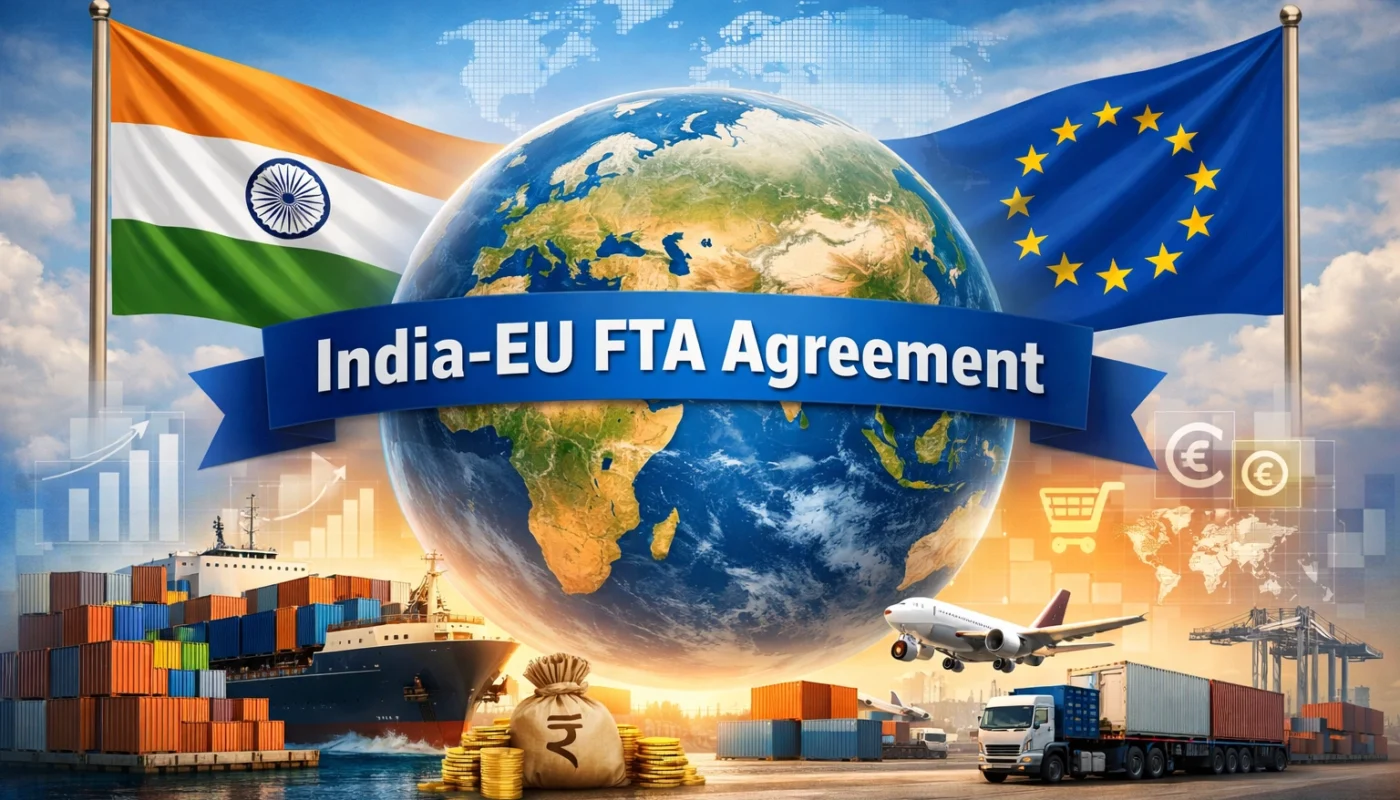
The India-European Union Free Trade Agreement (FTA) is one of the biggest and most important trade deals India has ever signed. It is often called the “mother of all deals” because of its scale and impact. This agreement brings India and the European Union (EU) closer together in trade, investment, and economic cooperation. After nearly 20 years of discussions and negotiations, India and the EU have finally concluded this historic agreement.
What Is the India-EU Free Trade Agreement?
The India-EU FTA is a trade agreement between India and the European Union, which is a group of 27 European countries working together as a single economic and political unit. The EU is one of the largest economic groups in the world, with about 450 million people and contributing around 25% of the world’s economy.
Also Read: Economic Survey 2026
Latest Data and Economic Impact
The India-EU FTA will benefit many sectors of the economy. Here are some important points:
Trade Volume
- India and the EU currently trade goods worth about $136 billion every year.
- India exports around $76 billion worth of goods, including textiles, spices, engineering products, and leather.
- India imports around $61 billion, including machinery, automobiles, chemicals, and other industrial goods.
Tariff Reductions
- The EU will remove taxes on almost all Indian exports over time.
- India will also reduce taxes on most EU products, including cars and machinery.
- This will make goods cheaper for consumers and increase trade for businesses.
Sector Benefits
- Indian exporters of textiles, leather, gems, jewellery, and spices will get easier access to the EU market.
- EU companies will be able to sell automobiles, electronics, and industrial tools in India at lower prices.
- Both sides will benefit from better cooperation in digital services, technology, and standards.
Projected Growth
Trade between India and the EU is expected to grow from $136 billion to $200 billion by 2030 as more products and services get easier access.
Key Highlights of the India-EU Free Trade Agreement
The India-EU FTA, also called the “mother of all deals,” includes many important features that benefit both India and the European Union. Here are the key highlights:
1. Tariff Reduction on Goods
- The EU will eliminate tariffs on almost all Indian exports over time, covering over 99% of trade value.
- India will reduce tariffs on most EU products, including automobiles, machinery, chemicals, and industrial equipment.
- Example: EU cars will enter India at a much lower duty, dropping from 110% to 10% under annual quotas.
2. Increased Market Access for Indian Exports
- Key Indian export sectors like textiles, leather, spices, gems, jewellery, and engineering goods will get easier access to EU markets.
- This is expected to increase India’s exports to the EU by 20-25% over the next few years.
3. Services and Digital Trade Cooperation
- Indian IT and software services will find better access to the European market.
- The deal also promotes digital trade, e-commerce, and professional services.
- Around $83 billion of India’s services trade with the EU stands to benefit.
4. Investment Opportunities
- EU companies will find it easier to invest in India, especially in sectors like automobile manufacturing, renewable energy, pharmaceuticals, and technology.
- India is expected to attract billions of dollars in foreign investment as a result of this FTA.
5. Protection for Sensitive Products
- Some sensitive agricultural and food products are protected.
- India will maintain tariffs on dairy, rice, certain meats, and some cereals to protect domestic farmers.
6. Regulatory Cooperation
- Both India and the EU will work together to simplify trade rules, reduce red tape, and align standards.
- This includes cooperation in environmental standards, product quality, and safety regulations, making trade smoother.
7. Long-Term Economic Impact
- Bilateral trade, currently around $136 billion, could grow to $200 billion by 2030.
- The deal is expected to boost India’s GDP, create jobs, and make Indian products more competitive globally.
8. Strategic Partnership Beyond Trade
- The FTA strengthens India-EU relations in areas like technology transfer, renewable energy, and innovation.
- Both sides plan to cooperate on sustainability, climate change, and skill development, creating long-term benefits beyond just trade.
Also Read: Union Budget 2026-27
About the European Union (EU)
The European Union (EU) is a group of 27 European countries that work together economically and politically. It is one of the largest markets in the world and plays a major role in global trade and standards.
- Member Countries: Includes 27 nations such as Germany, France, Italy, Spain, and the Netherlands.
- Population: Around 450 million people, making it one of the largest consumer markets globally.
- Economic Size: Contributes about 25% of the world’s GDP and one-third of global trade.
- Single Market: Allows free movement of goods, services, capital, and people among member countries.
- Customs Union: Member countries follow common trade rules and tariffs with non-EU countries.
- Euro Currency: 19 of the 27 countries use the Euro, simplifying trade and finance in the region.
- Global Trade Influence: Sets international standards for manufacturing, environment, and digital trade.
- Strategic Partner for India: The EU is a major importer of Indian goods like textiles, spices, and engineering products, and a source of advanced technology and investment.
India’s Other Successful Free Trade Agreements
India has signed several successful Free Trade Agreements (FTAs) with countries around the world, helping Indian businesses grow, increasing exports, and strengthening international economic ties. These agreements cover goods, services, and investment, making trade easier and more profitable.
India-UAE CEPA (2022)
- Full form: Comprehensive Economic Partnership Agreement.
- Goal: Increase trade between India and UAE to $100 billion by 2030.
- Key exports: Gems, jewellery, engineering goods, pharmaceuticals, textiles.
- Benefits: Reduced tariffs, better market access, and investment opportunities in UAE.
India-Mauritius CECPA (2021)
- Full form: Comprehensive Economic Cooperation and Partnership Agreement.
- Covers: Preferential access for over 600 Indian products.
- Benefits: Promotes exports, services, and investments between India and Mauritius.
- Significance: Strengthens India’s economic presence in Africa.
India-EFTA Trade Agreement (2024)
- Partner countries: Iceland, Norway, Switzerland, and Liechtenstein.
- Focus: Reduces tariffs on most products and increases trade in goods and services.
- Benefits: Encourages investments and strengthens economic ties with Europe.
India-UK CECA (2025)
- Full form: Comprehensive Economic and Trade Agreement.
- Benefits: Reduces tariffs, improves market access for goods and services.
- Significance: Boosts bilateral trade and cooperation in services, technology, and investment.
India-Oman CEPA (2025)
- Coverage: Nearly zero tariffs for 98% of Indian exports to Oman.
- Benefits: Easier trade for Indian businesses, especially in engineering goods, textiles, and food products.
- Significance: Strengthens India’s trade in the Gulf region.
India-New Zealand FTA (2025)
- Goal: Increase bilateral trade and strengthen economic ties.
- Benefits: Reduces tariffs, improves access for goods and services.
- Significance: Supports growth in dairy, agriculture, and technology sectors
India-EU FTA Agreement FAQs
What is the India-EU FTA?
The India-EU FTA is a trade agreement between India and the European Union that reduces tariffs on goods and services, making trade easier and more profitable.Why is it called the “mother of all deals”?
Because it is one of the largest and most comprehensive trade agreements India has ever signed, covering goods, services, and investment with a huge market of 450 million people.Which countries are part of the European Union?
The EU includes 27 countries such as Germany, France, Italy, Spain, and the Netherlands, all working together economically and politically.What products will benefit most from the FTA?
Indian exports like textiles, leather, gems, jewellery, spices, and engineering goods will benefit, while EU products like cars, machinery, and chemicals will enter India at lower tariffs.Will the FTA affect India’s farmers?
India protects sensitive agricultural products such as dairy, rice, and certain meats, so farmers’ interests remain safeguarded.How will the FTA benefit India’s services sector?
Indian IT, software, and professional services will have better access to European markets, increasing exports in services worth about $83 billion.What impact will the FTA have on trade volume?
Current India-EU trade is about $136 billion, and it is expected to grow to $200 billion by 2030 as market access expands.Will the FTA attract foreign investment?
Yes, EU companies will find it easier to invest in India, especially in sectors like automobiles, pharmaceuticals, renewable energy, and technology.Are there rules on quality and safety?
Yes, India and the EU will cooperate to align standards for products, environment, and safety, making trade smoother and reliable.How does this FTA compare to India’s other trade agreements?
It is the largest and most comprehensive deal, surpassing agreements with countries like UAE, UK, Mauritius, Oman, and New Zealand in scale and potential impact.