 by
by 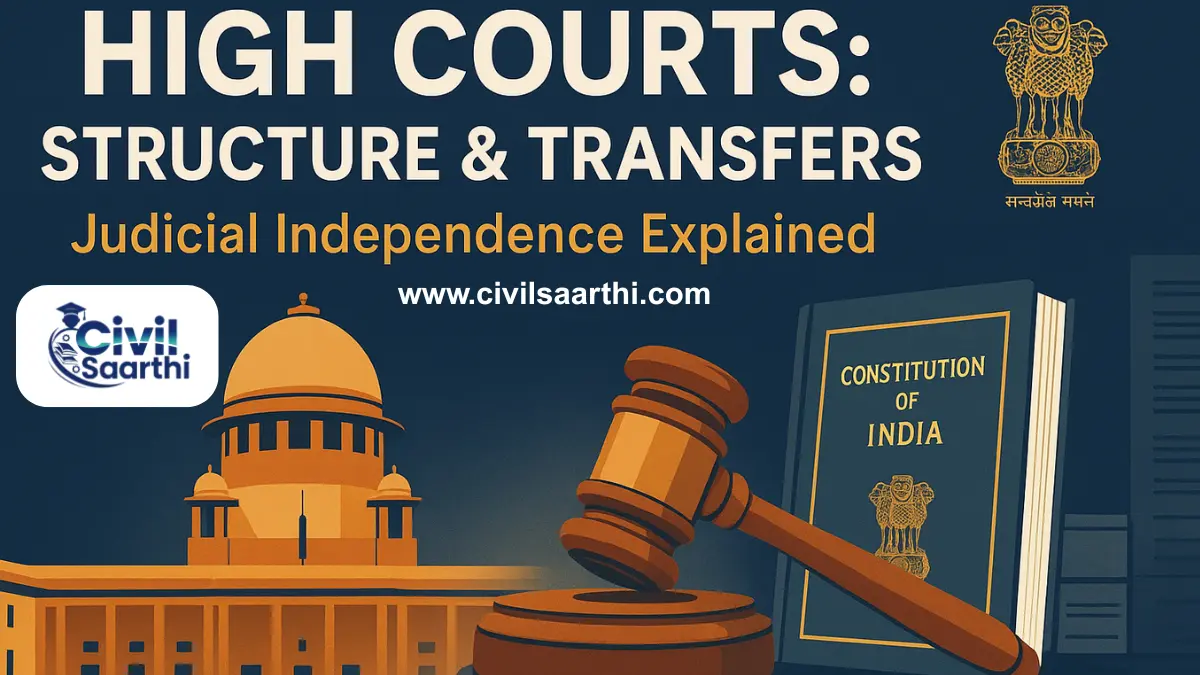
High Courts in India play a crucial role in upholding the Constitution, ensuring justice, and maintaining the federal balance. They act as constitutional courts for the states and have powers of judicial review. For UPSC aspirants, understanding the structure, transfer mechanism, judicial interpretation, and constitutional debates around High Courts is important for both the Prelims and Mains.
High Courts
The High Courts in India stand as constitutional courts with the authority to uphold the law, ensure justice, and protect the rights of citizens. Their independence and impartiality are essential to the rule of law. High Courts have jurisdiction over civil, criminal, constitutional, and administrative matters within their respective states.
High Courts Overview
The High Courts are empowered by the Constitution and hold authority over the judiciary of their respective states. Each High Court can exercise original, appellate, and writ jurisdiction. The power of judicial review allows High Courts to strike down unconstitutional laws and executive actions.
| High Courts Overview | |
| Feature | Details |
| Constitutional Status | Article 214 – 231 |
| Total High Courts (2024) | 25 |
| First High Court | Calcutta High Court (1862) |
| Common High Courts | Punjab & Haryana, Mumbai, Guwahati |
| Jurisdiction | Civil, Criminal, Writ, Appellate |
Judicial Transfers Latest News – High Courts
Judicial transfers involving High Courts have been a matter of frequent debate. In 2024–25, several judges were transferred from one High Court to another, triggering discussions on transparency and judicial independence. The transfer of Chief Justices from one High Court to another continues to draw attention from legal experts, political analysts, and civil society.
Transfer of High Court Judges: Constitutional Framework and Judicial Interpretation – High Courts
The Constitution provides a framework for the functioning and transfer of High Court judges. Articles 222 and 217 are especially significant. While Article 222 allows the President to transfer a judge from one High Court to another after consultation with the Chief Justice of India, Article 217 deals with the appointment and conditions of service.
Transfer of High Court Judges | |
| Article | Provision |
| Article 214 | Establishment of High Courts |
| Article 217 | Appointment and tenure of High Court judges |
| Article 222 | Transfer of judges from one High Court to another |
| Article 226 | Writ jurisdiction of High Courts |
Judicial Evolution of Transfer Process – High Courts
The concept of judicial transfers in High Courts was not extensively practiced until post-Emergency reforms. The First Judges Case (1981) gave primacy to the executive, but the Second (1993) and Third (1998) Judges Cases altered the balance, giving the judiciary the final say through the collegium system. The system developed to protect independence but has also raised concerns regarding opacity.
| Judicial Evolution of Transfer Process | |
| Judges Case | Outcome |
| First Judges Case (1981) | Executive primacy in appointments |
| Second Judges Case (1993) | Collegium system established |
| Third Judges Case (1998) | Defined collegium composition clearly |
Process of Transfer – High Courts
The transfer of judges in High Courts is managed through the collegium system. The Chief Justice of India, along with senior judges, recommends transfers which are then approved by the President. Judicial transfers are carried out either for administrative convenience or in the interest of justice and impartiality. No judge can refuse a transfer order, although they can seek reconsideration.
| Process of Transfer – High Courts | |
| Step | Description |
| Initiation | By CJI and collegium |
| Consultation | With Chief Justice of the concerned High Court |
| Approval | By President of India |
| Notification | Published by the Department of Justice |
Key Considerations in Judicial Transfers – High Courts
Several criteria are considered before transferring a judge from one High Court to another. These include judicial competence, public interest, seniority, and administrative reasons. However, these are not publicly disclosed, which raises transparency concerns.
| Key Considerations in Judicial Transfers | |
| Criterion | Explanation |
| Public Interest | Fair trial, impartiality, rotation |
| Administrative Reasons | Case backlog, balancing workload |
| Seniority & Experience | Placement based on merit |
| Collegium Advice | Final say on suitability |
Criticisms of Judicial Transfers in India – High Courts
Critics argue that transfers of High Court judges are often done without giving clear reasons, impacting judicial morale. Sometimes, it is seen as a form of punishment or a tool for influencing judicial conduct. The lack of transparency in the collegium process has also been widely criticized.
Striking Down of the NJAC: Reasons and Judicial Verdict – High Courts
The National Judicial Appointments Commission (NJAC) was introduced via the 99th Constitutional Amendment to replace the collegium system with a more transparent body. However, the Supreme Court struck it down in 2015, citing concerns over judicial independence.
| Striking Down of the NJAC | |
| Feature | NJAC Provision |
| Introduced by | 99th Amendment |
| Composition | CJI + 2 SC Judges + Law Minister + 2 Eminent Persons |
| Purpose | Transparent appointment and transfer |
| Verdict | Struck down as unconstitutional in 2015 |
Composition of the NJAC – High Courts for UPSC
The NJAC was designed to have judicial and non-judicial members, but the Supreme Court ruled this diluted judicial independence. Eminent persons were to be selected by a committee including the PM, CJI, and Leader of Opposition, raising questions about political influence.
Political and Legal Challenges – High Courts
The challenge against NJAC was based on fears of executive overreach into the judiciary. Legal experts warned that it could undermine the autonomy of High Courts and the Supreme Court. The verdict emphasized the doctrine of separation of powers as a part of the basic structure.
Supreme Court Verdict (2015) – High Courts for UPSC
In Supreme Court Advocates-on-Record Association vs Union of India (2015), the apex court invalidated the NJAC Act and restored the collegium system, citing that independence of judiciary is a basic feature of the Constitution which cannot be diluted.
Judicial Transfers FAQs – High Courts for UPSC
Which Article deals with the transfer of High Court judges?
Article 222 of the Constitution governs the transfer of judges from one High Court to another.
What is the role of the President in transferring judges of High Courts?
The President acts on the advice of the CJI and the collegium to issue transfer notifications.
Why was the NJAC struck down by the Supreme Court?
NJAC was struck down in 2015 as it compromised the independence of the judiciary.
What is the criticism of the collegium system for High Court transfers?
The collegium system lacks transparency and is seen as opaque with no recorded reasons.
Can a judge refuse a transfer from one High Court to another?
No, once the President approves the transfer, a judge must comply.
How many High Courts are there currently in India?
There are 25 High Courts as of 2024.
Which High Court was established first in India?
The Calcutta High Court was the first, established in 1862.