
 by
by 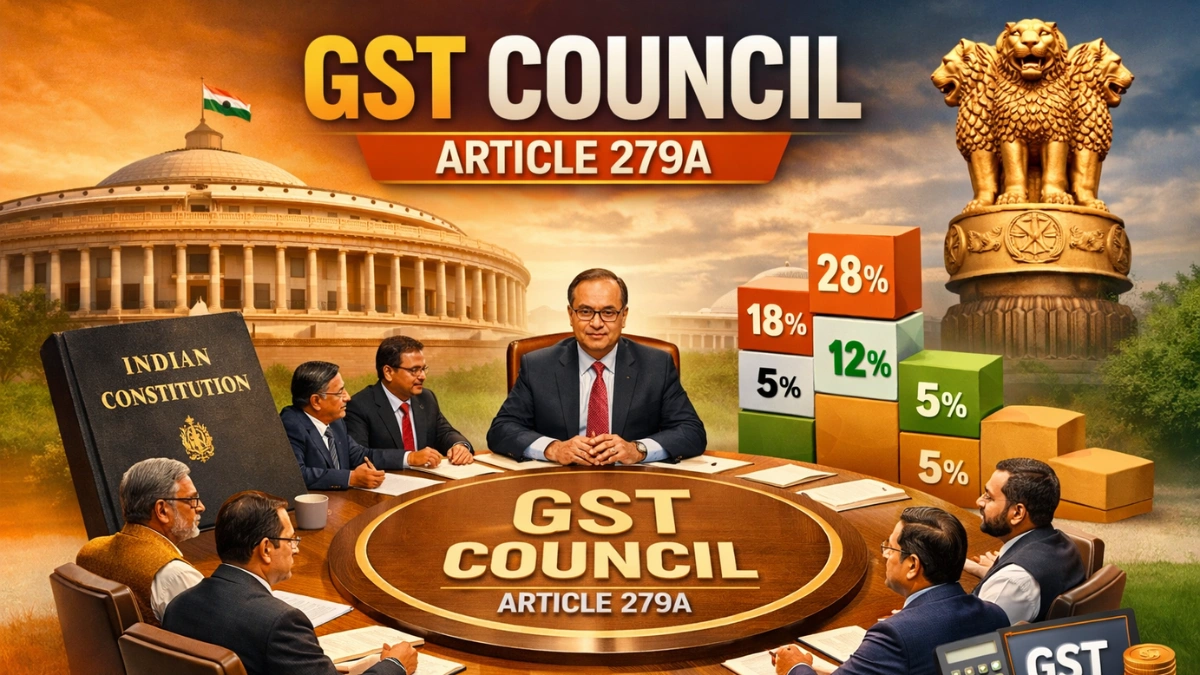
The GST Council is a constitutional body that plays a critical role in managing the Goods and Services Tax (GST) regime in India. Established to ensure uniformity and cooperation between the Centre and States, the GST Council determines tax rates, exemptions, and operational procedures under GST. It is a unique example of cooperative federalism in India’s economic structure.
GST Council
The GST Council was established under Article 279A of the Constitution through the 101st Constitutional Amendment Act, 2016. It acts as the apex decision-making body on all matters related to GST. The primary objective of the GST Council is to maintain a harmonious structure for GST implementation across the country while preserving the fiscal autonomy of both the Centre and the States.
GST Council with Constitutional Provisions Table Overview
The GST Council represents both the Centre and States and aims to resolve disputes and frame a consistent tax structure for the nation. The Constitution mandates its establishment, composition, and powers.
| Overview of GST Council with Constitutional Provisions Table | |
| Aspect | Detail |
| Article | 279A |
| Introduced By | 101st Constitutional Amendment Act, 2016 |
| Type | Constitutional body |
| Aim | Uniform implementation of GST across India |
| Secretariat | Located in New Delhi |
Composition and Voting Mechanism of GST Council
The composition of the GST Council includes representation from both Union and State governments. The decision-making in the GST Council is designed to reflect a federal balance with a weighted voting mechanism.
| Composition and Voting Mechanism of GST Council | |
| Member | Role |
| Union Finance Minister | Chairperson |
| Union Minister of State (Finance) | Member |
| State Finance/Taxation Ministers | One from each state |
| Voting Weightage | Centre: 1/3; States (collectively): 2/3 |
| Decision Threshold | 75% of total weighted votes required |
GST Council Powers and function
The GST Council has broad and exclusive powers in shaping the GST regime in India. It is empowered to make recommendations and decisions on all aspects of GST.
- Determining GST rates (standard, lower, and higher rates)
- Deciding threshold limits for GST registration
- Identifying exempted goods and services
- Reviewing compensation to states for revenue loss
- Establishing dispute resolution mechanisms between Centre and States
GST Council Taken by Important Decisions
Since its inception, the GST Council has met regularly and taken crucial decisions related to rate changes, simplification, compliance burden, and tax rationalization. These decisions reflect its active role in governance.
Important Decisions Taken by GST Council | |
| Council Meeting (Year) | Major Decision Taken |
| 1st (2016) | Approved rules for GST implementation |
| 22nd (2017) | Simplified return filing for small taxpayers |
| 31st (2018) | Reduced tax rates on 23 goods and services |
| 44th (2021) | Tax exemption on COVID essentials |
| 50th (2023) | GST on online gaming, horse racing, and casinos clarified |
GST Council and Fiscal Federalism
The GST Council embodies the spirit of fiscal federalism by enabling both the Union and State governments to participate in tax policy formation. It fosters dialogue and consensus, which are vital in a large and diverse federation like India.
| GST Council and Fiscal Federalism | |
| Federal Feature | Explanation |
| Joint Decision-Making | Centre and states decide tax policies together |
| Dispute Resolution Mechanism | Forum to resolve Centre-State conflicts over GST issues |
| Compensation to States | Centre compensates states for revenue loss after GST |
Challenges Faced by GST Council
Despite its federal and consultative framework, the GST Council faces operational, political, and administrative challenges. These hurdles affect its efficiency and decision-making.
| Challenges Faced by GST Council | |
| Challenge | Explanation |
| Revenue Concerns of States | Fear of revenue loss and delayed compensation |
| Delays in Decision Implementation | States differ in preparedness, slowing down reforms |
| Complex Rate Structure | Multiple slabs make compliance and enforcement difficult |
| Centre-State Political Tensions | Differences in political priorities impact GST discussions |
Reforms Suggested for GST Council
To improve the working of the GST Council, several experts and committees have suggested reforms focusing on simplification, transparency, and technology adoption.
| Reforms Suggested for GST Council | |
| Reform Area | Suggestion |
| Rate Rationalization | Move towards fewer tax slabs |
| Timely Compensation | Ensure predictable and timely compensation to states |
| Digital Infrastructure | Simplify GST compliance using AI and automation |
| Independent Secretariat | Make GST Council Secretariat functionally autonomous |
| Fiscal Independence | Allow flexibility to states in rate adjustments in emergencies |
FAQs on GST Council
What is the GST Council?
The GST Council is a constitutional body established under Article 279A to govern Goods and Services Tax in India.
Who chairs the GST Council?
The Union Finance Minister serves as the Chairperson of the GST Council.
What is the voting pattern in GST Council?
Decisions in the GST Council require 75% weighted majority — Centre has 1/3 weight and states collectively hold 2/3.
Is the GST Council binding on states?
While the recommendations are advisory in nature, they are usually followed to maintain uniformity.
How often does the GST Council meet?
The GST Council meets regularly; there have been 50+ meetings since its inception in 2016.
What are the functions of GST Council?
The GST Council decides tax rates, exemptions, procedural rules, and dispute resolution in GST matters.
What are the major challenges of the GST Council?
Key issues include compensation delays, complex tax structure, and Centre-State disagreements.