 by
by 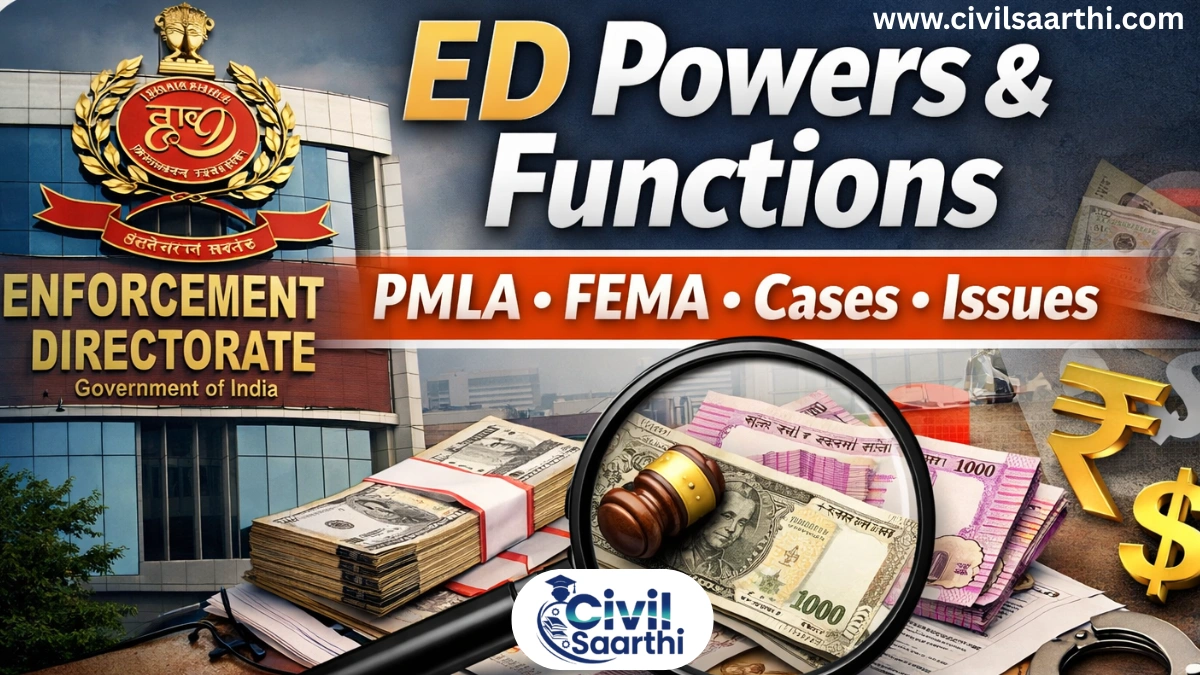
Enforcement Directorate(ED)
The Enforcement Directorate was initially formed in 1956 as an “Enforcement Unit” to deal with violations under the Foreign Exchange Regulation Act (FERA), 1947. It later evolved into a full-fledged agency empowered to investigate and prosecute offenses under the PMLA and FEMA. The Enforcement Directorate today is India’s principal authority for probing economic offenses and acts as a deterrent against black money, benami transactions, and cross-border financial crimes.
Enforcement Directorate (ED) with Basic Details Overview
The Enforcement Directorate operates across India and also coordinates with global financial intelligence and anti-money laundering bodies. Below is a summary table:
Overview of Enforcement Directorate with Basic Details | |
| Feature | Details |
| Full Name | Enforcement Directorate |
| Established | 1956 (as Enforcement Unit) |
| Current Legal Basis | PMLA 2002, FEMA 1999 |
| Parent Ministry | Ministry of Finance (Department of Revenue) |
| Headquarters | New Delhi |
| Jurisdiction | Pan-India |
| Reporting Authority | Department of Revenue, Ministry of Finance |
Enforcement Directorate (ED) Legal Framework
The powers and responsibilities of the Enforcement Directorate stem from two major legislations:
Legal Framework of Enforcement Directorate | ||
| Act Name | Objective | Role of ED |
| PMLA (Prevention of Money Laundering Act), 2002 | Combat laundering of proceeds of crime | Investigate, attach, confiscate property, prosecute offenders |
| FEMA (Foreign Exchange Management Act), 1999 | Regulate foreign exchange transactions | Adjudicate and compound contraventions |
Enforcement Directorate(ED) Organizational Structures
The Enforcement Directorate is headed by a Director, supported by Special Directors, Joint Directors, Deputy Directors, and Assistant Directors. It functions through zonal and sub-zonal offices across major Indian cities.
Organizational Structure of Enforcement Directorate | |
| Designation | Appointing Authority |
| Director of ED | Appointed by Central Government (ACC) |
| Other Officers | Selected from IRS, IPS, and other central services |
Enforcement Directorate powers and functions
The Enforcement Directorate performs a wide range of duties to prevent and prosecute economic crimes. Its primary role is to investigate offenses under PMLA and FEMA.
Functions and Powers of Enforcement Directorate | |
| Function | Description |
| Investigation under PMLA | Identifying proceeds of crime, money trails, shell companies |
| Attachment and Confiscation | Freezing assets derived from money laundering |
| Adjudication under FEMA | Penalizing violations in foreign exchange transactions |
| Coordination with Financial Intelligence | Collaborates with FIU-IND, CBI, INTERPOL, and FATF |
| Filing Prosecution Complaints | Files chargesheets and assists in court proceedings |
Notable Cases Handled by Enforcement Directorate
The Enforcement Directorate has investigated several high-profile cases, including political corruption, corporate fraud, and cross-border financial offenses.
Notable Cases Handled by Enforcement Directorate | ||
| Case Name | Nature of Offense | ED Action Taken |
| Vijay Mallya Case | Bank fraud & money laundering | Assets attached, extradition sought |
| PNB Scam (Nirav Modi) | Bank fraud, FEMA violations | Property confiscated, Interpol Red Corner Notice issued |
| AgustaWestland Scam | Defense bribery & laundering | Prosecution under PMLA |
| 2G Spectrum Case | Telecom scam | FEMA & PMLA violations investigated |
Enforcement Directorate(ED) Challenges
Despite its broad mandate, the Enforcement Directorate faces criticism and operational challenges.
Challenges Faced by Enforcement Directorate | |
| Challenge | Description |
| Allegations of Political Misuse | Accused of targeting opposition leaders selectively |
| Pendency of Cases | Huge backlog due to slow judicial process |
| Limited Manpower | Inadequate staff to handle increasing financial crime |
| Dependence on Other Agencies | Needs coordination with CBI, Income Tax Dept., and Police |
| Global Cooperation Constraints | Complexities in extradition and mutual legal assistance |
Reforms and Way Forward for Enforcement Directorate
To make the Enforcement Directorate more transparent, accountable, and effective, the following reforms are recommended:
| Reforms and Way Forward for Enforcement Directorate | |
| Reform Proposal | Expected Impact |
| Strengthen Autonomy & Safeguards | Reduce perception of political misuse |
| Increase Transparency in Proceedings | Regular publication of reports and prosecution outcomes |
| Enhance Capacity & Training | Specialize staff in cyber-financial frauds |
| Global Coordination Mechanisms | Sign more treaties for financial intelligence sharing |
| Judicial Monitoring | Court-monitored investigations for sensitive cases |
Enforcement Directorate (ED) FAQs
What is the Enforcement Directorate?
The Enforcement Directorate is a law enforcement agency under the Ministry of Finance that investigates financial crimes under PMLA and FEMA.
Under which ministry does the Enforcement Directorate work?
The Enforcement Directorate functions under the Department of Revenue, Ministry of Finance.
Does the Enforcement Directorate have arrest powers?
Yes, under PMLA, the Enforcement Directorate can arrest, search, seize, and prosecute individuals involved in money laundering.
Is the Enforcement Directorate a constitutional body?
No, the Enforcement Directorate is neither a constitutional nor statutory body; it operates under executive powers via PMLA and FEMA.
What is the role of Enforcement Directorate under FEMA?
Under FEMA, the Enforcement Directorate handles civil violations such as unauthorized forex dealings and foreign investments.
How is the Director of Enforcement Directorate appointed?
The Director is appointed by the central government based on the recommendations of a committee including the CVC and Home Secretary.
What are the criticisms of the Enforcement Directorate?
The Enforcement Directorate is often criticized for selective targeting, lack of transparency, and poor conviction rates.