 by
by 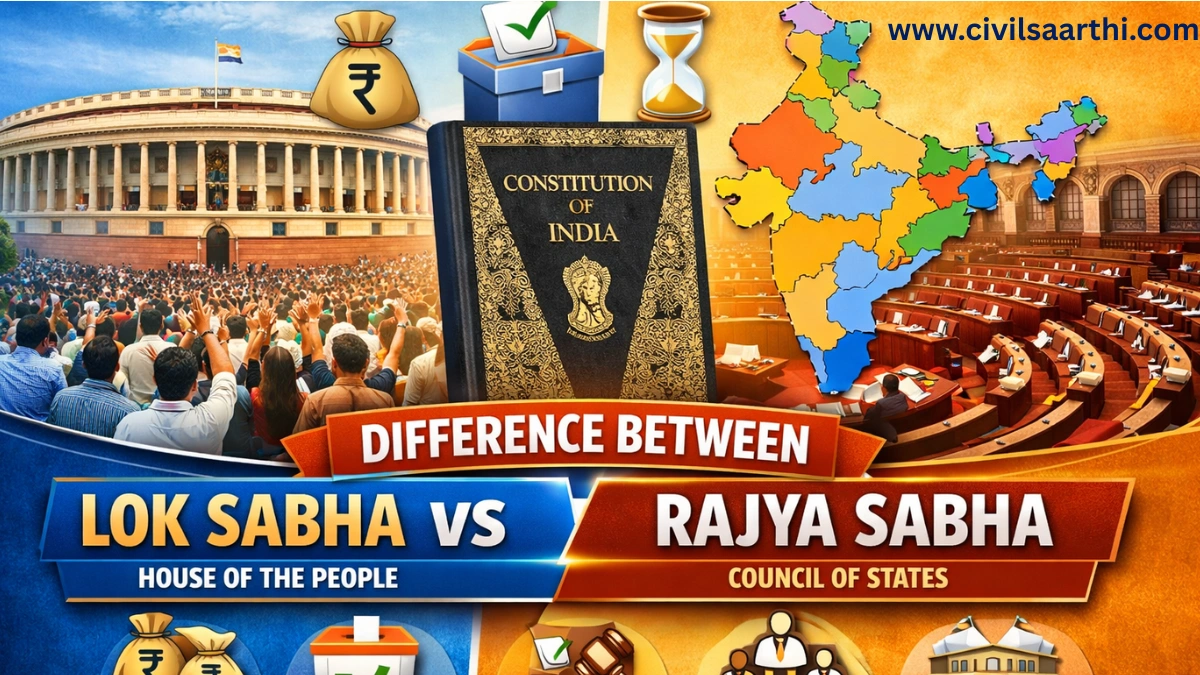
Both houses form the Indian Parliament, but they vary in terms of authority, representation, functions, tenure, and election process. Lok Sabha is the directly elected Lower House, representing the people of India, while Rajya Sabha is the Upper House, representing the states.
Difference Between Lok Sabha and Rajya Sabha
The Difference Between Lok Sabha and Rajya Sabha lies primarily in their structure and powers. Lok Sabha is composed of representatives directly elected by the people and is more powerful in financial matters. Rajya Sabha, on the other hand, is a permanent body with representatives elected by the state legislatures and plays a reviewing and advisory role. Their powers overlap in lawmaking but differ significantly in financial and executive control.
Difference Between Lok Sabha and Rajya Sabha Table Overview
The Lok Sabha (House of the People) and Rajya Sabha (Council of States) are the two houses of the Indian Parliament. While both serve crucial legislative functions, their composition, powers, and roles differ significantly. Lok Sabha members are directly elected by the people, giving it a more popular and financial authority, whereas Rajya Sabha represents the states of India and functions as a revising chamber.
| Feature | Lok Sabha | Rajya Sabha |
| House Type | Lower House of Parliament | Upper House of Parliament |
| Total Members | Maximum 552 (Presently 543 elected) | Maximum 250 (Presently 245) |
| Election | Directly elected by Indian citizens | Indirectly elected by state legislative assemblies |
| Term | 5 years (can be dissolved earlier) | 6 years (1/3rd members retire every 2 years) |
| Presiding Officer | Speaker | Vice President (as Chairman) |
| Constitutional Article | Article 81 | Article 80 |
| Representation | Citizens of India | States and Union Territories |
| Financial Powers | Can introduce and pass Money Bills | Cannot introduce Money Bills |
| Role in Executive Formation | Controls the Executive; Government is answerable to Lok Sabha | No such role |
| Dissolution | Can be dissolved by the President | Cannot be dissolved; it is a permanent body |
Lok Sabha vs Rajya Sabha Detailed Comparison
The Lok Sabha and Rajya Sabha together form the bicameral legislature of India, enshrined in the Constitution. While both houses collaborate in law-making, they differ in tenure, powers, composition, and responsibilities.
Composition and Representation
- Lok Sabha represents the people of India and has a higher number of members.
- Rajya Sabha represents the states and union territories, ensuring federal balance.
Election Process
- Lok Sabha members are directly elected by eligible voters through general elections.
- Rajya Sabha members are elected by MLAs of state legislative assemblies through proportional representation.
Tenure
- Lok Sabha has a term of 5 years and can be dissolved by the President.
- Rajya Sabha is a permanent body with staggered tenure for members.
Presiding Officers
- Lok Sabha is presided over by the Speaker.
- Rajya Sabha is chaired by the Vice President of India.
Legislative and Financial Powers
- Lok Sabha holds superior authority in passing Money Bills and budgets.
- Rajya Sabha can only recommend changes in Money Bills and must return them within 14 days.
Control Over Executive
- Lok Sabha plays a direct role in forming the Central Government. A vote of no confidence in the Lok Sabha can dissolve the government.
- Rajya Sabha has no such authority over the Council of Ministers.
Constitutional Basis – Lok Sabha and Rajya Sabha
The Indian Parliament is a bicameral legislature, comprising the Lok Sabha (Lower House) and the Rajya Sabha (Upper House), both established under the Constitution of India. Their powers, composition, and functions are defined in detail to ensure a balance between the voice of the people and the interests of the states.
Constitutional Basis – Lok Sabha and Rajya Sabha | ||
| House | Constitutional Article | Highlights |
| Lok Sabha | Article 81 | Seat distribution based on population |
| Rajya Sabha | Article 80 | State-wise allocation and nomination provisions |
Lok Sabha vs Rajya Sabha
Both Lok Sabha and Rajya Sabha play pivotal roles in India’s parliamentary democracy. While their functions may often overlap, key distinctions exist in their powers related to legislation, finance, and control over the executive.
Powers and Functions – Lok Sabha vs Rajya Sabha | ||
| Type of Power | Lok Sabha | Rajya Sabha |
| Legislative Powers | Equal with Rajya Sabha | Equal with Lok Sabha |
| Financial Powers | Superior – can introduce Money Bills | Limited – cannot initiate Money Bills |
| Executive Powers | Controls the executive | No direct control |
| Constitutional Amendment | Equal power | Equal power |
| Emergency Proclamation | Equal power | Equal power |
Difference Between Lok Sabha and Rajya Sabha FAQs
What is the main difference between Lok Sabha and Rajya Sabha?
The main difference lies in their composition, election, and powers. Lok Sabha is directly elected and more powerful in financial and executive matters, while Rajya Sabha is indirectly elected and primarily serves a reviewing role.
Who elects members of Lok Sabha and Rajya Sabha?
Lok Sabha members are directly elected by the public, while Rajya Sabha members are elected by MLAs of the states.
Can Rajya Sabha be dissolved like Lok Sabha?
No, Rajya Sabha is a permanent house. Lok Sabha can be dissolved by the President.
Who presides over Lok Sabha and Rajya Sabha?
Lok Sabha is presided over by the Speaker, and Rajya Sabha is chaired by the Vice President of India.
Which House has more power in passing Money Bills?
Lok Sabha has full authority in initiating and passing Money Bills. Rajya Sabha can only make recommendations.
Which house plays a role in forming the Central Government?
Lok Sabha forms the Government; a vote of no confidence here can dissolve the government.
Why do we have two Houses in Parliament?
To ensure both population-based and state-based representation – Lok Sabha represents the people, Rajya Sabha represents the states.