 by
by 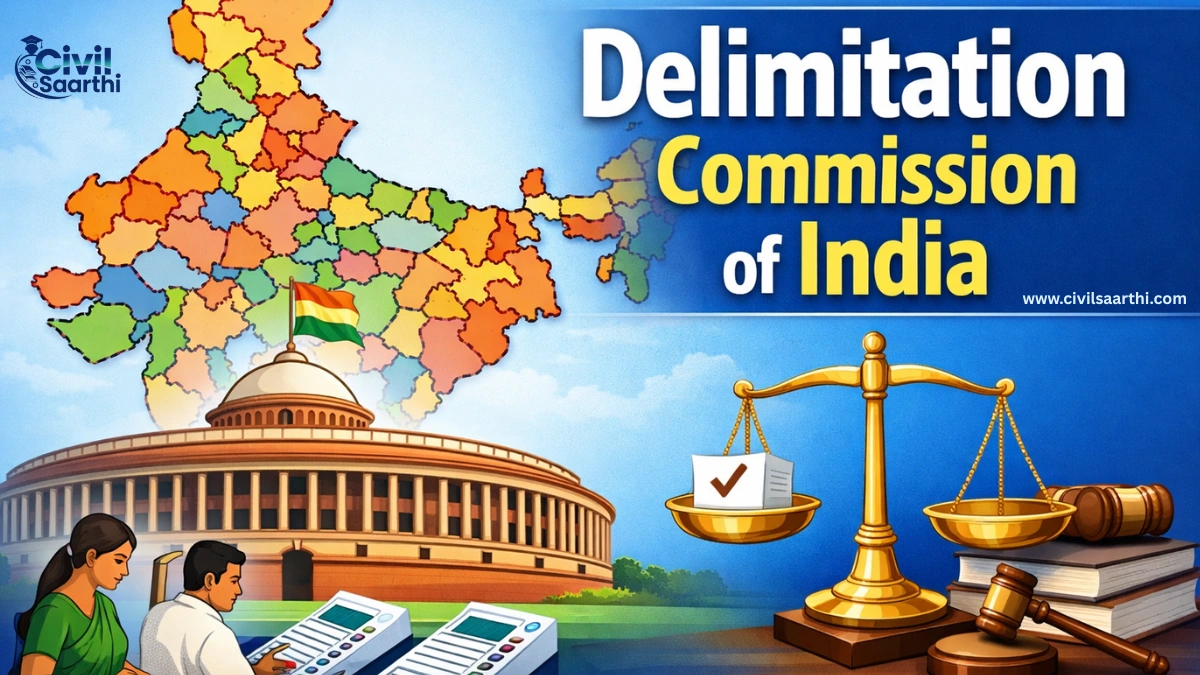
Delimitation Commission
The Delimitation Commission is an independent high-powered body constituted by the Government of India under the Delimitation Acts passed by Parliament. Its objective is to readjust the territorial boundaries of electoral constituencies for Lok Sabha and State Legislative Assemblies based on the latest census. The decisions of the Delimitation Commission have the force of law and cannot be challenged in court.
Delimitation Commission Overview
The Delimitation Commission works towards maintaining democratic balance by redistributing seats as per population shifts. It is composed of a retired Supreme Court judge, the Chief Election Commissioner, and the State Election Commissioners of the respective states. Its impartial and binding decisions uphold the constitutional mandate of equal representation.
| Delimitation Commission Overview | |
| Feature | Description |
| Nature | Statutory and Independent Body |
| Established Under | Delimitation Acts (1952, 1962, 1972, 2002) |
| Purpose | Redrawing of Parliamentary and Assembly constituencies |
| Based on | Latest decennial Census |
| Composition | Retired SC Judge (Chairperson), CEC, State Election Commissioners |
| Finality of Orders | Cannot be questioned in any court |
Delimitation Commission Historical Background
The Delimitation Commission has been constituted four times since independence, each time under a specific Delimitation Act passed by Parliament. It was not constituted after the 1981 and 1991 Censuses due to a constitutional freeze on delimitation until 2000, which was later extended to 2026 to encourage population stabilization.
| Delimitation Commission Historical Background | ||
| Delimitation Commission Year | Legal Basis | Chairperson |
| 1952 | Delimitation Act, 1952 | Justice Fazl Ali |
| 1963 | Delimitation Act, 1962 | Justice K. Subba Rao |
| 1973 | Delimitation Act, 1972 | Justice J.L. Kapur |
| 2002 | Delimitation Act, 2002 | Justice Kuldip Singh |
Delimitation Commission: Constitutional Provisions
The Constitution of India lays down clear provisions to ensure fair, population-based representation in Parliament and State Legislatures. These articles empower Parliament and guide the Delimitation Commission in redrawing constituency boundaries after each Census.
- Article 82: Mandates Parliament to enact a Delimitation Act after every Census to readjust the allocation of seats in the Lok Sabha and redefine constituency boundaries.
- Article 170: Provides for the readjustment of seats in State Legislative Assemblies based on population changes reflected in the Census.
- Articles 330 and 332: Ensure reservation of seats for Scheduled Castes and Scheduled Tribes in the Lok Sabha and State Assemblies in proportion to their population.
- Article 327: Grants Parliament the power to make laws relating to elections, including matters concerning delimitation of constituencies.
- Article 329(a): Bars judicial interference by stating that delimitation orders cannot be challenged in any court, ensuring finality and stability in the electoral process.
Composition of Delimitation Commission
The Delimitation Commission is a three-member statutory body with both judicial and executive components. This structure ensures neutrality and the required electoral expertise for constituency restructuring.
| Composition of Delimitation Commission | |
| Member | Role |
| Retired Supreme Court Judge | Chairperson of the Commission |
| Chief Election Commissioner (CEC) | Member representing the Election Commission of India |
| State Election Commissioners | Members representing respective states during proceedings |
Functions of Delimitation Commission
The Delimitation Commission is primarily responsible for adjusting the size and boundaries of electoral constituencies to reflect population changes. It also ensures that reserved constituencies for SCs and STs are equitably distributed based on population density.
Functions of Delimitation Commission | |
| Function Category | Description |
| Readjustment of Constituencies | Fixes number and boundaries of Lok Sabha & State Assembly constituencies |
| SC/ST Reservation Distribution | Allocates seats for Scheduled Castes and Scheduled Tribes based on census |
| Public Consultation | Seeks feedback from citizens and political parties |
| Final Notification | Publishes final constituency map, binding and unchangeable |
| Legal Enforcement | The orders of the Commission are final and have the force of law |
Delimitation Commission: Constitutional Amendments
Delimitation in India has been shaped by key constitutional amendments that sought to balance fair political representation with the objective of population stabilisation. The 42nd, 84th and 87th Constitutional Amendments introduced freezes and adjustments in seat allocation, significantly influencing how constituency boundaries are redrawn.
- 42nd Constitutional Amendment (1976): Froze the total number of seats in the Lok Sabha and State Legislative Assemblies until 2001, so that states implementing effective population control measures were not disadvantaged politically.
- 84th Constitutional Amendment (2002): Extended the freeze on seat allocation until 2026, while permitting internal readjustment of constituency boundaries based on the 1991 Census.
- 87th Constitutional Amendment (2003): Provided for the use of the 2001 Census for redefining constituency boundaries and re-determining SC/ST reserved seats.
Impact
- Ensured stability in political representation and protected states with lower population growth.
- Enabled limited delimitation without altering the total number of seats.
- However, it also delayed full adjustment of representation in line with actual population changes.
Process Followed by Delimitation Commission
The Delimitation Commission adopts a transparent and participative process. It prepares draft proposals, invites public suggestions, holds hearings, and then publishes its final orders.
- Census data is collected and verified.
- Constituency boundaries are redrawn based on population shifts.
- A draft proposal is published in official gazettes and newspapers.
- Public and political feedback is sought via hearings.
- Final boundaries are notified and become law.
Delimitation Commission Significance
The Delimitation Commission ensures democratic equality, helps eliminate malapportionment, and reflects demographic realities in the political map. It also plays a key role in strengthening federalism by maintaining proportional representation.
- Ensures equal representation by redrawing constituency boundaries so that each MP/MLA represents roughly the same population.
- Upholds the principle of “one person, one vote, one value”, strengthening electoral fairness.
- Reflects demographic changes such as population growth, migration, and urbanisation.
- Prevents malapportionment, where some constituencies become over- or under-represented.
- Provides a constitutional and independent mechanism, reducing political bias in drawing boundaries.
- Strengthens representative democracy by making legislatures more responsive to current population realities.
- Helps in the effective implementation of reservation for SCs and STs based on updated population data.
- Promotes electoral stability, as its orders have the force of law and cannot be challenged in courts.
- Facilitates balanced regional development by ensuring fair political voice to all areas.
- Enhances public trust in the electoral process by ensuring transparency and objectivity in constituency delimitation.
Delimitation Commission Challenges
Despite its neutrality, the Delimitation Commission faces several issues that hinder complete electoral reform. These challenges relate to legal, demographic, and political complexities.
- Creates political resistance, as changes in boundaries can alter electoral prospects of parties and leaders.
- Risks regional imbalance, with states showing higher population growth potentially gaining more seats than better-performing states.
- Raises concerns over penalising population control, especially for states that successfully reduced fertility rates.
- Can lead to social and regional tensions due to redistribution of political power.
- Faces administrative complexity in balancing population equality with geography, communication, and accessibility.
- Triggers urban–rural representation issues, as rapid urbanisation is hard to capture fairly.
- May result in public dissatisfaction when traditional or historical constituencies are altered or abolished.
- Limited scope for judicial review, which may raise concerns about accountability and corrective mechanisms.
Future of Delimitation Commission After 2026
After 2026, the Delimitation Commission is expected to play a crucial role in realigning India’s political representation with contemporary population realities, as the constitutional freeze on seat allocation based on the 1971 Census is set to end.
- Likely reallocation of Lok Sabha seats among states based on post-2026 Census data, reflecting current population trends.
- Possibility of increase in total Lok Sabha seats, requiring constitutional and legislative adjustments.
- Renewed debate on equity versus population growth, as states with lower fertility rates seek safeguards against loss of representation.
- Greater emphasis on balanced federalism, with demands for alternative formulas such as weighted population or development indicators.
- Need for transparent and consultative processes to manage political and social sensitivities.
- Enhanced role in urban representation, addressing rapid urbanisation and under-represented cities.
- Reassessment of SC/ST reserved constituencies based on updated demographic patterns.
UPSC Prelims PYQs on Delimitation Commission
How many Delimitation Commissions have been constituted by the Government of India till December 2023? [2024]
(a) One
(b) Two
(c) Three
(d) Four
Answer: (d) Four
Explanation:
- Delimitation Commissions have been constituted four times in India (1952, 1963, 1973 and 2002) to revise constituency boundaries.
- Each Commission was established under a Delimitation Commission Act enacted after the Census to reflect demographic changes.
- Their core purpose has been to ensure equal and fair representation by adjusting Parliamentary and Assembly constituencies based on population distribution.
Delimitation Commission FAQs
What is the Delimitation Commission?
The Delimitation Commission is a statutory body responsible for redrawing electoral constituencies based on population changes.
Is the Delimitation Commission a constitutional body?
No, it is a statutory body created under the Delimitation Acts passed by Parliament.
How many times has the Delimitation Commission been formed?
It has been constituted four times: in 1952, 1963, 1973, and 2002.
What is the legal status of Delimitation Commission decisions?
The decisions of the Delimitation Commission are final and cannot be challenged in any court.
Why was delimitation frozen until 2026?
To encourage states to control population growth without being penalized in terms of political representation.
Who are the members of the Delimitation Commission?
It includes a retired Supreme Court judge (Chairperson), the Chief Election Commissioner, and respective State Election Commissioners.
What is the basis for seat reservation by the Delimitation Commission?
Seats for SCs and STs are reserved based on their population ratio in each state or region according to the latest census.