
 by
by 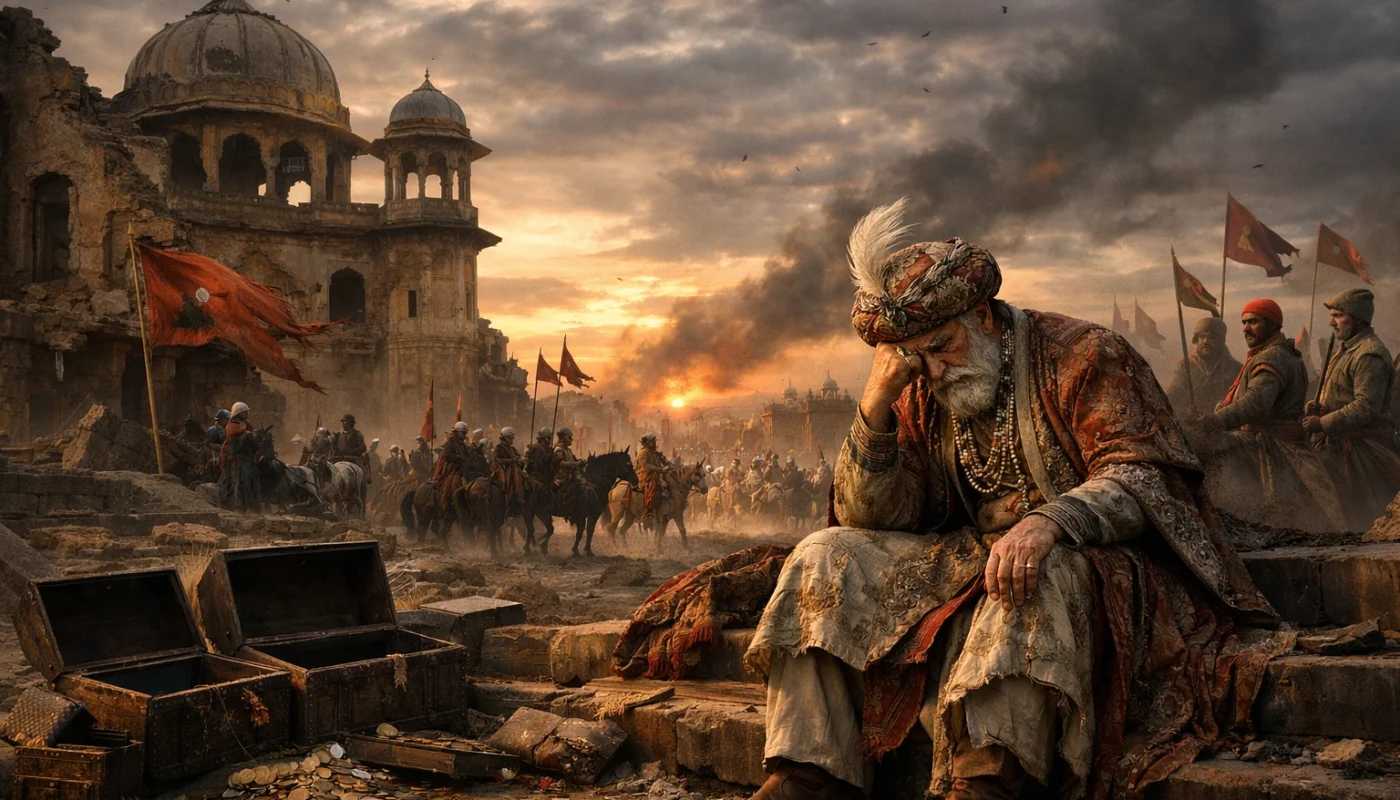
The Mughal Empire, one of the most powerful empires in Indian history, ruled the subcontinent for over two centuries, leaving an indelible mark on politics, culture, and architecture. However, the first half of the 18th century witnessed the decline of this mighty empire, which had been the envy of contemporary powers. The reign of Aurangzeb (1658–1707) is widely regarded as the turning point, marking the beginning of the empire’s gradual disintegration.
Although Aurangzeb was a capable administrator and military strategist, his policies strained the empire’s stability. After his death, weak successors, wars of succession, economic strain, and external invasions accelerated the decline, eventually paving the way for regional powers and colonial domination.
The Context of Decline of Mughal Empire
Aurangzeb’s long reign expanded the Mughal Empire to its greatest territorial extent, but it came at a cost. His religious orthodoxy, heavy taxation, and prolonged campaigns in the Deccan drained the empire’s resources. After his death in 1707, political instability intensified due to internal power struggles, while rulers such as Muhammad Shah (1719–1748) proved incompetent in restoring imperial authority.
During Muhammad Shah’s reign, the empire saw the rise of independent states like Hyderabad, Bengal, Awadh, and Punjab. Local chiefs asserted autonomy, and the Marathas emerged as a rising power, gradually challenging Mughal supremacy.
Major Challenges Faced by the Mughal Empire
The decline of the Mughal Empire was closely linked to the weaknesses of its successors after Aurangzeb. Each emperor faced unique challenges, both internal and external, which collectively led to the empire’s gradual collapse.
Weak Successors and Internal Instability
1. Bahadur Shah I (1707–1712)
- Succession War After Aurangzeb: Took the throne after killing his brothers Muhammad Azam and Kam Bakhsh. This left the empire destabilized.
- Noble Factionalism: Had to manage rivalries among the Mughal nobility, which weakened central authority.
- Rajput and Maratha Relations: Adopted a pacific policy, releasing Maratha prince Shahu and reconciling with Rajputs, but could not fully regain loyalty.
- Sikh Revolts: Faced repeated attacks from Sikh leader Banda Bahadur in Punjab.
2. Jahandar Shah (1712–1713)
- Dependence on Ministers: Relied heavily on Zulfikar Khan, who was effectively controlling the empire.
- Financial Strain: Introduced the Izara system to improve revenue, but it was short-term and inefficient.
- Short Reign: Lasted only a year, limiting any meaningful consolidation of power.
3. Farrukhsiyar (1713–1719)
- Noble Domination: Installed by the powerful Sayyid Brothers, highlighting emperor’s lack of independent authority.
- Religious Policy: Abolished jizya and pilgrimage tax, promoting tolerance but lacked political enforcement.
- Foreign Influence: Gave farmans (royal decrees) to the British, increasing European influence in India.
- Assassination by Nobles: Dethroned and killed by the Sayyid Brothers, first time in Mughal history a ruler was killed by his nobles.
4. Rafi-ud-Darajat & Shah Jahan II (1719)
- Extremely Short Reigns: Rafi-ud-Darajat ruled only from February to June 1719; Shah Jahan II (Rafi-ud-Daula) ruled for a few months.
- Opium Addiction and Incompetence: Personal weaknesses rendered them ineffective rulers.
- Continued Noble Dominance: The Sayyid Brothers controlled administration, reducing central power.
5. Muhammad Shah “Rangeela” (1719–1748)
- Lavish Lifestyle: Prioritized luxury over governance, weakening state administration.
- Noble Rebellions: Struggled with nobles seeking independence or higher jagirs.
- Rise of Regional States: Formation of independent states such as Hyderabad, Awadh, Bengal, and Punjab.
- External Invasion: Faced Nadir Shah’s invasion (1739); Delhi was looted, treasury emptied.
- Maratha Expansion: Marathas began extending influence northwards, challenging Mughal authority.
6. Ahmad Shah Bahadur (1748–1754)
- Incompetence: Depended on Udham Bai, the queen mother, and her paramour Javid Khan for administration.
- Military Weakness: Could not control rising Maratha power.
- Loss of Authority: Empire increasingly controlled by nobles and regional chiefs.
7. Alamgir II (1754–1759)
- Afghan Invasions: Ahmad Shah Abdali repeatedly invaded India; Alamgir II struggled to protect Delhi.
- Rise of Marathas: Marathas interfered in Mughal administration, including the expulsion of Abdali’s agents.
- Assassination: Alamgir II was assassinated, showing the vulnerability of the throne.
8. Shah Jahan III (1759–1760)
- Maratha Intervention: Placed and deposed by Marathas, showing lack of independent authority.
- Instability: Reign marked by political intrigue and short-term power struggles.
9. Shah Alam II (1760–1806)
- Military Defeats: Witnessed Third Battle of Panipat (1761) and Battle of Buxar (1764).
- British Control: Signed Treaty of Allahabad (1765), giving Diwani rights of Bengal, Bihar, and Orissa to East India Company.
- Maratha Pressure: Lived under Maratha protection in Delhi until 1803.
10. Akbar Shah II (1806–1837) & Bahadur Shah II (1837–1857)
- Loss of Sovereignty: East India Company stopped issuing coins in the emperor’s name.
- Symbolic Rule: Reduced to a ceremonial role without real power.
- 1857 Revolt: Bahadur Shah II briefly became a figurehead during the revolt, later exiled by the British.
2. External Invasions
The Mughal Empire’s northwestern frontiers were poorly defended, making India vulnerable to foreign invasions:
Nadir Shah (1738–1739): Invaded India, defeated the Mughal army at Karnal, looted Delhi, and carried away immense wealth, including the Peacock Throne and the Kohinoor diamond.
Ahmad Shah Abdali (1748–1767): Repeated invasions destabilized northern India; captured Delhi in 1757, and played a role in the Third Battle of Panipat (1761), defeating the Marathas.
These invasions not only weakened the Mughal treasury but also shattered the empire’s political and military authority.
3. Internal Administrative and Economic Problems
Several internal weaknesses contributed to the decline:
- Shifting Allegiance of Zamindars: Local landowners (zamindars) gained power, often siding with rebellious nobles or regional powers.
- Jagirdari Crisis: Nobles (mansabdars) faced shortages of jagirs, leading to peasant exploitation and unrest.
- Overextension of the Empire: The empire’s vast size made centralized administration inefficient.
- Economic Strain: Luxurious lifestyles, costly wars, and decreased agricultural productivity strained finances.
- Stagnation of Trade and Technology: Decline in innovation and inability to compete with European traders weakened economic stability.
4. Religious and Social Policies
Aurangzeb’s policies contributed to internal unrest:
- Re-imposition of jizya (poll tax on non-Muslims) alienated Hindus.
- Rajputs, Sikhs, Jats, and Marathas resisted imperial authority, creating regional unrest.
- Deccan campaigns drained resources and provoked local resistance, further weakening Mughal control.
5. Rise of Regional Powers
As Mughal authority waned, regional kingdoms gained strength:
- Marathas: Expanded northwards, collecting chauth and sardeshmukhi from Mughal provinces.
- Nawabs of Hyderabad, Bengal, Awadh, and Punjab: Exercised autonomy while nominally acknowledging Mughal sovereignty.
- Sikhs and Jats: Established independent territories, challenging Mughal control.
The rise of these powers signaled the fragmentation of the once-unified empire.
6. Military Weakness
Historians emphasize that the decline of the Mughal military played a crucial role:
- Armies became inefficient and poorly trained.
- Nobles and regional chiefs often pursued personal agendas instead of defending the empire.
- European military innovations further exposed the obsolescence of the Mughal army.
As William Irvine noted, the empire was “already doomed before any foreign adventurer appeared.”
Key Battles and Events
- Battle of Karnal (1739): Nadir Shah defeated Muhammad Shah.
- Third Battle of Panipat (1761): Ahmad Shah Abdali defeated the Marathas, showcasing Mughal impotence.
- Battle of Buxar (1764): Marked the rise of British East India Company influence.
- Treaty of Allahabad (1765): Shah Alam II granted Diwani rights of Bengal, Bihar, and Orissa to the British.
Conclusion
The decline of the Mughal Empire was a complex process influenced by both internal weaknesses and external pressures. The empire’s centralized system depended heavily on capable rulers; their absence led to corruption, factionalism, and rebellion. External invasions, economic crises, and the rise of regional powers further accelerated the decline. By the mid-18th century, the Mughal emperor had become a symbolic figure, paving the way for British colonial domination. The Mughal legacy, however, remains significant in India’s cultural, architectural, and administrative history.
FAQs: Decline of the Mughal Empire in India
1. When did the decline of the Mughal Empire begin?
The decline began during the reign of Aurangzeb (1658–1707) due to his prolonged Deccan campaigns, heavy taxation, and religious policies. The process accelerated after his death because of weak successors and internal instability.
2. Who were the main Mughal emperors after Aurangzeb?
The main Mughal emperors after Aurangzeb were Bahadur Shah I, Jahandar Shah, Farrukhsiyar, Muhammad Shah, Ahmad Shah Bahadur, Alamgir II, Shah Jahan III, Shah Alam II, Akbar Shah II, and Bahadur Shah II.
3. What were the major internal challenges faced by the Mughal Empire?
The major internal challenges included weak rulers, wars of succession, noble factionalism, economic strain, administrative inefficiency, and military decline.
4. What external threats weakened the Mughal Empire?
External threats included Nadir Shah’s invasion in 1739, repeated invasions by Ahmad Shah Abdali, and the growing influence of European powers like the British East India Company.
5. How did the Marathas contribute to the decline?
The Marathas contributed to the decline by expanding northwards, collecting taxes from Mughal provinces, and reducing the empire’s political and military authority.
6. What role did Muhammad Shah play in the empire’s decline?
Muhammad Shah accelerated the decline by living a luxurious lifestyle, failing to control nobles, facing Nadir Shah’s invasion, and allowing independent states to emerge.
7. Why was Panipat significant during the Mughal decline?
Panipat was significant because the Third Battle of Panipat in 1761 demonstrated Mughal weakness and allowed Ahmad Shah Abdali to defeat the Marathas.
8. What economic problems contributed to the decline?
Economic problems included high taxation, shortage of jagirs, exploitation of peasants, decline in trade, stagnant technology, and costly military campaigns.
9. When did the Mughal Empire officially end?
The Mughal Empire officially ended in 1858 when Queen Victoria was declared Empress of India after the Revolt of 1857.
10. Could the decline have been prevented?
The decline could have been delayed if capable rulers had succeeded Aurangzeb and maintained strong administration, alliances, and economic stability, but external and regional pressures would still have challenged the empire.