 by
by 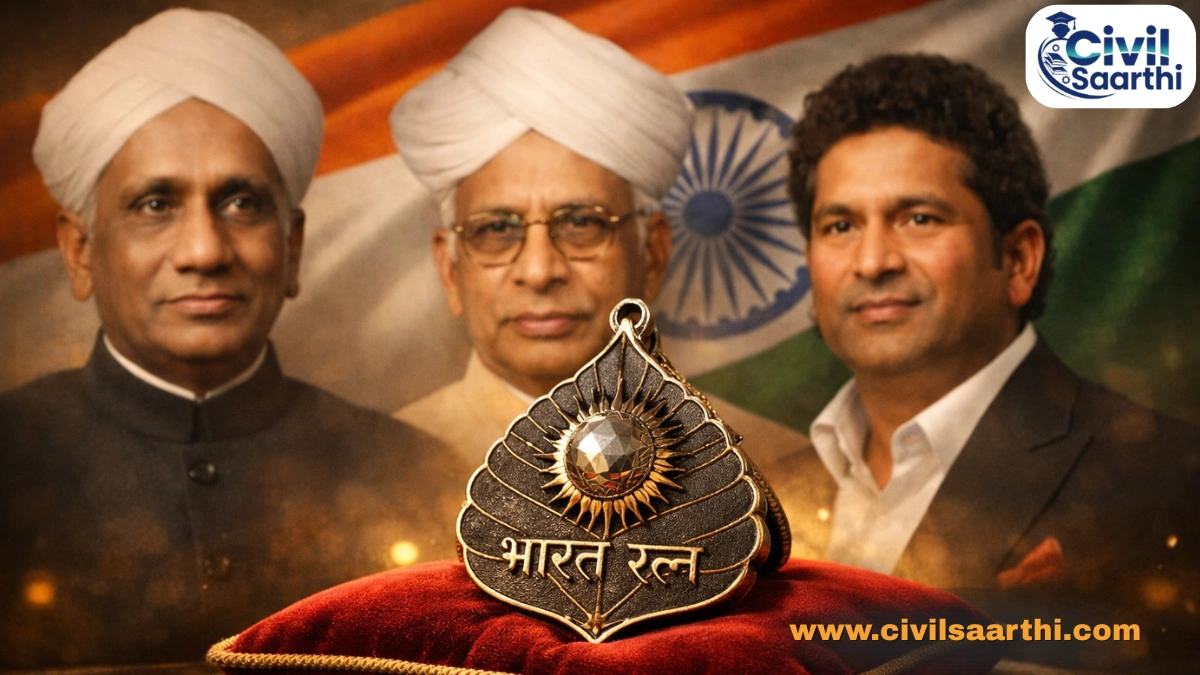
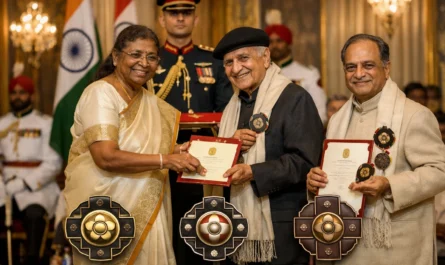
The Bharat Ratna is the highest civilian honour of India, awarded for exceptional service of the highest order in any field of human endeavour. Instituted in 1954, the award reflects the nation’s gratitude toward individuals whose contributions have significantly shaped India’s social, political, scientific, cultural, and global identity.
As of 2025, 53 eminent personalities have received the Bharat Ratna, including political leaders, scientists, social reformers, artists, educationists, and sportspersons.
This comprehensive guide covers the complete winners list (1954–2025), history, eligibility, medal design, selection process, key facts, and exam-oriented points.
Bharat Ratna Award Historical Background
The Bharat Ratna was instituted in January 1954 to recognize exceptional service of the highest order to the nation. Over the decades, it has evolved to honour excellence across diverse fields, reflecting India’s changing social and national priorities.
- Instituted in 1954 by the President of India.
- Initially limited to arts, literature, science, and public services.
- In 2011, the scope expanded to include any field of human endeavour, including sports.
- Posthumous awards were allowed starting from 1955.
- The award symbolizes the highest civilian recognition in the Republic of India.
- As of 2025, 53 individuals have been honoured.
Bharat Ratna Award Objectives
The Bharat Ratna aims to acknowledge individuals whose contributions have significantly shaped India’s development and global image. It represents national gratitude for lifelong dedication and excellence.
- To honour exceptional service of the highest order.
- To recognize contributions in governance, science, arts, literature, social reform, and sports.
- To celebrate individuals who have strengthened India’s international reputation.
- To inspire citizens toward excellence and public service.
- To promote national integration by recognizing diverse achievers.
- To uphold merit above all distinctions of caste, creed, gender, or profession.
Bharat Ratna Award Eligibility Criteria
The Bharat Ratna is awarded without discrimination and is open to individuals from any background who have demonstrated extraordinary service to humanity.
- Awarded for exceptional performance in any field of human endeavour.
- Open to Indian citizens and foreign nationals.
- No minimum age requirement specified.
- Maximum of three awards per year (generally followed).
- Posthumous awards are permitted.
- No formal application process; it is based purely on national recognition and merit.
- The award does not carry any monetary grant.
Bharat Ratna Award Winners (1954–2025) List
The Bharat Ratna is India’s highest civilian award, conferred on individuals for exceptional service of the highest order in any field of human endeavour. As of 2025, 53 distinguished personalities have been honoured — from national leaders and reformers to artists, scientists, and a sports icon.
Below is the complete list arranged from the most recent recipients to the oldest awardees, with brief descriptions of their contributions:
| Year | Recipient | Contribution / Description |
|---|---|---|
| 2024 | Karpoori Thakur | Socialist leader; former Chief Minister of Bihar (Posthumous) |
| 2024 | L. K. Advani | Veteran politician and former Deputy Prime Minister of India |
| 2024 | P. V. Narasimha Rao | Ninth Prime Minister of India; economic reforms architect (Posthumous) |
| 2024 | Charan Singh | Fifth Prime Minister; champion of agrarian welfare (Posthumous) |
| 2024 | M. S. Swaminathan | Agricultural scientist; leader of the Green Revolution (Posthumous) |
| 2019 | Pranab Mukherjee | Former President of India; veteran statesman |
| 2019 | Nanaji Deshmukh | Social reformer and community leader (Posthumous) |
| 2019 | Bhupen Hazarika | Renowned musician and filmmaker (Posthumous) |
| 2015 | Atal Bihari Vajpayee | Former Prime Minister; esteemed orator |
| 2015 | Madan Mohan Malaviya | Founder of Banaras Hindu University; educationist (Posthumous) |
| 2014 | Prof. C. N. R. Rao | Eminent scientist in chemistry and materials science |
| 2014 | Sachin Tendulkar | Legendary cricketer; first sportsperson to receive Bharat Ratna |
| 2009 | Bhimsen Joshi | Iconic Hindustani classical vocalist |
| 2001 | Lata Mangeshkar | “Nightingale of India”; legendary playback singer |
| 2001 | Bismillah Khan | Maestro of the shehnai; cultural ambassador |
| 1999 | Jayaprakash Narayan | Leader of socio-political reform movements |
| 1999 | Amartya Sen | Nobel Laureate economist |
| 1999 | Gopinath Bordoloi | First Chief Minister of Assam post-independence |
| 1999 | Ravi Shankar | Sitar maestro; global music icon |
| 1998 | M. S. Subbulakshmi | Carnatic music legend |
| 1998 | Chidambaram Subramaniam | Leader of the Green Revolution |
| 1997 | Gulzarilal Nanda | Interim Prime Minister; freedom activist |
| 1997 | Aruna Asaf Ali | Freedom fighter; first Mayor of Delhi |
| 1997 | A. P. J. Abdul Kalam | Scientist and former President of India |
| 1992 | Abul Kalam Azad | First Education Minister of India |
| 1992 | J. R. D. Tata | Industrialist and philanthropist |
| 1992 | Satyajit Ray | Filmmaker and cultural visionary |
| 1991 | Rajiv Gandhi | Former Prime Minister; modernisation efforts |
| 1991 | Vallabhbhai Patel | “Iron Man of India”; nation integration |
| 1991 | Morarji Desai | Former Prime Minister; independence activist |
| 1990 | B. R. Ambedkar | Architect of the Indian Constitution |
| 1990 | Nelson Mandela | South African leader and anti-apartheid icon |
| 1988 | M. G. Ramachandran | Actor and Chief Minister of Tamil Nadu |
| 1987 | Khan Abdul Ghaffar Khan | Freedom fighter from the Northwest Frontier Province |
| 1983 | Vinoba Bhave | Social reformer; Bhoodan movement leader |
| 1980 | Mother Teresa | Nobel Laureate and humanitarian worker |
| 1976 | K. Kamaraj | Statesman; education champion |
| 1975 | V. V. Giri | Fourth President of India |
| 1971 | Indira Gandhi | First woman Prime Minister of India |
| 1966 | Lal Bahadur Shastri | Second Prime Minister; “Jai Jawan Jai Kisan” slogan |
| 1963 | Zakir Husain | Scholar and President of India |
| 1963 | Pandurang Vaman Kane | Sanskrit scholar; Indology expert |
| 1962 | Rajendra Prasad | First President of India |
| 1961 | Bidhan Chandra Roy | Physician and Chief Minister of West Bengal |
| 1961 | Purushottam Das Tandon | Freedom activist and linguistic reformer |
| 1958 | Dhondo Keshav Karve | Social reformer for women’s education |
| 1957 | Govind Ballabh Pant | Chief Minister of Uttar Pradesh; statesman |
| 1955 | Bhagwan Das | Philosopher and educationist |
| 1955 | M. Visvesvaraya | Engineer and nation-builder |
| 1955 | Jawaharlal Nehru | First Prime Minister of India |
| 1954 | C. Rajagopalachari | Last Governor-General of India |
| 1954 | Dr. Sarvepalli Radhakrishnan | Philosopher and President of India |
| 1954 | C. V. Raman | Nobel Laureate Physicist |
Bharat Ratna Award Selection & Nomination Process
The selection process of the Bharat Ratna is highly confidential and rests with the highest constitutional authorities of India. It ensures that only individuals of extraordinary merit are honoured.
- Recommendations are made by the Prime Minister of India.
- The Prime Minister submits the names to the President of India.
- The President officially confers the award.
- There is no formal nomination system open to the public.
- The number of awards is typically restricted to three per year.
- Announcements are usually made on significant national occasions.
Also Read: Neighbouring Countires of India
Design and Features of the Bharat Ratna Medal
The Bharat Ratna medal is a symbol of India’s highest civilian honour, reflecting the country’s cultural heritage and prestige. Its unique design combines simplicity, elegance, and profound symbolism to honour the exceptional contributions of awardees.
- Shape: Peepal leaf, representing wisdom, spirituality, and growth.
- Material: Made of toned bronze, giving it a dignified and lasting appearance.
- Obverse Side: Features a radiant sun with the inscription “Bharat Ratna” in Hindi.
- Reverse Side: Displays the State Emblem of India along with the motto “Satyameva Jayate” (Truth Alone Triumphs).
- Ribbon: Worn around the neck with a white ribbon, symbolizing peace and purity.
- Certificate: Accompanied by a Sanad (official certificate) signed by the President of India.
- Symbolism: Represents excellence, service, and dedication to the nation across all fields of human endeavour.
- Uniqueness: No monetary prize is associated, emphasizing recognition of merit above material reward.
Category-wise Distribution of Awardees
The Bharat Ratna award has been conferred across multiple fields, recognizing excellence in governance, culture, science, social work, and sports. This category-wise distribution helps understand which areas India prioritizes for national recognition.
Detailed Points:
- Politics & Leadership: Includes Prime Ministers, Presidents, Chief Ministers, and national leaders like Jawaharlal Nehru, Atal Bihari Vajpayee, and Lal Bahadur Shastri.
- Arts & Culture: Musicians, filmmakers, and artists such as M. S. Subbulakshmi, Lata Mangeshkar, and Satyajit Ray.
- Science & Technology: Visionaries like C. V. Raman, A. P. J. Abdul Kalam, and C. N. R. Rao.
- Social Service & Reform: Freedom fighters and social reformers like Vinoba Bhave, Bhupen Hazarika, and Nanaji Deshmukh.
- Sports: Recognized with Sachin Tendulkar being the first sportsperson recipient in 2014.
This categorization emphasizes India’s commitment to rewarding diverse contributions to national development.
First Recipients of Bharat Ratna – Highlighting 1954 Awardees
The first Bharat Ratna awards were conferred in 1954, setting the benchmark for future recipients. These awardees were pioneers in governance, philosophy, and science.
Detailed Points:
- C. Rajagopalachari: Last Governor-General of India; prominent statesman.
- Dr. Sarvepalli Radhakrishnan: Philosopher and India’s second President; celebrated for education and philosophy.
- C. V. Raman: Nobel Prize-winning physicist; discovered the Raman Effect.
- Their recognition reflected the award’s aim to honor exceptional service across leadership, intellect, and scientific achievement.
Youngest and Oldest Recipients – Interesting Facts for Exams
The Bharat Ratna has been awarded to people of varying ages, highlighting both early achievements and lifelong contributions. This is often a popular point for UPSC and other competitive exams.
Detailed Points:
- Youngest Recipient: Sachin Tendulkar, 40 years old in 2014, recognized for his exceptional sports career.
- Oldest Recipient: M. Visvesvaraya, 88 years old in 1955, honoured for engineering and nation-building contributions.
- Posthumous awards can be conferred at any age, expanding the scope of recognition.
- Age diversity illustrates that impact is valued over timing, making contributions in youth and later life equally significant.
Foreign Recipients of Bharat Ratna – Global Recognition
Although primarily for Indian citizens, the Bharat Ratna has been awarded to a few foreign nationals, reflecting India’s recognition of global figures who have contributed to peace, freedom, or humanitarian causes.
Detailed Points:
- Khan Abdul Ghaffar Khan (1987): Freedom fighter from the Northwest Frontier Province (now Pakistan); known as “Frontier Gandhi.”
- Nelson Mandela (1990): Former President of South Africa; anti-apartheid leader.
- Their awards demonstrate India’s acknowledgement of international contributions aligned with Indian values.
- Highlights the award’s global perspective and diplomatic symbolism.
Posthumous Awards – Rules and Notable Posthumous Awardees
The Bharat Ratna can be awarded posthumously to honour individuals who made extraordinary contributions but were not recognized during their lifetime. This rule was formally introduced in 1955.
- Posthumous awards allow recognition of individuals whose legacy continues to inspire.
- Notable Posthumous Recipients:
- Lal Bahadur Shastri (1966) – Second Prime Minister of India.
- B. R. Ambedkar (1990) – Architect of the Indian Constitution.
- Rajiv Gandhi (1991) – Former Prime Minister.
- Madan Mohan Malaviya (2015) – Educationist and BHU founder.
- Nanaji Deshmukh (2019) – Social reformer.
Posthumous awards reflect India’s commitment to honoring lasting contributions beyond lifetime recognition.
Controversies & Debates Around the Award – Political Debates or Notable Omissions
The Bharat Ratna, being India’s highest civilian award, has sometimes been surrounded by controversies and debates over its recipients. These debates often involve allegations of political favoritism or questions about eligibility.
- Political Influence Allegations: Some awards, particularly to political leaders like Indira Gandhi and Atal Bihari Vajpayee, were debated as potentially influenced by the ruling government.
- Notable Omissions: Mahatma Gandhi, despite being the Father of the Nation, never received the Bharat Ratna.
- Field Bias Concerns: Early awards focused on politics and public service, leading to criticism of underrepresentation in arts, science, and sports.
- Posthumous Recognition Delays: Some awardees were recognized posthumously decades after their contributions, leading to public debate.
- Public and Media Discussion: Debates on fairness, timing, and merit of the award often trend during national events.
- Despite controversies, the award maintains its prestige as the highest civilian recognition in India.
Comparison with Other Civilian Awards – Padma Vibhushan, Padma Bhushan, Padma Shri
While the Bharat Ratna represents the highest civilian honour, India also recognizes contributions with other prestigious awards. Comparing them provides clarity on hierarchy and eligibility.
- Bharat Ratna: Highest civilian award; maximum three recipients per year; awarded for exceptional service of the highest order; includes all fields of human endeavour.
- Padma Vibhushan: Second-highest award; recognizes distinguished service of exceptional order in any field.
- Padma Bhushan: Third-highest award; for distinguished service of high order in any domain.
- Padma Shri: Fourth-highest award; acknowledges distinguished service in any field, often at regional or national level.
- Hierarchy Summary: Bharat Ratna > Padma Vibhushan > Padma Bhushan > Padma Shri.
- All awards are conferred by the President of India, with formal nominations usually proposed by the Ministry of Home Affairs.
Conclusion
The Bharat Ratna remains a symbol of national honour and excellence, celebrating individuals whose contributions have profoundly impacted India and the world. From political leaders and social reformers to scientists, artists, and sports icons, each awardee represents dedication, vision, and service.