 by
by 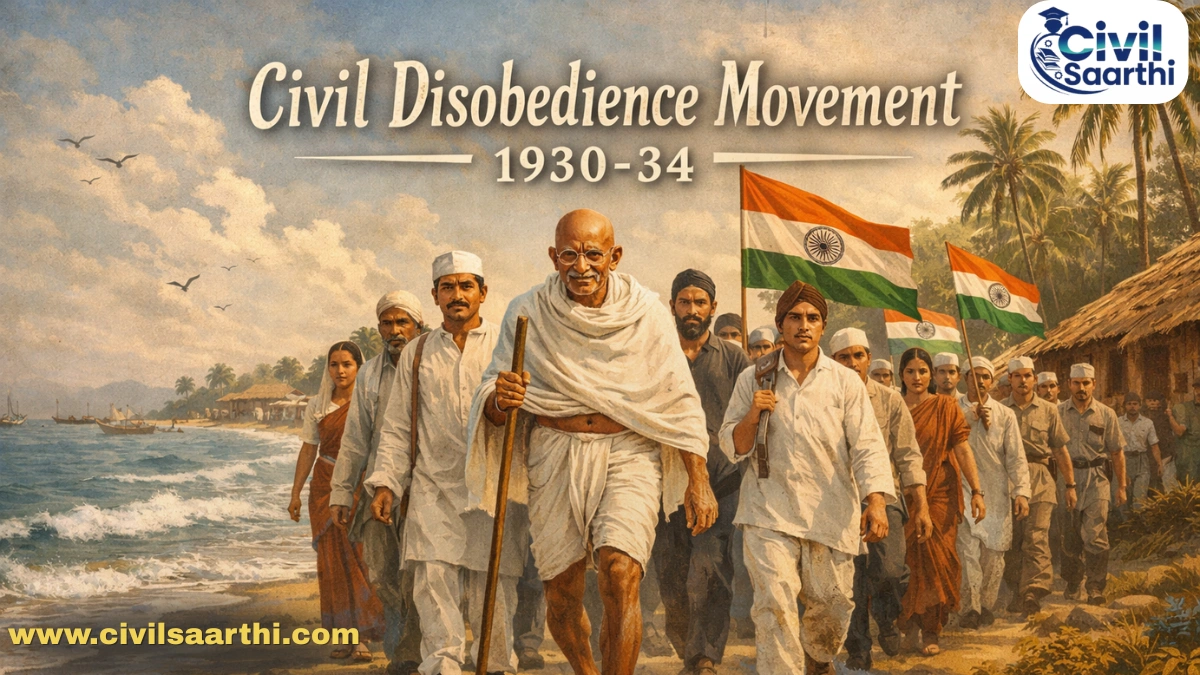
On 6 April 1930, Mahatma Gandhi officially started the Civil Disobedience Movement by breaking the British salt law after completing the historic Dandi March from Sabarmati Ashram to the coastal village of Dandi. By picking up a handful of salt from the seashore, Gandhi openly challenged British authority and marked the beginning of a nationwide protest. He became the main inspiration behind the movement and motivated common people, especially at the grassroots level, to actively participate in the freedom struggle. The violation of the salt law encouraged people across India to produce salt illegally as a form of resistance. During the early phase of the movement, salt became a powerful symbol of public unity and opposition to British rule. This article explains the Civil Disobedience Movement 1930-34 in detail, which is important for UPSC exam preparation.
Civil Disobedience Movement 1930-34 Background
- To implement the decision taken during the Lahore Congress Session, Mahatma Gandhi submitted 11 demands to the British government and gave them time until 31 January 1930 to accept or reject them.
- When the British government failed to respond positively, the Congress Working Committee authorised Gandhi to start the Civil Disobedience Movement at a suitable time and place chosen by him.
- By the end of February 1930, Gandhi decided to make salt the main issue of the movement because it directly affected every Indian citizen.
- After the nationwide celebration of Independence Day on 26 January 1930, preparations began for launching the Civil Disobedience Movement under Gandhi’s leadership.
- The movement began with the historic Dandi March. On 12 March 1930, Gandhi started walking from Sabarmati Ashram in Ahmedabad along with 78 Ashram followers towards Dandi, a coastal village located about 385 kilometres away.
- After a journey of nearly 25 days, Gandhi and his followers reached Dandi on 6 April 1930. At Dandi, Gandhi broke the salt law, which prohibited Indians from producing salt because it was under British monopoly.
- Gandhi openly challenged British authority by picking up a handful of salt formed from evaporated seawater, symbolising the beginning of mass civil resistance against colonial rule.
Civil Disobedience Movement – Features
- The Civil Disobedience Movement was the first mass movement that spread across the entire country, unlike earlier movements that were mostly limited to urban areas.
- It encouraged strong participation from rural populations, allowing villagers and farmers to actively join the freedom struggle.
- The movement witnessed large-scale participation of women, marking an important change in India’s social and political environment.
- Several prominent women leaders such as Kasturba Gandhi, Kamaladevi Chattopadhyay, Avantikabai Gokhale, Lilavati Munshi, and Hansaben Mehta played key roles in leading protests and spreading awareness.
- The movement strictly followed the principle of non-violence (Ahimsa) as its core strategy to oppose British rule.
- Despite severe British repression, including arrests, violence, and strict laws, the movement continued with strong public support and determination.
Gandhi’s Eleven Demands (1930)
Mahatma Gandhi placed eleven demands before the British government as a middle-path proposal that could satisfy different political groups and reduce public suffering. He gave the British government time until January 31, 1930, to respond. Gandhi also warned that if these demands were not accepted, he would start a Civil Disobedience Movement.
- Reduction of Rupee–Sterling Ratio – Gandhi demanded lowering the exchange ratio to 1 shilling 4 pence to reduce the financial burden on Indians and stabilise the economy.
- 50% Reduction in Land Revenue – He demanded a major cut in agricultural tax and insisted that land revenue should be controlled by legislative bodies to protect farmers from exploitation.
- Abolition of Salt Tax and Monopoly – Gandhi demanded the removal of government control over salt production and complete abolition of the salt tax, as salt was a basic necessity for all people.
- Reduction in Military Expenditure – He called for cutting excessive military spending, which heavily burdened Indian taxpayers. Gandhi demanded lowering the high salaries of top British administrative officers to reduce economic inequality and government expenses.
- Release of Political Prisoners – He demanded the immediate release of all prisoners who had been jailed for participating in political and nationalist activities.
- Reform in the Criminal Investigation Department (CID) – Gandhi demanded reforms in CID functioning, which was widely criticised for surveillance, harassment, and suppression of nationalists.
- Acceptance of the Postal Reservation Bill – He demanded protection for Indian postal services by giving preference to Indian operators and reducing foreign dominance.
- Protection of Indian Textile Industry – Gandhi demanded government support for Indian textile industries to protect them from foreign competition, especially British manufactured cloth.
- Prohibition of Intoxicants – He demanded a ban on liquor and intoxicating substances to improve public health and social conditions.
- Reservation of Coastal Shipping for Indians – Gandhi demanded that coastal trade and shipping should be reserved mainly for Indian companies to promote economic self-reliance.
- Popular Control Over Firearm Licences – He demanded that Indians should be given fair and public-based authority in granting firearm licences instead of strict colonial control.
Civil Disobedience Movement – Causes
- Growing dissatisfaction with British policies and worsening social and political unrest created conditions that led to the launch of the Civil Disobedience Movement.
- The Simon Commission (1927) was appointed by the British government to suggest constitutional reforms for India, but it included only British members and no Indians. This insulted Indian leaders and was widely opposed, earning the name “All-White Commission.”
- In response, a committee headed by Motilal Nehru prepared a new constitutional framework in 1928, popularly known as the Nehru Report. The Indian National Congress demanded that the British government accept this report.
- The Nehru Report mainly proposed granting Dominion Status to India, giving Indians greater control over their governance while remaining within the British Empire. The report also warned that if the British rejected these demands, Congress would start a civil disobedience movement.
- The then Governor-General of India, Lord Irwin, announced that constitutional reforms would eventually aim to grant Dominion Status to India, but he did not provide a clear timeline or plan.
- Gandhi and other Congress leaders suggested holding a Round Table Conference to resolve political disagreements and discuss constitutional reforms peacefully.
- When the British government failed to respond positively to these proposals and continued delaying reforms, the Congress decided to launch the Civil Disobedience Movement as a mass protest against colonial rule.
Dandi March (Salt Satyagraha)
- Mahatma Gandhi had been planning a large-scale national movement for a long time to challenge British rule through peaceful resistance.
- He wanted a powerful and simple symbol that could unite people from all sections of society, and he chose salt as the main issue. Gandhi believed that the salt tax was one of the most unfair taxes because salt was a basic necessity for human survival, similar to air and water.
- Gandhi decided that breaking the British salt law would be the most effective way to begin the Civil Disobedience Movement and inspire mass participation.
- The historic Dandi March started on 12 March 1930 from Sabarmati Ashram in Gujarat and continued towards the coastal village of Dandi, covering a distance of nearly 390 kilometres. Gandhi began the journey on foot along with 78 followers.
- The march lasted for about 25 days, and during the journey, Gandhi addressed large crowds and encouraged people to join the freedom struggle. On reaching Dandi on 6 April 1930, Gandhi broke the salt law by picking up a handful of salt from the seashore, officially launching the Civil Disobedience Movement.
- Prominent leaders, including Sarojini Naidu, supported and participated in the Dandi March, helping to expand the movement across the country.
Spread of Civil Disobedience Movement
The Civil Disobedience Movement, launched by Mahatma Gandhi in 1930, soon transformed into a massive nationwide protest against British colonial rule. What began with the symbolic breaking of the Salt Law at Dandi rapidly expanded to different provinces, where people adopted various forms of resistance such as defying forest laws, refusing to pay taxes, boycotting foreign goods, organizing demonstrations, and resigning from government services.
Gujarat
- The Civil Disobedience Movement gained momentum in Gujarat through the historic Salt March from Sabarmati Ashram to Dandi, led by Mahatma Gandhi. Thousands of people joined Gandhi in defying the British salt tax, making it a turning point in the freedom struggle.
- The movement also encouraged economic boycotts, where people refused to purchase British goods, especially foreign cloth. The promotion of khadi and indigenous products became a symbol of self-reliance and nationalism.
Tamil Nadu
- In Tamil Nadu, the movement was highlighted by the Vedaranyam Salt March, led by C. Rajagopalachari, which closely followed Gandhi’s Dandi March. Protesters collected salt from the seashore, openly challenging British authority.
- Students played an active role by boycotting British-controlled educational institutions and spreading nationalist awareness among the youth.
Bengal (West Bengal)
- The Civil Disobedience Movement in Bengal involved tax refusal campaigns, boycotts of British goods, and picketing of liquor shops. These actions weakened colonial economic control.
- Bengal also witnessed strong cultural and intellectual mobilisation, with writers, artists, and social reformers supporting nationalist ideas. Leaders such as Sachindranath Sanyal and Sachindranath Jhulki contributed to revolutionary and nationalist activities in the region.
Maharashtra
- In rural Maharashtra, farmers launched No-Tax Campaigns, refusing to pay land revenue and other government taxes. The British responded with confiscation of land and property, which intensified public resistance.
- Urban areas like Bombay (Mumbai) became centres of political protests, where people boycotted British goods, institutions, and government services.
Also Read: Quit India Movement 1942
Punjab
- Punjab witnessed large-scale protests and strikes, encouraging mass participation in the movement. Nationalist leaders inspired people to actively oppose British policies.
- Rural Punjab experienced peasant uprisings, where farmers refused to pay taxes and challenged colonial authority through organised resistance.
Uttar Pradesh
- In districts such as Ballia and Gorakhpur, people openly refused to pay taxes, leading to harsh repression and confiscation of property by the British administration.
- Students and youth in cities like Allahabad and Varanasi played a major role in spreading nationalist ideas and organising protests.
Bihar
- Bihar saw strong peasant mobilisation under leaders such as Dr. Rajendra Prasad, who encouraged farmers to refuse taxes and revenue payments. This often resulted in clashes between peasants and British authorities.
- Urban centres like Patna actively supported the movement by organising boycotts of British goods and institutions.
Karnataka
- The Salt Satyagraha inspired people along the coastal regions of Karnataka to defy salt laws and join mass protests.
- Leaders such as Nittoor Srinivasa Rao played an important role in organising resistance movements and spreading awareness throughout the state.
Andhra Pradesh
- In the Madras Presidency, including parts of modern Andhra Pradesh, leaders such as the Chowdary Brothers organised resistance against British rule.
- People in coastal areas actively participated in salt satyagraha movements and economic boycotts of foreign goods.
Kerala
- Although the Vaikom Satyagraha occurred earlier, it inspired later participation during the Civil Disobedience Movement. People actively joined salt protests and nationalist campaigns.
- There was widespread boycott of foreign cloth and liquor shops, reflecting strong public support for the movement.
Assam
- Workers in tea plantations participated in the movement by opposing British-imposed restrictions and joining boycott campaigns.
- Students and educational institutions played an important role in organising protests and spreading nationalist awareness.
Odisha
- Inspired by Gandhi’s movement, local leaders organised salt marches across coastal areas, openly challenging British salt laws.
- The movement also included strong economic boycott campaigns against British goods and services.
Rajasthan
- The Civil Disobedience Movement encouraged peasant movements, especially in princely states, where farmers resisted oppressive taxes and policies.
- Urban centres such as Jaipur witnessed political protests and active participation in economic boycotts.
North-West Frontier Province (NWFP)
- The movement gained strength through Salt Satyagraha campaigns in regions now part of Pakistan.
- Khan Abdul Ghaffar Khan led the Khudai Khidmatgar Movement, which followed Gandhi’s principles of non-violence and civil resistance and mobilised large numbers of people.
Central Provinces and Berar
- Agricultural communities launched campaigns of tax refusal, with villagers refusing to pay land revenue and other taxes.
- Students also played a significant role by boycotting British educational institutions and promoting nationalist ideology.
Kashmir
- Although Kashmir was under princely rule and somewhat isolated from mainstream nationalist politics, it experienced rising political awareness and mobilisation.
- People supported the broader movement indirectly by offering moral and economic support to nationalist activities.
Civil Disobedience Movement – Impact
- The Civil Disobedience Movement created strong political awareness and reduced public trust in British rule. It also popularised new protest methods like Prabhat Pheris, pamphlet distribution, and public meetings.
- Mass defiance of colonial laws forced the government to reconsider oppressive policies. Protests against forest laws and refusal to pay the Chaukidari Tax increased pressure on British authorities.
- Continuous public resistance led to the withdrawal of the unpopular salt tax, which had burdened common people.
- The boycott of foreign goods caused a sharp fall in the import of British cloth and cigarettes. This weakened British economic control over India.
- Government revenue declined due to reduced collection of land revenue and liquor excise taxes, affecting colonial administration.
- The movement saw large participation from women and students, encouraging women to enter public and political life for the first time in large numbers.
Civil Disobedience Movement – Drawbacks
- Muslim participation in the Civil Disobedience Movement remained limited in many regions due to the influence of communal leaders and British policies that encouraged communal divisions to weaken nationalist unity.
- Industrial workers generally showed limited involvement in the movement, except in areas like Nagpur, where workers actively participated in protests and nationalist activities.
Civil Disobedience Movement – Government Response
- During 1930, the British government showed an uncertain and confused response, as it struggled to decide how to handle the rapidly growing Civil Disobedience Movement.
- The government faced a difficult situation. If it used force, Congress accused it of repression, but if it showed leniency, Congress claimed it as a victory. In both cases, British authority weakened.
- Gandhi’s arrest was delayed due to careful government discussions. However, once repression began, strict laws were introduced, including restrictions on civil liberties and censorship of newspapers.
- • Provincial governments were given special powers to ban civil disobedience groups and control public protests. The Congress Working Committee was officially declared illegal only in June 1930.
- British authorities used lathi charges and firing on peaceful protestors, causing deaths and injuries. Thousands of satyagrahis, along with major Congress leaders including Gandhi, were arrested and jailed.
- In July 1930, Viceroy Lord Irwin proposed holding a Round Table Conference and again mentioned the British intention of granting India dominion status in the future.
- Lord Irwin also allowed leaders Tej Bahadur Sapru and M.R. Jayakar to explore possibilities of negotiations and peace between the British government and Congress.
- In August 1930, Motilal Nehru and Jawaharlal Nehru were brought to Yerawada Jail to meet Gandhi and discuss possible settlement options with the British government.
- Gandhi and the Nehrus placed clear demands before the government, including:
- The right of India to separate completely from British rule if desired.
- Formation of a full national government with control over defence and financial matters.
- Creation of an independent tribunal to settle financial claims made by Britain against India.
Gandhi-Irwin Pact (1931)
- On March 5, 1931, Mahatma Gandhi and the then Viceroy of India, Lord Irwin, signed the historic Gandhi-Irwin Pact, marking an important political agreement between the British government and the Indian National Congress.
- The pact was signed just before the Second Round Table Conference in London, with the aim of creating a peaceful environment for discussions on India’s constitutional future.
- The agreement, also known as the Delhi Pact, placed the Congress and the British government on a more equal negotiating position and recognised Congress as a major political force.
- Before signing the pact, Mahatma Gandhi held detailed discussions with Lord Irwin for about two weeks, which finally resulted in the agreement. Gandhi signed it on behalf of the Congress, while Lord Irwin signed it representing the British Indian government.
Civil Disobedience Movement – Evaluation
- Gandhi’s decision to suspend the Civil Disobedience Movement under the Gandhi-Irwin Pact was not considered a surrender because large mass movements usually cannot continue for a very long time without pause.
- The ability of common people to continue making sacrifices was limited compared to dedicated political activists, which made continuation of the movement difficult.
- By September 1930, signs of fatigue had started appearing, especially among traders and shopkeepers who had earlier supported the movement very actively.
- Many young participants felt disappointed because they had joined the movement with great enthusiasm and expected it to end with a major revolutionary success.
- Peasants of Gujarat felt unhappy as their confiscated lands were not immediately returned, and restoration happened later during the rule of the Congress ministry.
- At the same time, a large section of Indians felt proud because the British government was forced to recognise the importance of the national movement and negotiate with Gandhi as an equal leader.
- When political prisoners and satyagrahis were released from jail after the pact, they were welcomed by the public as national heroes and symbols of sacrifice.
Conclusion
Civil Disobedience Movement UPSC PYQs
Q1: “Sedition has become my religion” was the famous statement given by Gandhiji at the time of (UPSC Prelims 2025)
a) the Champaran Satyagraha
b) publicly violating Salt Law at Dandi
c) attending the Second Round Table Conference in London
d) the launch of the Quit India Movement
Ans: (b)