 by
by 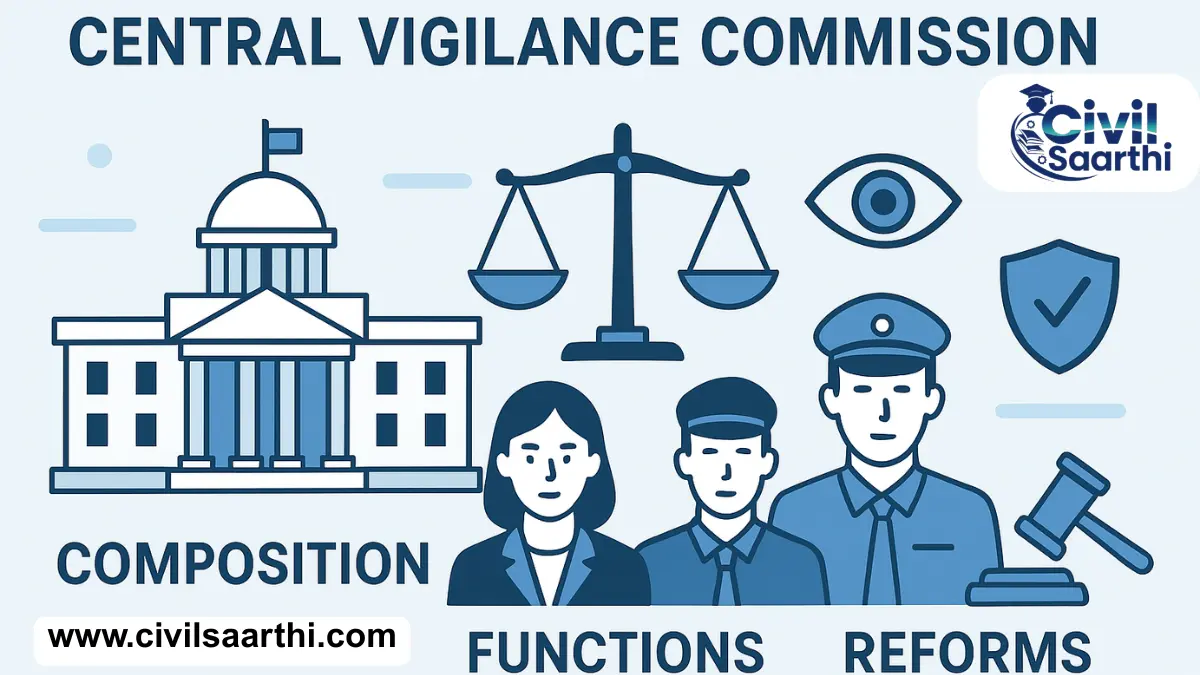
The Central Vigilance Commission (CVC) is India’s apex integrity institution that oversees vigilance administration and ensures accountability in the government machinery. Set up to combat corruption, the Central Vigilance Commission functions independently of executive control and plays a key role in supervising vigilance activities across ministries and public sector units.
Central Vigilance Commission
The Central Vigilance Commission was established in 1964 based on the recommendations of the Santhanam Committee and was later given statutory status through the CVC Act of 2003. As an independent authority, the Central Vigilance Commission supervises vigilance activities, advises the government in disciplinary matters, and acts as the nodal agency for implementing anti-corruption policies.
Central Vigilance Commission Overview
The Central Vigilance Commission is an autonomous body under the Government of India. It monitors all vigilance activities and investigates corruption cases involving central government employees and public sector enterprises.
Central Vigilance Commission Overview | |
| Particulars | Details |
| Name | Central Vigilance Commission |
| Established | 1964 (statutory status in 2003) |
| Legal Basis | Central Vigilance Commission Act, 2003 |
| Type | Statutory body |
| Jurisdiction | Central Government offices, PSUs, Banks, etc. |
| Headquarters | New Delhi |
| Reports To | President of India |
Composition and Structure of Central Vigilance Commission
The Central Vigilance Commission is composed of a Central Vigilance Commissioner and two Vigilance Commissioners. They are appointed by the President on the recommendation of a high-level committee.
| Composition and Structure of Central Vigilance Commission | |
| Position | Appointment Process |
| Central Vigilance Commissioner | Appointed by President on recommendation of a 3-member committee |
| Vigilance Commissioners | Maximum of two; appointed in the same manner |
| Appointment Committee | Prime Minister (Chair), Home Minister, and Leader of Opposition in Lok Sabha |
Powers and Functions of Central Vigilance Commission
The Central Vigilance Commission performs multiple key functions to ensure vigilance and prevent corruption in public offices.
| Powers and Functions of Central Vigilance Commission | |
| Function | Description |
| Advisory Role | Advises central government in vigilance and disciplinary cases |
| Supervision of CBI | Supervises investigations under the Prevention of Corruption Act |
| Monitoring Vigilance Administration | In central ministries, PSUs, and other public bodies |
| Reviewing Progress | Reviews progress of pending vigilance cases |
| Complaint Handling | Receives and acts on complaints from whistle-blowers |
| Direction to Departments | Can give directions for preventive vigilance |
Legal and Constitutional Status of Central Vigilance Commission
The Central Vigilance Commission is a statutory body but not a constitutional one. It derives authority from the CVC Act, 2003, passed by Parliament following Supreme Court directives in the Vineet Narain case.
| Legal and Constitutional Status of Central Vigilance Commission | |
| Status Type | Details |
| Constitutional Status | Not a constitutional body |
| Statutory Status | Yes, under the CVC Act, 2003 |
| Related Court Case | Vineet Narain v. Union of India (1997) – directed CVC reform |
| Related Committees | Santhanam Committee on Prevention of Corruption |
Role of Central Vigilance Commission in Preventing Corruption
The Central Vigilance Commission is central to India’s anti-corruption architecture and plays a significant role in coordination with other institutions like CBI and Lokpal.
- Exercises superintendence over CBI in corruption-related investigations
- Promotes systemic reforms in vigilance mechanisms across departments
- Maintains transparency through timely advisories and annual reports
- Encourages whistle-blower protection and grievance redressal under the Public Interest Disclosure Resolution (PIDPI)
Limitations and Criticisms of Central Vigilance Commission
Despite its importance, the Central Vigilance Commission has faced criticism over its limited powers and lack of enforcement authority.
| Limitations and Criticisms of Central Vigilance Commission | |
| Limitation | Impact |
| No Investigative Powers | Relies on CBI and departmental vigilance wings |
| Advisory Role Only | Cannot enforce its decisions; only recommends actions |
| Jurisdictional Limitations | No power over private sector or state government employees |
| Delay in Vigilance Cases | Recommendations often delayed or ignored by departments |
| Dependency on Political Will | Effectiveness varies with political and bureaucratic support |
Reforms and Way Forward for Central Vigilance Commission
To strengthen the Central Vigilance Commission, experts have suggested several structural and functional reforms.
| Reforms and Way Forward for Central Vigilance Commission | |
| Suggested Reform | Expected Outcome |
| Empower CVC with Investigative Powers | Reduce dependency on CBI |
| Make CVC’s Advice Binding | Increase accountability in bureaucracy |
| Better Whistle-blower Protection | Encourage citizen participation in anti-corruption efforts |
| Faster Disposal of Cases | Strengthen trust in vigilance processes |
| Coordination with Lokpal | Ensure synergy between anti-corruption agencies |
FAQs on Central Vigilance Commission
What is the Central Vigilance Commission?
The Central Vigilance Commission is a statutory body established to oversee vigilance administration and prevent corruption in central government departments and PSUs.
When was the Central Vigilance Commission established?
The Central Vigilance Commission was created in 1964 and was given statutory status in 2003 through the CVC Act.
Who appoints the Central Vigilance Commissioner?
The President of India appoints the Central Vigilance Commissioner based on recommendations by a committee comprising the PM, Home Minister, and Leader of Opposition in Lok Sabha.
What are the powers of the Central Vigilance Commission?
The Central Vigilance Commission has advisory powers and supervises vigilance work in central ministries, CBI, and PSUs but does not have direct investigation powers.
Is the Central Vigilance Commission a constitutional body?
No, the Central Vigilance Commission is a statutory body, not a constitutional one.
Does the Central Vigilance Commission control the CBI?
The Central Vigilance Commission exercises superintendence over the CBI in cases under the Prevention of Corruption Act.
Can the Central Vigilance Commission investigate private sector corruption?
No, the Central Vigilance Commission’s jurisdiction is limited to public servants under the Central Government and does not include private companies or state officers.