 by
by 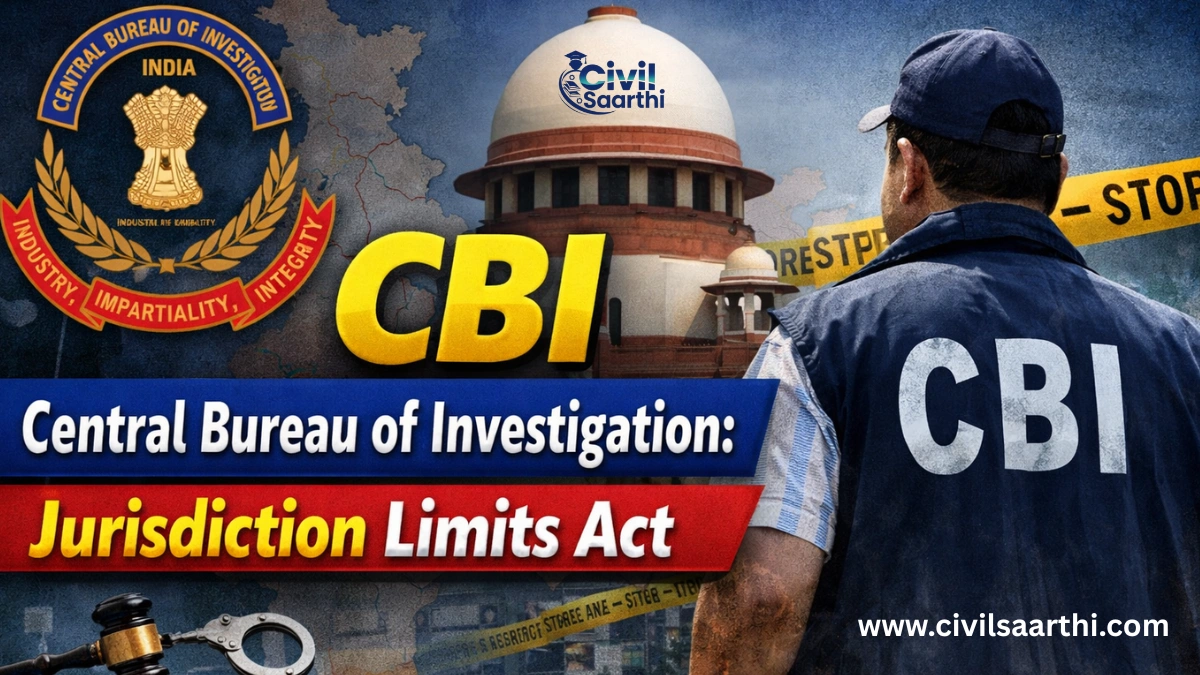
The CBI (Central Bureau of Investigation) is India’s apex investigative agency that deals with corruption, economic offenses, and serious criminal cases. Known for handling high-profile and sensitive matters, the CBI plays a crucial role in ensuring transparency and justice in public administration. Though it is not a constitutional or statutory body, the CBI operates under the Delhi Special Police Establishment Act (DSPE), 1946. For UPSC, understanding the CBI’s functions, powers, limitations, and reforms is important across GS2, GS3, and Ethics.
Central Bureau of Investigation (CBI)
The Central Bureau of Investigation (CBI) is India’s premier investigative agency, established in 1963 under the Delhi Special Police Establishment Act, 1946. It investigates corruption, economic offenses, and serious crimes across the country and serves as the nodal agency for INTERPOL in India. Though not a constitutional body, the CBI functions under the administrative control of the Ministry of Personnel and reports to the Prime Minister’s Office. Its role in ensuring accountability and justice makes it a crucial topic for UPSC GS-II and GS-III.
CBI – Central Bureau of Investigation
The CBI was set up in 1963 based on the recommendations of the Santhanam Committee. It functions under the Ministry of Personnel and reports to the Prime Minister’s Office. The CBI is tasked with probing corruption in government departments, economic frauds, and inter-state crimes. The agency is also India’s nodal point for INTERPOL coordination. Below is a summary table to provide a snapshot of essential facts about the CBI.
CBI – Central Bureau of Investigation for UPSC | |
| Feature | Details |
| Full Form | Central Bureau of Investigation |
| Established | 1963 (via executive resolution) |
| Legal Basis | Delhi Special Police Establishment (DSPE) Act, 1946 |
| Nature | Non-statutory body |
| Parent Ministry | Ministry of Personnel, Public Grievances, and Pensions |
| Headquarters | New Delhi |
| Reporting To | Prime Minister’s Office |
Central Bureau of Investigation Organizational Structure
The CBI has a hierarchical structure with officers recruited from IPS, IRS, and other central services. It is divided into various divisions like Anti-Corruption, Economic Offenses, and Special Crimes. Each division is overseen by senior officers such as Joint Directors and DIGs. This structure enables the CBI to investigate specialized areas while ensuring coordination and central control.
Organizational Structure of CBI – Central Bureau of Investigation | |
| Post/Division | Description |
| Director | Head of CBI; fixed 2-year tenure |
| Special Director | Assists Director in overall management |
| Joint Directors | Manage different zones and branches |
| Anti-Corruption Division | Investigates cases under Prevention of Corruption Act |
| Economic Offenses Division | Handles bank frauds, money laundering, and white-collar crimes |
| Special Crimes Division | Deals with inter-state crimes, terrorism, and cybercrimes |
Central Bureau of Investigation Jurisdiction and Powers of CBI
The CBI operates across India but requires consent from state governments to investigate cases in their jurisdictions. This often leads to limitations, especially when states withdraw general consent. The CBI’s authority comes from the DSPE Act, which gives it police powers in Union Territories and approved states. It also acts as India’s INTERPOL liaison and is empowered to make arrests, conduct raids, and file chargesheets.
Jurisdiction and Powers of CBI – Central Bureau of Investigation | |
| Area | Powers of CBI |
| Legal Authority | DSPE Act, 1946 |
| Jurisdiction | Union Territories & consenting states |
| Investigative Powers | Arrest, search, seizure, interrogation, and charge-sheet filing |
| International Coordination | Nodal agency for INTERPOL in India |
| Court Prosecution | Conducts trials in CBI-designated courts |
Central Bureau of Investigation Functions
The CBI has multifaceted roles. Its primary function is to investigate corruption involving central government officials. It also looks into complex crimes such as cyber fraud, financial scams, and high-level conspiracies. The agency has jurisdiction over inter-state crimes and special authority in cases referred by the Supreme Court or High Courts. The table below summarizes the core functions of the CBI.
Functions of CBI – Central Bureau of Investigation | |
| Function | Description |
| Anti-Corruption | Investigation under the Prevention of Corruption Act |
| Economic Offenses | Bank frauds, money laundering, corporate scams |
| Special Crimes | Terrorism, murder, kidnapping, and major criminal cases |
| Cybercrime | Digital frauds, cyber espionage |
| Judiciary-Referred Cases | Takes up cases based on court orders |
Major Cases Handled by CBI – Central Bureau of Investigation
Over the years, the CBI has handled some of India’s most controversial and politically sensitive cases. These cases brought the agency into the limelight but also raised concerns over its neutrality. The following table highlights a few landmark investigations carried out by the CBI, illustrating its influence in India’s justice system.
Major Cases Handled by CBI – Central Bureau of Investigation | ||
| Case Name | Type of Crime | Outcome/Remarks |
| 2G Spectrum Scam | Corruption in telecom | Initial arrests, later acquittals in lower court |
| Satyam Scam | Corporate fraud | Convictions, improved corporate governance norms |
| Nirav Modi PNB Scam | Bank fraud | Ongoing extradition and asset seizures |
| Vyapam Scam | Recruitment scandal | Over 40 mysterious deaths linked to the case |
| Bofors Scandal | Defense procurement fraud | Case re-opened multiple times, no convictions |
Central Bureau of Investigation Issues and Challenges Faced by CBI
Despite its reputation, the CBI is often criticized for being influenced by political pressure and executive control. The Supreme Court once termed it a “caged parrot.” Delays in trials, lack of independence, and withdrawal of consent by states are major challenges. The table below summarizes the most pressing issues faced by the CBI.
Issues and Challenges Faced by CBI – Central Bureau of Investigation | |
| Challenge | Impact on CBI’s Effectiveness |
| Lack of Statutory Backing | Weakens autonomy and legal protections |
| Political Interference | Undermines public trust in impartial investigations |
| Consent Issues with States | Limits the agency’s ability to act in non-consenting states |
| Judicial Backlog | Delays justice and affects conviction rates |
| Human Resource Shortage | Reduces investigative efficiency |
Reforms and Way Forward for CBI – Central Bureau of Investigation
To restore faith in the CBI, various reforms have been suggested. Experts call for granting statutory status, ensuring transparent appointments, and creating independent oversight. Modernization and better coordination with state police forces are also crucial for CBI’s effectiveness in a federal structure. The table below provides key reform suggestions for strengthening the CBI.
Reforms and Way Forward for CBI – Central Bureau of Investigation | |
| Reform Suggestion | Expected Outcome |
| Enact a CBI Act | Provide statutory and legal clarity |
| Fixed Tenure for Director | Prevent arbitrary transfers |
| Judicial Oversight | Ensure transparency in high-profile investigations |
| Fast-Track Courts | Speedy disposal of corruption and economic offense cases |
| Inter-State Coordination | Reduce friction with state police and improve operational scope |
FAQs on CBI – Central Bureau of Investigation
What is the full form of CBI?
The full form of CBI is Central Bureau of Investigation.
Is CBI a statutory body?
No, CBI is a non-statutory body. It operates under the DSPE Act, 1946.
Who appoints the CBI Director?
The CBI Director is appointed by a committee consisting of the Prime Minister, Leader of Opposition in Lok Sabha, and Chief Justice of India.
Why do some states withdraw consent to CBI?
Some states claim that the CBI is misused by the central government for political purposes and therefore withdraw “general consent.”
Does CBI investigate all crimes in India?
No, the CBI investigates select crimes such as corruption, economic frauds, and serious inter-state cases, and requires state consent.
What are CBI’s divisions?
The CBI has divisions for Anti-Corruption, Economic Offenses, Special Crimes, Policy and Coordination, and Cybercrime.
What are reforms needed in CBI?
Reforms include granting it statutory status, improving autonomy, strengthening inter-state coordination, and fast-tracking trials.