
 by
by 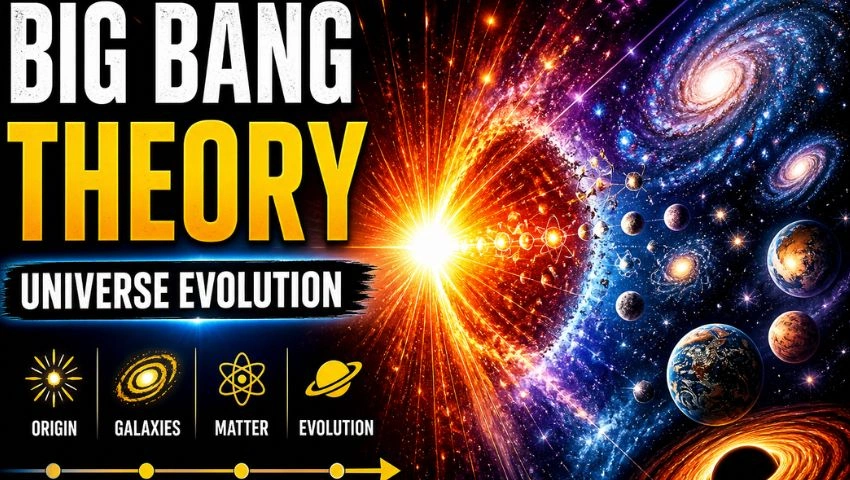
From the mysteries of black holes to the glow of distant galaxies, the story of the universe is a narrative that has intrigued humankind for centuries. At the heart of this story lies the Big Bang Theory, which seeks to explain how the universe came into existence and how it has expanded over time. These ideas are not just the foundation of astrophysics but also deeply connected to our understanding of space, time, and matter.
The Universe, Big Bang Theory and the Evolution of the Universe
The Big Bang Theory suggests that the universe began from a state of extremely high temperature and density nearly 13.8 billion years ago, and it has been expanding ever since. The concept of a singularity—a point with infinite mass and zero volume marks the beginning of this cosmic journey. Over billions of years, this expansion led to the formation of galaxies, stars and planets, includinga our own Earth. The theory is backed by several pieces of scientific evidence, including Cosmic Microwave Background Radiation (CMBR) and redshift in galaxies.
Overview – The Universe and Its Evolution
The universe is a vast and dynamic entity, constantly evolving from its origin in a high-energy event to its present structure filled with galaxies, dark matter and cosmic dust. Over time, astronomers have developed different models to explain its behavior and composition.
| Overview – The Universe and Its Evolution | ||
| Stage of Evolution | Timeline After Big Bang | Key Features |
| Singularity | Time = 0 | Infinite density and zero volume |
| Big Bang | ~13.8 billion years ago | Rapid expansion, beginning of time & space |
| Inflationary Period | 10⁻³⁶ to 10⁻³² seconds | Universe expands exponentially |
| Formation of Atoms | ~3,80,000 years | Atoms form; universe becomes transparent |
| Star & Galaxy Formation | ~1 billion years onward | First stars and galaxies take shape |
| Present Universe | Now | Continually expanding universe |
Evolution of the Big Bang Theory
The Big Bang Theory wasn’t born overnight. It gradually evolved from observations and mathematical models that challenged the idea of a static universe. In the 1920s, Edwin Hubble observed that galaxies are moving away from us — a discovery that hinted at an expanding universe. Later, scientists like Georges Lemaitre and George Gamow proposed that the universe had a beginning, and all matter once existed in a single point.
| Overview – The Universe and Its Evolution | |
| Contributor | Contribution to the Theory |
| Georges Lemaitre | Proposed the idea of a “primordial atom” |
| Edwin Hubble | Observed redshift; proved universe expansion |
| George Gamow | Developed nuclear physics aspect of Big Bang |
| Arno Penzias & Robert Wilson | Discovered CMBR in 1965 |
Formation of the Present Universe
The universe today is filled with galaxies, stars, planets, and dark matter, but its structure evolved slowly. Following the Big Bang, the universe cooled down, allowing subatomic particles to form atoms. Over millions of years, these atoms grouped together under gravity to create stars and galaxies.
| Formation of the Present Universe | |
| Component of Universe | Approximate Composition |
| Dark Energy | ~68% |
| Dark Matter | ~27% |
| Ordinary Matter | ~5% |
Singularity
At the very beginning, the universe is thought to have existed as a singularity—an extremely dense point where gravity and quantum physics intersected. At this moment, space and time did not exist separately, and conventional physics cannot fully explain this state. The concept of singularity is crucial because it sets the stage for the Big Bang and defines the boundary where classical physics breaks down, leading to new models in quantum gravity and string theory.
The Big Bang
The Big Bang was not an explosion in space; it was an expansion of space itself. In an instant, all matter, energy, space, and time began expanding from a highly dense and hot state. This event occurred around 13.8 billion years ago, and it continues even today in the form of an expanding universe. During the initial moments, the universe was a soup of quarks, electrons, and photons. As it expanded and cooled, these particles combined to form protons, neutrons, and later atoms.
Evidence Supporting the Big Bang Theory
The Big Bang Theory is not speculative; it is grounded in a number of solid scientific observations. These findings from astrophysics and cosmology validate many of its predictions.
| Evidence Supporting the Big Bang Theory | |
| Type of Evidence | Explanation |
| Redshift of Galaxies | Galaxies are moving away, showing universe expansion |
| Cosmic Microwave Background | Thermal radiation leftover from the early universe |
| Abundance of Light Elements | Matches predictions from nucleosynthesis models |
| Large Scale Structure | Distribution of galaxies fits Big Bang simulations |
The Expanding Universe
One of the most important revelations in modern cosmology is that the universe is not static but expanding. The further away a galaxy is, the faster it appears to be receding. This observation, known as Hubble’s Law, provides direct evidence for the Big Bang model. Modern data from satellites like Planck and WMAP show that the rate of expansion, or the Hubble Constant, may even be changing, suggesting a dynamic and possibly accelerating universe.
Cosmic Microwave Background Radiation (CMBR)
CMBR is often called the echo of the Big Bang. Discovered accidentally in 1965, this faint microwave radiation pervades the entire universe. It is the leftover heat from the time when the universe was about 380,000 years old, when atoms first formed and light could travel freely.
CMBR provides a snapshot of the infant universe and supports many predictions made by the Big Bang Theory.
Evidence Against Big Bang Theory
While the Big Bang Theory explains much, it doesn’t answer everything. Several gaps and anomalies have prompted questions and criticisms. Some argue that it cannot fully explain what existed before the Big Bang, or why the universe’s expansion rate is accelerating.
| Evidence Against Big Bang Theory | |
| Criticism/Challenge | Issue Raised |
| Horizon Problem | Uniformity of CMBR despite causally disconnected regions |
| Flatness Problem | Universe appears geometrically flat |
| Monopole Problem | Big Bang doesn’t account for absence of magnetic monopoles |
| Dark Matter & Energy | These are unexplained by classical Big Bang |
Alternative Theories of the Universe
Given these issues, some scientists have proposed alternative or complementary models to the Big Bang. These theories attempt to either modify or replace the standard model of cosmology.
| Alternative Theories of the Universe | |
| Theory Name | Key Idea |
| Steady State Theory | Universe has no beginning or end; it always existed |
| Cyclic Universe Theory | Universe goes through cycles of expansion and contraction |
| Multiverse Theory | Suggests existence of multiple or infinite universes |
| Ekpyrotic Model | Universe created from collision of branes in higher dimensions |
FAQs
What is the Big Bang Theory?
It’s a scientific explanation for the origin of the universe, suggesting that it began expanding from a singular point about 13.8 billion years ago.
Who proposed the Big Bang Theory?
While many contributed, Georges Lemaître is credited with the idea of a “primordial atom.” Edwin Hubble provided observational proof.
What is Cosmic Microwave Background Radiation (CMBR)?
CMBR is the remnant heat from the Big Bang, detected as low-level microwave radiation across space.
Is the universe still expanding?
Yes, galaxies are moving away from each other, indicating continuous expansion.
What is meant by singularity?
Singularity refers to a point of infinite density and zero volume, believed to be the universe’s origin state.
Does the Big Bang Theory explain everything?
No, it has limitations, especially regarding the origin of dark matter, dark energy and conditions before the Big Bang.
What are alternative theories to the Big Bang?
Some popular alternatives include the Steady State Theory, Cyclic Universe and Multiverse Hypothesis.