 by
by 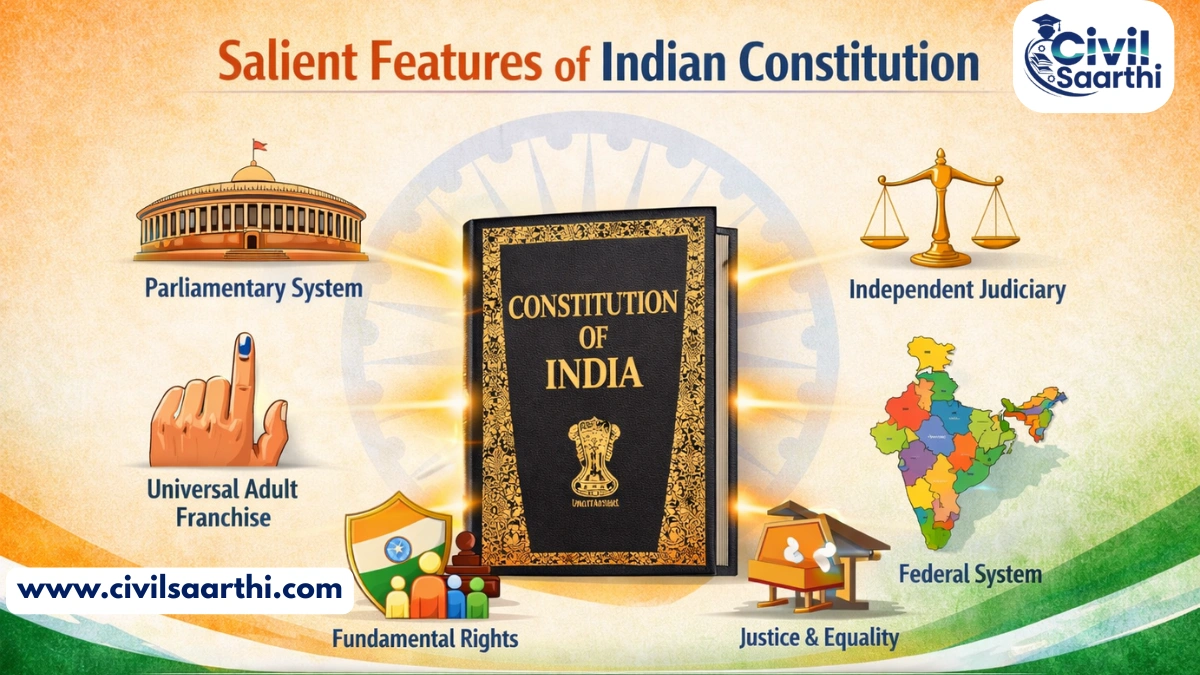
The Indian Constitution is the supreme law of the land and serves as the foundation of India’s democratic governance. Adopted on 26th January 1950, it is one of the most detailed and dynamic constitutions in the world. Its design reflects India’s diversity, history, and aspirations, making it both unique and adaptable. This article explores the salient features of the Indian Constitution in detail, including its structure, sources, and key provisions.
1. Lengthiest Written Constitution in the World
The Indian Constitution is the longest written Constitution in the world. It contains detailed provisions covering the structure of government, rights of citizens, Centre–State relations, emergency powers, and local governance. Its length reflects India’s vast diversity, historical background, and the need for clarity in administration.
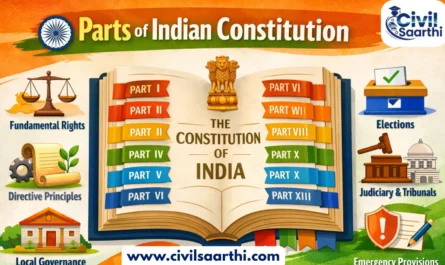
- Originally contained 395 Articles, 22 Parts, and 8 Schedules along with a Preamble.
- At present, it has around 470 Articles, 25 Parts, and 12 Schedules.
- Provides a single Constitution for both the Union and the States.
- Includes detailed provisions on Fundamental Rights, Directive Principles, and Fundamental Duties.
- Clearly defines powers and functions of the executive, legislature, and judiciary.
- Contains elaborate emergency provisions to deal with extraordinary situations.
- Borrowed many administrative details from the Government of India Act, 1935.
- Covers local self-government through constitutional status to Panchayats and Municipalities.
2. Borrowed Features from Different Countries
The Indian Constitution has borrowed important features from various world constitutions. However, it is not a copy; the framers carefully selected and modified these features according to Indian needs and conditions. This borrowing helped in creating a strong and practical constitutional framework.
- Federal structure, emergency provisions, and office of Governor were taken from the Government of India Act, 1935.
- Parliamentary system, Rule of Law, Cabinet system, and bicameral legislature were adopted from the British Constitution.
- Fundamental Rights, Judicial Review, impeachment procedure, and independence of judiciary were inspired by the US Constitution.
- Directive Principles of State Policy were borrowed from the Irish Constitution.
- The idea of a strong Centre and residuary powers were taken from the Canadian Constitution.
- Concurrent List and joint sitting of Parliament were inspired by the Australian Constitution.
- Fundamental Duties were influenced by the Soviet Constitution.
- Ideals of Liberty, Equality, and Fraternity were inspired by the French Constitution.
- Amendment procedure was influenced by the South African Constitution.
- Borrowed provisions were modified to suit India’s social, political, and economic conditions.
3. Blend of Rigidity and Flexibility
The Indian Constitution is neither completely rigid nor completely flexible. It combines both qualities to maintain stability while allowing necessary changes. This balance helps the Constitution adapt to changing circumstances without losing its basic structure.
- Some provisions can be amended by a simple majority of Parliament like ordinary laws.
- Important provisions require a special majority of two-thirds in Parliament.
- Certain federal provisions need approval of at least half of the state legislatures.
- Article 368 provides the procedure for constitutional amendments.
- This system protects important features like federalism and judiciary.
- It allows social and political reforms through amendments.
- More than 100 amendments have been passed, showing flexibility.
- At the same time, the Basic Structure Doctrine prevents misuse of amendment power.
- The Constitution remains stable yet dynamic.
4. Federal System with Unitary Bias
India has a federal system of government, where powers are divided between the Centre and the States. However, the Constitution also gives strong powers to the Centre, making it federal in form but unitary in spirit. This system ensures unity and national integrity.
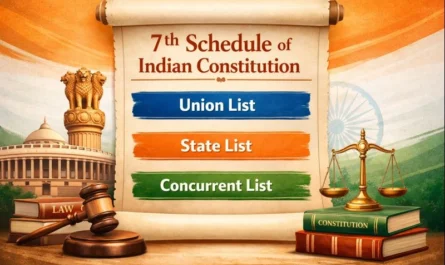
- Powers are divided into Union List, State List, and Concurrent List.
- There are two levels of government: Central and State governments.
- The Constitution is written and supreme over both Centre and States.
- An independent judiciary settles disputes between Centre and States.
- India has a bicameral legislature at the Centre.
- The Centre has more powers than the States.
- Governors of states are appointed by the President.
- Single Constitution and single citizenship exist in India.
- Emergency provisions can make the system unitary during crisis.
- Article 1 describes India as a “Union of States,” and states cannot secede from the Union.
5. Parliamentary System of Government
India follows the Parliamentary system in which the executive is responsible to the legislature. The real executive power lies with the Council of Ministers headed by the Prime Minister, while the President is the nominal head.
- Nominal and Real Executive – The President is the constitutional head, but real powers are exercised by the Prime Minister and Council of Ministers.
- Collective Responsibility – The Council of Ministers is collectively responsible to the Lok Sabha.
- Leadership of Prime Minister – The Prime Minister is the head of government and leader of the majority party.
- Dissolution of Lower House – The Lok Sabha can be dissolved before completing its term.
- Fusion of Powers – Executive members are part of the Legislature.
- Political Homogeneity – Ministers usually belong to the majority party or coalition.
6. Independent Judiciary
The Constitution provides for an independent judiciary to protect the supremacy of the Constitution and safeguard Fundamental Rights. The judiciary acts as the guardian of the Constitution and ensures rule of law in the country.
- Supremacy of Constitution – Courts ensure that laws follow the Constitution.
- Judicial Review – The judiciary can strike down unconstitutional laws.
- Security of Tenure – Judges have fixed tenure and cannot be removed easily.
- Fixed Service Conditions – Salaries and allowances cannot be reduced during tenure.
- Separation from Executive – Judiciary functions independently from the government.
- Integrated Judicial System – Single system from Supreme Court to subordinate courts.
7. Fundamental Rights
Fundamental Rights are essential rights guaranteed to citizens for their overall development. These rights protect individuals from arbitrary actions of the state and ensure equality and freedom.
- Right to Equality (Articles 14–18) – Ensures equality before law.
- Right to Freedom (Articles 19–22) – Protects freedoms like speech and movement.
- Right against Exploitation (Articles 23–24) – Prohibits forced labour and child labour.
- Right to Freedom of Religion (Articles 25–28) – Guarantees religious freedom.
- Cultural and Educational Rights (Articles 29–30) – Protect minority interests.
- Right to Constitutional Remedies (Article 32) – Allows citizens to approach courts.
8. Directive Principles of State Policy (DPSP)
Directive Principles of State Policy (DPSP) are guidelines given to the government to establish social and economic democracy. Though non-justiciable, they are fundamental in governance.
- Non-Justiciable Nature – Cannot be enforced in courts.
- Social Justice Goals – Aim to reduce inequality.
- Welfare State Concept – Promote welfare of the people.
- Equal Pay for Equal Work – Ensure fairness in wages.
- Promotion of Education and Health – Improve living standards.
- International Peace – Encourage global harmony.
9. Single Citizenship
India provides single citizenship to all its citizens, unlike some federal countries. Every person is only a citizen of India and not of any particular state.
- Uniform Citizenship – No separate state citizenship.
- Promotes National Unity – Strengthens national integration.
- Equal Rights Across States – Citizens enjoy equal rights everywhere.
- Prevents Regionalism – Reduces state-based discrimination.
- Inspired by British System – Adopted from the UK model.
- Strengthens Federal Structure – Supports unity with diversity.
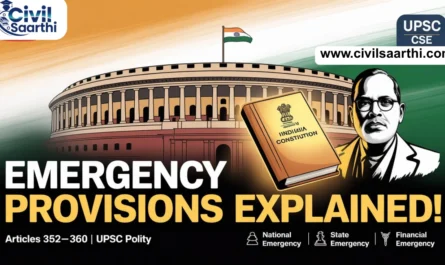
10. Emergency Provisions
- The Constitution provides emergency provisions to deal with extraordinary situations. During emergencies, the Centre becomes more powerful to maintain unity and integrity.
- National Emergency (Article 352) – Declared during war or external aggression.
- State Emergency (Article 356) – President’s Rule in states.
- Financial Emergency (Article 360) – Declared during financial crisis.
- Centralized Power – Centre controls state subjects.
- Suspension of Rights – Certain Fundamental Rights may be restricted.
- Ensures Stability – Maintains law and order during crisis.
11. Universal Adult Franchise
The Constitution grants the right to vote to all citizens above 18 years of age without discrimination. This ensures political equality and strengthens democracy in India.
- Right to Vote at 18 Years – Every citizen above 18 years can vote.
- No Discrimination – No restriction based on caste, religion, gender, or wealth.
- Political Equality – Each vote has equal value.
- Largest Democracy – Makes India the world’s largest democratic electorate.
- Free and Fair Elections – Conducted by an independent Election Commission.
- Promotes People’s Participation – Citizens directly participate in governance.
12. Secular State
India is a secular state where the government has no official religion. All religions are treated equally, and citizens have the freedom to practice and propagate their faith.
- No State Religion – The state does not promote any religion.
- Equal Respect for All Religions – Principle of religious neutrality.
- Freedom of Religion – Citizens can practice and propagate religion.
- No Religious Discrimination – Equality before law in religious matters.
- State Intervention if Needed – Government can regulate secular activities of religion.
- Promotes Unity in Diversity – Encourages peaceful coexistence.
13. Fundamental Duties
Fundamental Duties were added to remind citizens of their responsibilities towards the nation. They promote discipline, patriotism, and national unity.
- Added by 42nd Amendment (1976) – Inspired by the Soviet Constitution.
- Moral Obligations – Not legally enforceable.
- Promote National Unity – Encourage harmony and brotherhood.
- Respect Constitution and National Symbols – Duty of every citizen.
- Protect Environment – Duty to safeguard forests and wildlife.
- Promote Scientific Temper – Develop spirit of inquiry and reform.
14. Integrated and Single Judicial System
India has a single integrated judicial system for both the Centre and the States. The judiciary works in a unified manner to maintain uniformity in laws and justice delivery.
- Single Hierarchy of Courts – From Supreme Court to subordinate courts.
- No Separate State Courts System – Unlike the USA.
- Uniform Application of Law – Same laws interpreted across India.
- Supreme Court at the Apex – Highest judicial authority.
- High Courts in States – Head of state judiciary.
- Ensures Legal Unity – Maintains consistency in judicial decisions.
15. Special Provisions for Certain States
The Constitution provides special provisions for certain states to protect their unique social, cultural, and administrative needs. These provisions ensure balanced regional development.
- Article 371 to 371J – Special provisions for some states.
- Protection of Tribal Areas – Safeguards local customs and land rights.
- Autonomous Councils – For administration in certain regions.
- Developmental Safeguards – Promote regional growth.
- Cultural Protection – Preserve traditions and identity.
- Ensures National Integration – Balances unity with regional diversity.