 by
by 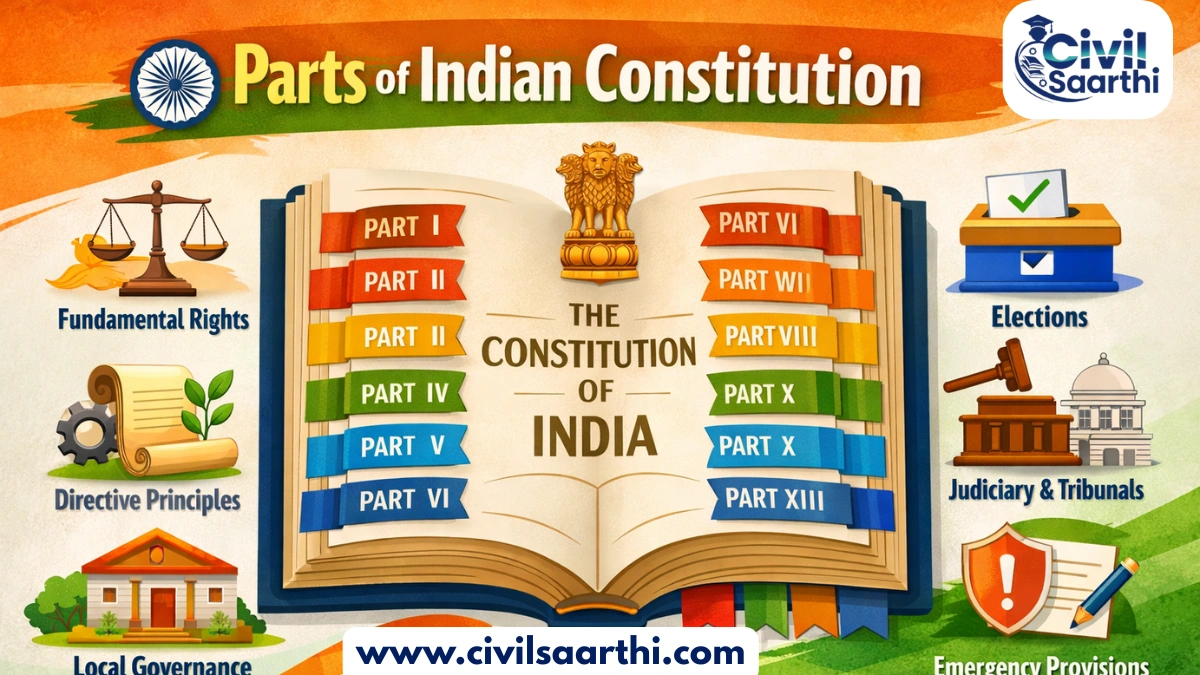
The Indian Constitution, adopted on 26th January 1950, is the supreme law of India. It lays down the framework defining the political principles, powers, duties, and structure of government. Originally the Indian Constituion consisted of 22 Parts and 8 Schedules. Now it consists of 25 Parts and 12 Schedules, covering everything from the structure of government to Fundamental Rights and Directive Principles of State Policy.
Parts of Indian Constitution List
The Constitution’s 25 Parts cover distinct areas, from governance to citizen rights and emergency provisions. Here’s a detailed table of all 25 Parts:
| Part | Topic | Key Features & Explanation | Examples |
|---|---|---|---|
| Part I | The Union and its Territory | Defines India as a Union of States, lays down territory, formation of new states, and state boundaries. | Formation of Telangana (2014) |
| Part II | Citizenship | Details Indian citizenship at the commencement of the Constitution and rules for acquiring or losing citizenship. | Citizenship Act, 1955 |
| Part III | Fundamental Rights | Enforceable rights ensuring liberty, equality, and protection from discrimination; includes Articles 12-35. | Right to Equality, Right to Freedom of Speech |
| Part IV | Directive Principles of State Policy | Guidelines for government policies to establish socio-economic justice; non-justiciable. | Mahatma Gandhi National Rural Employment Guarantee Scheme |
| Part IV-A | Fundamental Duties | Duties of citizens to promote patriotism, constitutional spirit, and social responsibility. | Duty to protect environment (Article 51A(g)) |
| Part V | The Union | Structure of central government including President, Vice-President, Union Parliament, Union Executive, and legislative powers. | President’s role during parliamentary dissolution |
| Part VI | The States | Structure, powers, and functions of state governments, including Governor, State Legislature, and State Executive. | Legislative Assembly functioning in Uttar Pradesh |
| Part VII | States in Part B of First Schedule | Repealed. Initially covered certain princely states integrated into India. | Historical context; States Reorganisation Act (1956) |
| Part VIII | Union Territories | Administration and governance of Union Territories under central control. | Delhi, Puducherry governance structure |
| Part IX | The Panchayats | Rural local self-government institutions to promote decentralized democracy; Articles 243-243O. | Gram Panchayat functioning |
| Part IX-A | The Municipalities | Urban local self-government including Municipal Corporations and Municipal Councils; Articles 243P-243ZG. | Delhi Municipal Corporation |
| Part X | Scheduled and Tribal Areas | Administration and governance of tribal areas; special protections for tribal communities. | Fifth and Sixth Schedule areas in Northeast India |
| Part XI | Relations between the Union and States | Distribution of powers through Union List, State List, and Concurrent List. | Union vs State authority on education policy |
| Part XII | Finance, Property, Contracts | Fiscal relations, allocation of resources, state property, and government contracts. | Goods and Services Tax (GST) framework |
| Part XIII | Trade, Commerce and Intercourse | Regulation of trade, commerce, and economic interconnection across states. | Inter-state trade of agricultural products |
| Part XIV | Services under the Union and States | Civil services structure, public service commissions, and recruitment processes. | Indian Administrative Service (IAS) |
| Part XIV-A | Tribunals | Administrative and quasi-judicial tribunals for disputes and appeals. | Income Tax Appellate Tribunal |
| Part XV | Elections | Conduct of elections to Parliament, State Legislatures, President, and Vice-President. | Election Commission guidelines |
| Part XVI | Special Provisions for SC/ST | Protection, reservation, and welfare for Scheduled Castes and Tribes. | Reservation in educational institutions and jobs |
| Part XVII | Official Language | Official languages of the Union; Hindi in Devanagari script; English usage for official purposes. | Hindi and English for central administration |
| Part XVIII | Emergency Provisions | Types of emergencies (national, state, financial) and powers during emergencies. | National Emergency during 1975-77 |
| Part XIX | Miscellaneous | Provisions covering general and miscellaneous matters like liability of government. | Government indemnity in certain cases |
| Part XX | Amendment of the Constitution | Procedures for amending the Constitution, requiring Parliament and sometimes state ratification. | 42nd Amendment Act, 1976 |
| Part XXI | Temporary, Transitional and Special Provisions | Transitional arrangements for states, special provisions for certain regions. | Article 370 (Jammu & Kashmir, now repealed) |
| Part XXII | Short Title, Commencement, Authoritative Text | Final provisions including enforcement date and authoritative texts. | Constitution came into force on 26 Jan 1950 |
Also Read: Schedules of Indian Constituion
Parts of Indian Constitution Detailed Explanation
The Indian Constitution consists of 25 Parts, covering the Union, States, citizenship, Fundamental Rights, Directive Principles, and Fundamental Duties. It defines governance at the Union, State, and local levels, including emergency provisions, official languages, elections, and provisions for SC/ST and tribal areas. Together, these Parts provide a comprehensive framework for democracy, federalism, social justice, and efficient governance in India.
Part I: The Union and its Territory (Articles 1-4)
Purpose: Part I declares India as a Union of States and defines the territorial scope of the country.
Key Features:
- India is a sovereign, democratic, and federal country, but the Constitution declares it as a Union to emphasize unity.
- Articles under this part empower the Parliament to admit new states or alter existing boundaries, ensuring flexibility for administrative efficiency.
- Protects India’s territorial integrity by giving legal authority to govern all parts of the country under a single Constitution.
Examples:
- Formation of Telangana (2014) as the 29th state of India.
- The States Reorganisation Act (1956) reorganized states based on linguistic lines.
Significance: This Part forms the foundation of India’s federal structure, ensuring unity and legal clarity on boundaries.
Part II: Citizenship (Articles 5-11)
Purpose: Defines who is a citizen of India and regulates acquisition, termination, and rights of citizenship.
Key Features:
- Citizenship at the commencement of the Constitution (1950).
- Acquisition of citizenship by birth, descent, registration, or naturalization.
- Parliament is empowered to modify or regulate citizenship laws.
Examples:
- Citizenship Act, 1955 provides rules for naturalization and dual citizenship restrictions.
- Amendments like CAA 2019 affect eligibility criteria for citizenship.
Significance: Ensures legal clarity on the status of citizens, which is crucial for rights and duties under Part III and IV-A.
Part III: Fundamental Rights (Articles 12-35)
Purpose: Protect citizens’ liberties and create a framework of justice, equality, and freedom.
Key Features:
- Right to Equality (Articles 14-18): Equality before law, prohibition of discrimination based on religion, caste, gender, or race.
- Right to Freedom (Articles 19-22): Freedom of speech, movement, assembly, and association, subject to reasonable restrictions.
- Right against Exploitation (Articles 23-24): Abolishes human trafficking, forced labor, and child labor.
- Right to Freedom of Religion (Articles 25-28): Protects religious freedom, allows secular governance.
- Cultural and Educational Rights (Articles 29-30): Protects linguistic, cultural, and minority education rights.
- Right to Constitutional Remedies (Article 32): Citizens can approach Supreme Court/High Courts to enforce Fundamental Rights.
Examples:
- Kesavananda Bharati Case (1973): Fundamental Rights are part of the basic structure and cannot be altered by amendment.
- Maneka Gandhi vs Union of India (1978): Expanded the interpretation of Right to Life under Article 21.
Significance: Fundamental Rights safeguard individual liberty and equality, ensuring the democratic ethos of India.
Part IV: Directive Principles of State Policy (Articles 36-51)
Purpose: Provides guidelines for the State to establish social, economic, and political justice.
Key Features:
- Non-justiciable; cannot be enforced in courts.
- Promote welfare, reduce inequalities, and ensure citizen well-being.
- Encourage state policies like free education, work security, and public health.
Examples:
- Mahatma Gandhi National Rural Employment Guarantee Scheme (MNREGA) promotes rural employment.
- Welfare laws for women and children reflect DPSP objectives.
Significance: Part IV complements Fundamental Rights, shaping India into a welfare state while guiding policy-making.
Part IV-A: Fundamental Duties (Article 51A)
Purpose: Lists duties of citizens to promote patriotism, constitutional values, and social harmony.
Key Features:
- Added by 42nd Amendment (1976).
- Includes duty to respect Constitution, safeguard public property, protect environment, and promote scientific temper.
Examples:
- Duty to protect forest and wildlife supports environmental protection laws.
- Duty to promote harmony underpins anti-discrimination laws.
Significance:
Encourages citizens to be responsible participants in the democratic framework.
Part V: The Union (Articles 52-151)
Purpose: Lays down the structure and powers of the central government.
Key Features:
- President of India: Constitutional head and emergency powers.
- Vice-President: Role in Rajya Sabha and succession.
- Parliament: Lok Sabha and Rajya Sabha legislative powers.
- Union Executive: Prime Minister and Council of Ministers.
- Legislative powers: Union List, residuary powers, and concurrent powers with states.
Examples:
President’s role during parliamentary dissolution or emergency declaration.
Significance: Defines the core governance framework of India, ensuring a functioning democracy.
Part VI: The States (Articles 152-237)
Purpose: Establishes state governments and their powers in India’s federal system.
Key Features:
- Governor as state head; Chief Minister and Council of Ministers manage administration.
- State Legislature with Legislative Assembly and Legislative Council.
- Distribution of powers with Union ensures cooperative federalism.
Examples:
Legislative powers for states in areas like police, agriculture, and local government.
Significance: Maintains federal balance while allowing states autonomy within a Union framework.
Part VII: States in Part B of the First Schedule (Repealed)
Purpose: Initially dealt with the administration of Part B states (former princely states) integrated into India after independence.
Key Features:
- Defined the governance and integration of princely states into the Union.
- Repealed by the 7th Amendment Act, 1956, during the States Reorganisation Act, which reorganized states based on linguistic lines.
Significance: Though repealed, it played a historical role in the integration of princely states and the formation of modern India’s federal structure.
Part VIII: Union Territories (Articles 239-242)
Purpose: Provides administration of Union Territories (UTs) directly under the central government.
Key Features:
- President appoints an administrator for each UT.
- Legislative provisions for UTs vary; some have legislatures (like Delhi and Puducherry), others are administered directly by the President.
Examples:
- Delhi and Puducherry have elected legislatures;
- Lakshadweep and Chandigarh are centrally administered.
Significance: Ensures central oversight for strategic or small territories while maintaining local governance flexibility.
Part IX: The Panchayats (Articles 243-243O)
Purpose: Establishes rural local self-governments to empower villages and implement decentralized governance.
Key Features:
- Introduces three-tier system: Gram Panchayat, Block Samiti, Zila Parishad.
- Ensures reservation for SC/ST and women in local governance.
- Empowers Panchayats to implement local development programs.
Examples:
Implementation of Mahatma Gandhi National Rural Employment Guarantee Act (MGNREGA) at the village level.
Significance: Strengthens grassroots democracy and citizen participation in governance.
Part IX-A: The Municipalities (Articles 243P-243ZG)
Purpose: Provides urban local self-governments for cities and towns.
Key Features:
- Includes Municipal Corporations, Municipal Councils, and Nagar Panchayats.
- Ensures decentralized governance for urban areas, including urban planning, public health, and infrastructure.
- Mandates financial and administrative autonomy.
Examples:
Delhi Municipal Corporation manages urban services and sanitation.
Significance: Promotes efficient urban governance and citizen participation in city administration.
Part IX-B: Co-operative Societies (Articles 243ZH-243ZT)
Purpose: Provides a constitutional framework for co-operative societies to promote collective economic and social development.
Key Features:
- Empowers State Legislatures to regulate, incorporate, and manage co-operative societies.
- Ensures democratic governance and accountability within co-operative institutions.
- Promotes self-help, mutual assistance, and community welfare.
Examples:
- Agricultural co-operative societies for farmers’ credit and marketing.
- Co-operative banks and consumer co-operatives in rural and urban areas.
Significance: Part IX-B strengthens economic democracy, encourages community participation, and supports local development through structured co-operative institutions.
Part X: Scheduled and Tribal Areas (Articles 244-244A)
Purpose: Provides special governance and protection for tribal areas.
Key Features:
- Administered under Fifth and Sixth Schedule.
- Special provisions for autonomous district councils and local administration.
- Protects tribal land, culture, and social structure.
Examples:
Tribal councils in North-East India, like Mizoram and Meghalaya, manage local resources.
Significance: Preserves tribal identity and autonomy within the Indian federal framework.
Part XI: Relations between the Union and States (Articles 245-263)
Purpose: Defines distribution of legislative, administrative, and financial powers between the Union and States.
Key Features:
- Union List, State List, Concurrent List specify subjects for legislation.
- Provides mechanisms for resolving disputes between Union and States.
- Encourages cooperative federalism.
Examples:
Union has power over defense; States over police and agriculture; both can legislate on education.
Significance: Maintains a balance of power while ensuring governance efficiency.
Part XII: Finance, Property, Contracts (Articles 264-300A)
Purpose: Governs financial relations, allocation of resources, and government property.
Key Features:
- Division of taxes and revenues between Union and States.
- Grants-in-aid and borrowing powers.
- Government contracts and property ownership rules.
Examples:
Implementation of Goods and Services Tax (GST) under cooperative federalism.
Significance: Ensures financial stability and equitable resource distribution across India.
Part XIII: Trade, Commerce and Intercourse (Articles 301-307)
Purpose: Regulates inter-state and intra-state trade, commerce, and movement of goods and citizens.
Key Features:
- Freedom of trade across India, subject to reasonable restrictions.
- Parliament can make laws for trade regulation in emergencies.
Examples:
Regulation of agricultural trade between Maharashtra and Gujarat.
Significance: Promotes economic unity and smooth inter-state commerce.
Part XIV: Services under the Union and States (Articles 308-323)
Purpose: Governs civil services and public employment.
Key Features:
- Establishes All India Services, Union Services, and State Services.
- Provides for Public Service Commissions and disciplinary proceedings.
Examples:
Recruitment of Indian Administrative Service (IAS) officers and their allocation to states.
Significance: Maintains efficiency, neutrality, and accountability in public administration.
Part XIV-A: Tribunals (Articles 323A-323B)
Purpose: Establishes administrative and quasi-judicial tribunals for specialized disputes.
Key Features:
- Tribunals for taxation, service disputes, and administrative law.
- Relieves regular courts of specialized matters.
Examples:
Income Tax Appellate Tribunal (ITAT) resolves tax disputes efficiently.
Significance: Ensures speedy, expert adjudication in specialized areas of law.
Part XV: Elections (Articles 324-329A)
Purpose: Provides framework for free, fair, and regular elections.
Key Features:
- Establishes Election Commission of India.
- Regulates elections for Parliament, State Legislatures, President, and Vice-President.
Examples:
Conduct of general elections to Lok Sabha every five years.
Significance: Protects democracy and electoral integrity in India.
Part XVI: Special Provisions for SC/ST (Articles 330-342)
Purpose: Ensures representation and protection of Scheduled Castes and Tribes.
Key Features:
- Reservation in Parliament and State Assemblies.
- Special provisions for social, educational, and economic advancement.
Examples:
Reservation for SC/ST students in educational institutions.
Significance: Promotes social justice and equality for marginalized communities.
Part XVII: Official Language (Articles 343-351)
Purpose: Defines official language policy of India.
Key Features:
- Hindi in Devanagari script as official language; English for official purposes.
- Encourages development of regional languages.
- Parliament can adopt legislation for language promotion.
Examples:
Use of Hindi and English in central government documents.
Significance: Balances linguistic diversity with administrative efficiency.
Part XVIII: Emergency Provisions (Articles 352-360)
Purpose: Allows the central government to declare emergencies during crises.
Key Features:
- National emergency (war, external aggression).
- State emergency (failure of constitutional machinery).
- Financial emergency (threat to financial stability).
Examples:
National Emergency declared in 1975-77 during political unrest.
Significance: Provides mechanisms to protect national unity and security.
Part XIX: Miscellaneous (Articles 361-367)
Purpose: Covers general provisions including government liability and legal immunity.
Key Features:
- President and governors enjoy immunity from legal proceedings.
- Rules for office of profit, public servants, and interpretation of terms.
Examples:
Immunity granted to President while in office (Article 361).
Significance: Clarifies legal protections and miscellaneous governance rules.
Part XX: Amendment of the Constitution (Article 368)
Purpose: Allows Parliament to amend the Constitution, preserving its basic structure.
Key Features:
- Requires Parliamentary approval; some amendments need state ratification.
- Ensures flexibility while maintaining the core principles of the Constitution.
Examples:
- 42nd Amendment Act (1976): Added Fundamental Duties.
- 44th Amendment Act (1978): Repealed certain emergency provisions.
Significance: Balances stability with adaptability in India’s legal framework.
Part XXI: Temporary, Transitional, and Special Provisions (Articles 369-392)
Purpose: Deals with temporary arrangements during Constitution implementation.
Key Features:
- Special provisions for integration of princely states.
- Transitional provisions for laws existing before 1950.
Examples:
Special provisions for Jammu & Kashmir (Article 370, now repealed).
Significance: Facilitates smooth transition from colonial governance to constitutional rule.
Part XXII: Short Title, Commencement, Authoritative Text (Articles 393-395)
Purpose: Final provisions regarding the title, commencement, and official text of the Constitution.
Key Features:
- Constitution comes into force on 26th January 1950.
- Authoritative text in Hindi and English.
- Provides legal formalities for implementation.
Significance: Marks the formal adoption and enforcement of the Constitution.