 by
by 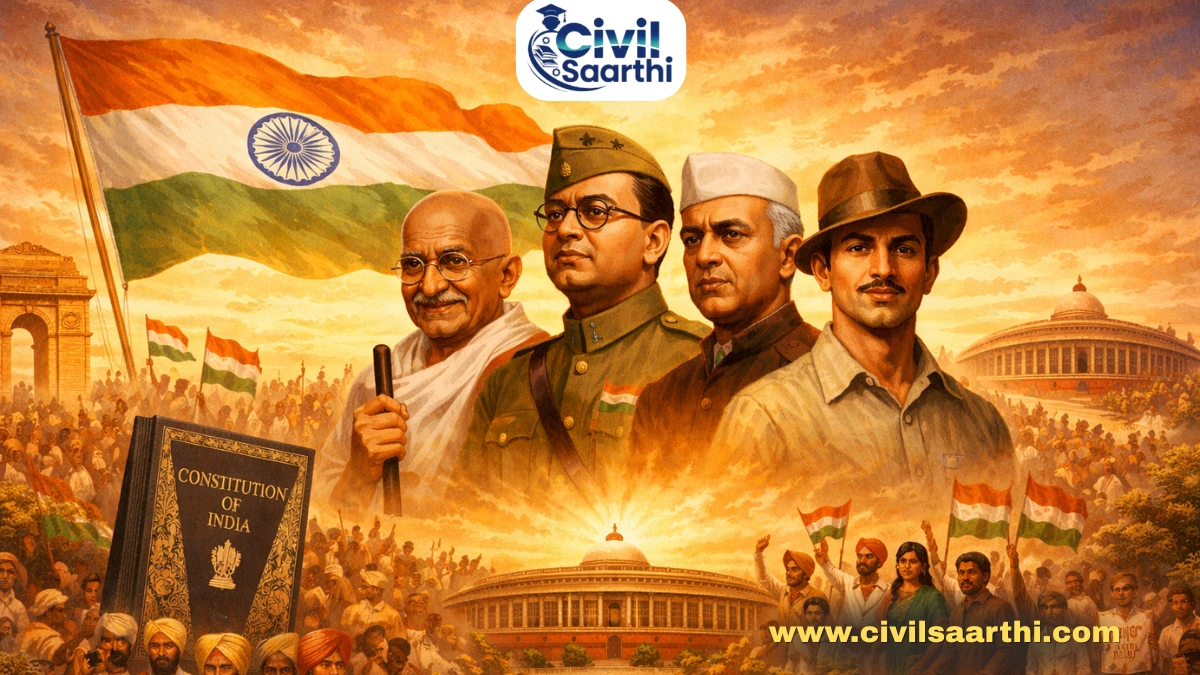
The Indian National Movement (1857-1947) was one of the most significant struggles in world history, representing India’s long fight against British colonial rule. It began gradually in the late 19th century and finally resulted in India gaining independence on 15 August 1947. The movement was not limited to political protests but included social, economic, and cultural resistance that united millions of Indians.
Several great leaders such as Mahatma Gandhi, Jawaharlal Nehru, Subhas Chandra Bose, Bal Gangadhar Tilak, Dadabhai Naoroji, and many others played crucial roles. The freedom struggle included constitutional reforms, mass movements, revolutionary activities, and civil disobedience campaigns. Over time, it transformed India’s political identity and shaped the foundation of modern democratic India.
Revolt of 1857: Beginning of Nationalist Awakening
The Revolt of 1857, often called the First War of Indian Independence, was the first large-scale uprising against British rule. The revolt started due to multiple causes including military grievances, economic exploitation, religious interference, and political dissatisfaction.
Key Features of Revolt of 1857
- Began in Meerut and spread to Delhi, Kanpur, Lucknow, and Jhansi
- Important leaders included:
- Mangal Pandey
- Rani Lakshmibai
- Nana Sahib
- Bahadur Shah Zafar
- United soldiers, peasants, rulers, and common people
- Though the revolt was suppressed, it created nationalist consciousness and inspired future movements
The revolt exposed the weaknesses of British administration and laid the foundation for organized nationalist movements in India.
Phases of the Indian National Movement
The Indian National Movement evolved over several decades and passed through different phases, each reflecting changing strategies, leadership styles, and public participation. Historians generally divide the movement into three major phases: Moderate Phase (1885–1905), Extremist Phase (1905–1919), and Gandhian Phase (1919–1947). These phases represent the gradual transformation of India’s freedom struggle from constitutional petitions to mass revolutionary and non-violent movements.
1. Moderate Phase (1885 – 1905)
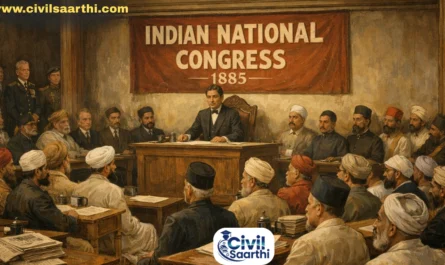
The Moderate Phase marks the beginning of organized political nationalism in India. During this period, leaders believed that British rule could be reformed through constitutional and peaceful methods. They adopted strategies such as petitions, resolutions, and dialogue with British authorities to secure political and administrative reforms.
Moderate leaders were mostly educated Indians who had faith in British justice and liberalism. Their objective was not complete independence but greater participation in governance, economic reforms, and protection of Indian interests. This phase laid the intellectual and political foundation of the national movement.
Major Objectives of the Moderate Phase
- To increase Indian participation in legislative councils and administrative services.
- To reduce economic exploitation through reforms in taxation and trade policies.
- To promote political awareness among Indians through public meetings and writings.
- To demand civil rights and equality before law.
- To achieve self-government within the British Empire (Dominion Status).
Methods Adopted by Moderates
Moderate leaders relied on constitutional and non-violent methods to achieve their objectives. Their approach was based on persuasion rather than confrontation.
- Submitting petitions and memorandums to British authorities.
- Passing resolutions during Indian National Congress sessions.
- Organizing public meetings and political discussions.
- Publishing articles and books exposing British economic exploitation.
- Sending delegations to Britain to present Indian grievances.
Major Leaders of Moderate Phase
Moderate leaders were intellectuals and reformers who believed in gradual political progress.
Dadabhai Naoroji
- Known as the “Grand Old Man of India.”
- Developed the Drain Theory explaining British economic exploitation.
- Advocated Indian representation in British Parliament.
Gopal Krishna Gokhale
- Promoted constitutional reforms and social development.
- Founded the Servants of India Society.
- Influenced Gandhi’s political ideology.
Surendranath Banerjee
- Promoted national unity through political education.
- Led protests against British discrimination.
Pherozeshah Mehta and W.C. Bonnerjee
- Strengthened political organization and leadership in early Congress.
Major Events During Moderate Phase
| Event | Year | Significance |
|---|---|---|
| Foundation of Indian National Congress | 1885 | Created national political platform |
| Indian Councils Act | 1892 | Increased Indian participation in councils |
| Growth of Political Associations | 1885-1900 | Spread political awareness |
| Early Opposition to Bengal Partition | 1905 | Triggered mass political activism |
Achievements of Moderate Phase
- Created political consciousness among Indians.
- Exposed British economic exploitation through intellectual critique.
- Promoted national unity and democratic political culture.
- Developed leadership for future nationalist movements.
- Established Indian National Congress as a national political body.
Limitations of Moderate Phase
- Overdependence on British goodwill and reforms.
- Limited mass participation as movement remained elite-dominated.
- Slow progress in achieving political reforms.
- Failure to challenge colonial rule directly.
2. Extremist Phase (1905 – 1919)
The Extremist Phase emerged as a reaction to the failure of moderate policies. Younger leaders believed that constitutional agitation was insufficient to achieve self-rule. They advocated aggressive nationalism, mass participation, and direct political action against British authority.
This phase witnessed the rise of emotional nationalism, revolutionary activities, and boycott movements. The Partition of Bengal in 1905 became a turning point that intensified nationalist sentiment across India.
Also Read: Advent of Europeans in India
Major Objectives of Extremist Phase
- To achieve Swaraj (self-rule) through direct political action.
- To boycott British goods and promote indigenous industries.
- To encourage national education and cultural revival.
- To mobilize common people into political struggle.
- To strengthen patriotic feelings and self-confidence among Indians.
Methods Adopted by Extremists
Extremist leaders used more aggressive and mass-oriented methods compared to moderates.
- Boycott of British goods and promotion of Swadeshi products.
- Organizing public demonstrations and protests.
- Encouraging national education institutions.
- Use of revolutionary literature and newspapers.
- Supporting secret revolutionary organizations.
Major Leaders of Extremist Phase
Bal Gangadhar Tilak
- Popularized slogan “Swaraj is my birthright.”
- Promoted Swadeshi and national education.
- Organized Ganpati and Shivaji festivals to promote nationalism.
Lala Lajpat Rai
- Led nationalist movement in Punjab.
- Played key role in anti-partition protests.
Bipin Chandra Pal
- Promoted aggressive nationalist ideology.
- Supported boycott and Swadeshi movements.
Aurobindo Ghosh
Advocated revolutionary nationalism and spiritual nationalism.
Partition of Bengal (1905) and Swadeshi Movement
The partition of Bengal by Lord Curzon aimed to divide Indians on communal lines. It triggered mass protests and became the foundation of extremist nationalism.
- Boycott of British textiles and goods.
- Promotion of indigenous industries and handicrafts.
- Establishment of national schools and colleges.
- Public demonstrations and strikes increased.
- Strengthened emotional and cultural nationalism.
Revolutionary Nationalism During Extremist Phase
Revolutionary groups emerged alongside extremist politics, believing armed resistance was necessary.
- Formation of Anushilan Samiti and Jugantar in Bengal.
- Activities of Ghadar Party abroad.
- Political assassinations of British officials.
- Secret training camps for revolutionaries.
- Inspired youth participation in freedom struggle.
Major Events During Extremist Phase
| Movement / Event | Year | Objective | Outcome |
|---|---|---|---|
| Partition of Bengal | 1905 | Divide Bengal and weaken nationalism | Led to Swadeshi Movement |
| Swadeshi Movement | 1905 | Boycott British goods | Increased mass participation |
| Home Rule Movement | 1916 | Self-government within British Empire | Political awakening nationwide |
| Lucknow Pact | 1916 | Hindu-Muslim unity | Strengthened nationalist unity |
Achievements of Extremist Phase
- Expanded movement beyond educated elite to masses.
- Strengthened Swadeshi industries and cultural pride.
- Created revolutionary spirit among youth.
- Increased political pressure on British government.
- Prepared ground for mass movements under Gandhi.
Limitations of Extremist Phase
- Lack of unified leadership strategy.
- Internal conflicts between moderates and extremists.
- Revolutionary violence led to British repression.
- Failed to achieve immediate self-rule.
3. Gandhian Phase / Mass Movement Phase (1919 – 1947)
The Gandhian Phase marked the transformation of the Indian National Movement into a mass movement. Mahatma Gandhi introduced non-violence, truth, and civil disobedience as political weapons. His leadership united peasants, workers, women, and youth across India.
This phase witnessed the largest participation of common people in the freedom struggle. Gandhi’s strategies made nationalism a mass phenomenon and weakened British authority.
Major Objectives of Gandhian Phase
- To achieve Sampoorna Swaraj (complete independence).
- To promote non-violent resistance against colonial rule.
- To unite Indians across caste, religion, and regional differences.
- To promote self-reliance through Swadeshi and Khadi.
- To address social issues such as untouchability and poverty.
Methods Adopted by Gandhi
Gandhi introduced innovative methods that mobilized millions.
- Satyagraha (truth-based resistance).
- Civil disobedience against unjust laws.
- Non-cooperation with colonial institutions.
- Mass protests and peaceful demonstrations.
- Promotion of indigenous industries and rural development.
Major Gandhian Movements
Here are the Major Gandhain Movements discussed below in detail:
Non-Cooperation Movement (1920–1922)
- Boycott of British schools, courts, and government services.
- Promotion of khadi and swadeshi industries.
- Encouraged Hindu-Muslim unity.
- Suspended after Chauri Chaura incident.
Civil Disobedience Movement (1930–1934)
- Started with Salt March to Dandi.
- Indians refused to pay taxes and broke salt law.
- Massive participation of women and students.
- Gained international attention and support.
Quit India Movement (1942)
- Final mass movement demanding immediate independence.
- Nationwide protests, strikes, and demonstrations.
- British arrested major leaders.
- Youth and underground groups continued resistance.
- Weakened British political control in India.
Major Leaders of Gandhian Phase
- Mahatma Gandhi – Leader of non-violent resistance.
- Jawaharlal Nehru – Promoted socialist and democratic vision.
- Subhas Chandra Bose – Advocated armed resistance through INA.
- Sardar Vallabhbhai Patel – Organized peasant movements.
- Sarojini Naidu and Kasturba Gandhi – Mobilized women participation.
Major Events During Gandhian Phase
| Movement | Year | Method | Outcome |
|---|---|---|---|
| Champaran Satyagraha | 1917 | Non-violent protest | Relief to indigo farmers |
| Kheda Satyagraha | 1918 | Tax refusal | Government concessions |
| Non-Cooperation Movement | 1920-22 | Boycott institutions | Mass political awakening |
| Civil Disobedience Movement | 1930-34 | Salt March & tax refusal | International recognition |
| Quit India Movement | 1942 | Mass uprising | Strengthened independence demand |
Achievements of Gandhian Phase
- Transformed freedom struggle into nationwide mass movement.
- United diverse communities under nationalist ideology.
- Weakened economic and administrative control of British.
- Promoted social reform and rural development.
- Led directly to independence in 1947.
Limitations of Gandhian Phase
- Suspension of movements sometimes disappointed radical groups.
- Communal tensions increased during final phase.
- Some revolutionary groups disagreed with non-violence.
- Independence accompanied by partition and communal violence.
Comparison of Phases of Indian National Movement
| Feature | Moderate Phase | Extremist Phase | Gandhian Phase |
|---|---|---|---|
| Time Period | 1885-1905 | 1905-1919 | 1919-1947 |
| Nature of Movement | Constitutional and peaceful | Aggressive and revolutionary | Mass non-violent movement |
| Objective | Political reforms, Dominion Status | Swaraj (Self-rule) | Complete Independence |
| Leaders | Naoroji, Gokhale, Banerjee | Tilak, Lajpat Rai, Pal | Gandhi, Nehru, Bose |
| Methods | Petitions, dialogue | Boycott, Swadeshi, protests | Satyagraha, civil disobedience |
| Public Participation | Limited to educated class | Increasing mass involvement | Nationwide mass participation |
| Achievements | Political awareness | Swadeshi nationalism | Independence of India |
Factors Responsible for National Uprising
The Indian National Movement was fueled by several underlying causes that affected Indian society at multiple levels. These causes collectively contributed to the rise of nationalist sentiment and the demand for independence.
1. Political Factors
Political exclusion and discriminatory governance were among the primary causes of the nationalist movement. Indians were denied participation in administrative decision-making and were treated as subjects rather than citizens. British political policies systematically suppressed Indian aspirations for self-governance.
Exclusion from Administrative Power
- Indians were rarely appointed to high administrative positions.
- The Indian Civil Services (ICS) examination was conducted in England, making it inaccessible to most Indians.
- British officials dominated governance, leading to resentment among educated Indians.
Racial Discrimination
- British officers followed racial superiority policies.
- Indians were treated as inferior in courts, jobs, and public spaces.
- Discriminatory laws created social inequality and humiliation.
Divide and Rule Policy
- The British deliberately promoted communal divisions.
- Religious and regional conflicts were encouraged to weaken Indian unity.
- The Partition of Bengal in 1905 was a classic example of this policy.
Repressive Legislative Measures
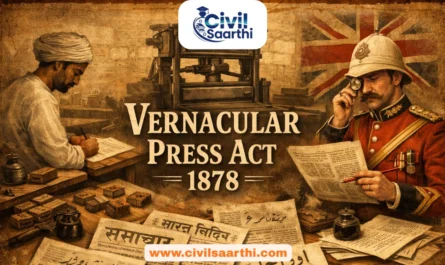
- Laws such as the Vernacular Press Act restricted freedom of expression.
- The Rowlatt Act allowed detention without trial.
- These laws strengthened anti-British sentiment.
2. Economic Factors
Economic exploitation under British rule severely damaged India’s traditional economy. Colonial policies were designed to benefit Britain while impoverishing Indian industries, farmers, and workers.
Drain of Wealth
- Dadabhai Naoroji highlighted how Indian resources were transferred to Britain.
- Profits from Indian industries were exported to Britain.
- Indian taxpayers funded British administrative expenses.
Deindustrialization
- British machine-made goods destroyed Indian handicrafts.
- Textile centers like Bengal and Surat suffered massive decline.
- Millions of artisans lost employment.
Heavy Taxation
- Peasants were forced to pay high land revenue regardless of crop failure.
- Zamindari system exploited farmers through intermediaries.
- Agricultural distress increased rural poverty.
Commercialization of Agriculture
- Farmers were forced to grow cash crops like indigo, cotton, and opium.
- Food crop production declined leading to food shortages.
- This contributed to frequent famines.
Industrial Exploitation
- Indian laborers worked in poor conditions.
- British industrial policies restricted Indian entrepreneurship.
- Railways primarily benefited British trade.
3. Social and Cultural Factors
Social issues and reform movements played a crucial role in awakening nationalist consciousness. The spread of Western education exposed Indians to democratic ideals and liberty concepts.
Famines and Poverty
- British neglect during famines caused mass deaths.
- Export of food grains continued despite shortages.
- Government relief measures were inadequate.
Low Literacy Rate
- British education policies focused on limited elite education.
- Majority of Indians remained uneducated and economically weak.
- Educated Indians later became leaders of nationalist movements.
Social Reform Movements
- Reformers like Raja Ram Mohan Roy and Swami Vivekananda promoted social unity.
- Movements challenged social evils such as child marriage and caste discrimination.
- These reforms strengthened national identity.
Rise of National Press
- Newspapers spread awareness about British exploitation.
- Vernacular press connected nationalist leaders with common people.
- Press became a powerful tool of resistance.
4. Historical and International Events
Several global and national events influenced Indian nationalism by exposing weaknesses in British rule and inspiring Indians to demand independence.
Partition of Bengal (1905)
- Created widespread protests.
- Triggered Swadeshi and Boycott Movements.
- Strengthened mass political participation.
World War I
- Indians supported Britain expecting political reforms.
- Post-war betrayal increased nationalist anger.
- Economic hardship intensified public dissatisfaction.
World War II
- British involvement without Indian consent created outrage.
- Led to the Quit India Movement.
- Weakened British economic and military strength.
Russian Revolution (1917)
- Inspired revolutionary movements in India.
- Promoted ideas of equality and anti-imperialism.
5. Repressive British Policies
Harsh colonial laws and violent suppression intensified resistance against British authority. These policies transformed moderate demands into aggressive nationalist movements.
Rowlatt Act (1919)
- Allowed detention without trial.
- Suspended civil liberties.
- Led to nationwide protests.
Jallianwala Bagh Massacre (1919)
- British troops fired on peaceful protesters.
- Hundreds of innocent people were killed.
- Created nationwide outrage and distrust.
Simon Commission (1927)
- Excluded Indian members.
- Faced nationwide protests.
- Strengthened unity among Indian leaders.
Indian National Movement (1857–1947) Timeline
The Indian National Movement progressed through various stages marked by significant events and movements. The following timeline provides a chronological overview of major developments.
| Year | Event / Movement | Leader(s) | Location | Outcome / Significance |
|---|---|---|---|---|
| 1857 | Revolt of 1857 | Rani Lakshmibai, Mangal Pandey | North India | First major revolt against British rule |
| 1885 | Formation of INC | A.O. Hume | Bombay | Beginning of organized nationalism |
| 1905 | Partition of Bengal | Lord Curzon | Bengal | Swadeshi Movement started |
| 1916 | Home Rule Movement | Tilak, Annie Besant | Nationwide | Demand for self-government |
| 1917 | Champaran Satyagraha | Mahatma Gandhi | Bihar | First Gandhian movement |
| 1918 | Kheda Satyagraha | Mahatma Gandhi | Gujarat | Tax relief for farmers |
| 1919 | Jallianwala Bagh | British authority | Punjab | Strengthened national unity |
| 1920-22 | Non-Cooperation Movement | Gandhi | Nationwide | Mass boycott of British institutions |
| 1930 | Salt March | Gandhi | Dandi | Civil Disobedience intensified |
| 1935 | Government of India Act | British Parliament | India | Provincial autonomy introduced |
| 1942 | Quit India Movement | Gandhi, Nehru | Nationwide | Final mass movement |
| 1943 | INA Formation | Subhas Chandra Bose | Southeast Asia | Military resistance against British |
| 1947 | Independence | Indian leaders | India | End of British rule |
Major Movements of Indian National Struggle
The Indian National Struggle consisted of several mass movements, revolts, and political campaigns that collectively challenged British colonial rule. These movements evolved from regional protests to nationwide mass participation and played a decisive role in India’s independence.
Revolt of 1857
The Revolt of 1857 was the first large-scale uprising against British rule in India. It united soldiers, peasants, rulers, and civilians and is often called the First War of Indian Independence.
The revolt began as a mutiny among Indian soldiers of the British East India Company but soon spread across northern and central India. The introduction of greased cartridges offended religious sentiments of Hindu and Muslim soldiers, triggering widespread anger. The movement gained support from dispossessed rulers, farmers suffering heavy taxes, and citizens affected by British policies.
Key Points:
- Began in Meerut in May 1857.
- Leaders included Rani Lakshmibai, Nana Sahib, Bahadur Shah Zafar, and Tantia Tope.
- Spread to Delhi, Kanpur, Jhansi, Lucknow, and other regions.
- Suppressed by British forces by 1858.
- Resulted in the end of East India Company rule and start of direct British Crown rule.
Indigo Rebellion (1859–1860)
The Indigo Rebellion was a farmers’ revolt against forced indigo cultivation in Bengal. It highlighted exploitation of peasants under British plantation policies.
British planters forced Indian farmers to cultivate indigo under unfair contracts, leading to severe financial losses. Farmers refused to grow indigo and protested against oppressive practices. The rebellion gained support from intellectuals and journalists who exposed plantation atrocities.
Key Points:
- Occurred mainly in Bengal.
- Farmers protested forced indigo cultivation.
- Supported by local leaders and press.
- British introduced minor reforms after protests.
- Inspired future agrarian movements.
Swadeshi and Boycott Movement (1905)
The Swadeshi Movement emerged as a protest against the Partition of Bengal in 1905. It promoted indigenous industries and boycott of British goods.
The British divided Bengal claiming administrative convenience but Indians viewed it as an attempt to divide Hindus and Muslims. Leaders encouraged people to boycott foreign goods, promote Indian products, and strengthen national unity. The movement saw participation from students, women, and businessmen.
Key Points:
- Led by Bal Gangadhar Tilak, Bipin Chandra Pal, and Lala Lajpat Rai.
- Promoted Swadeshi industries and national education.
- Strengthened nationalist consciousness.
- Marked beginning of mass political activism.
- Encouraged cultural nationalism.
Home Rule Movement (1916)
The Home Rule Movement demanded self-government for India within the British Empire. It strengthened political awareness and mobilized public participation.
Led by Bal Gangadhar Tilak and Annie Besant, the movement sought constitutional reforms and political autonomy. It organized meetings, campaigns, and publications to spread nationalist ideas. The movement united moderate and extremist leaders and prepared the ground for Gandhian mass movements.
Key Points:
- Started in 1916 across India.
- Inspired by Irish Home Rule Movement.
- Increased political participation among Indians.
- Strengthened demand for self-governance.
- Led to greater national unity.
Champaran Satyagraha (1917)
Champaran Satyagraha was Mahatma Gandhi’s first successful civil disobedience movement in India. It addressed exploitation of indigo farmers in Bihar.
British planters forced farmers to grow indigo under the Tinkathia system. Gandhi used peaceful protest methods to support farmers. The British were forced to investigate grievances and introduce reforms, marking the success of Gandhian strategy.
Key Points:
- Gandhi’s first Satyagraha in India.
- Highlighted farmer exploitation.
- Introduced non-violent protest as political tool.
- Strengthened rural participation.
- Established Gandhi as national leader.
Kheda Satyagraha (1918)
Kheda Satyagraha was a non-violent movement supporting farmers affected by crop failure in Gujarat. It demanded tax relief from British authorities.
Farmers faced severe crop losses but were still forced to pay revenue. Gandhi and Sardar Patel organized farmers to refuse tax payment peacefully. The British eventually agreed to suspend tax collection, proving effectiveness of collective resistance.
Key Points:
- Focused on farmers’ rights.
- Promoted unity among peasants.
- Demonstrated success of non-violent protest.
- Strengthened Gandhian leadership.
- Encouraged rural nationalism.
Non-Cooperation Movement (1920–1922)
The Non-Cooperation Movement was the first nationwide mass movement led by Gandhi. It urged Indians to withdraw support from British institutions.
Gandhi launched this movement after the Jallianwala Bagh massacre and Khilafat issue. People boycotted British schools, courts, goods, and government jobs. The movement witnessed massive participation but was withdrawn after the violent Chauri Chaura incident.
Key Points:
- Promoted Swadeshi and Khadi.
- Encouraged resignation from government posts.
- Unified Hindus and Muslims temporarily.
- Increased mass political awareness.
- Demonstrated power of peaceful resistance.
Bardoli Satyagraha (1928)
Bardoli Satyagraha was led by Sardar Vallabhbhai Patel against increased land revenue in Gujarat. It achieved significant success through non-violent resistance.
British authorities increased land revenue despite poor agricultural conditions. Patel organized farmers to refuse payment. The British government eventually reduced taxes, strengthening Patel’s reputation as a national leader.
Key Points:
- Strengthened farmers’ rights.
- Demonstrated disciplined mass protest.
- Patel earned title “Sardar”.
- Inspired rural nationalist movements.
- Highlighted success of peaceful struggle.
Civil Disobedience Movement and Salt March (1930)
The Civil Disobedience Movement challenged British laws through peaceful defiance. The Salt March symbolized resistance against unjust taxation.
Gandhi marched from Sabarmati Ashram to Dandi to produce salt illegally. The movement encouraged Indians to break colonial laws such as salt tax and forest laws. It gained international attention and forced British negotiations.
Key Points:
- Salt March covered 240 miles.
- Encouraged nationwide law defiance.
- Increased participation of women and youth.
- Strengthened international support for India.
- Led to Gandhi-Irwin Pact.
Quit India Movement (1942)
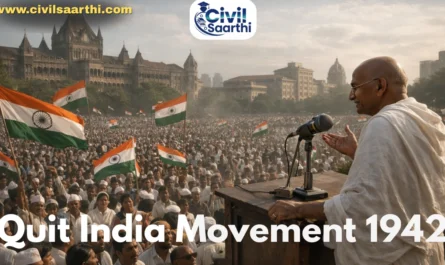
Quit India Movement was the final mass movement demanding immediate independence from British rule. It marked the peak of nationalist unity.
Launched during World War II, Gandhi called for “Do or Die” struggle. British arrested leaders immediately, but protests continued through underground networks. Though suppressed, it weakened British administrative control and accelerated independence.
Key Points:
- Nationwide strikes and protests.
- Participation of students and workers.
- Strengthened revolutionary activities.
- Demonstrated complete rejection of British rule.
- Prepared India for independence.
Indian National Army Movement (1942–1945)
The Indian National Army (INA) was formed to fight British rule through armed struggle. It represented militant nationalism under Subhas Chandra Bose.
Subhas Chandra Bose reorganized INA with support from Japan. The army aimed to liberate India through military campaigns. Though unsuccessful militarily, INA trials created nationalist unity and inspired Indian soldiers.
Key Points:
- Formation of Azad Hind Government.
- INA campaigns in Northeast India.
- Inspired patriotic sentiment among Indians.
- Influenced British decision to leave India.
- Strengthened nationalist morale.
Newspaper and Press Rebellion
The press played a revolutionary role in shaping public opinion and spreading nationalist ideas during the Indian freedom struggle. Newspapers and journals exposed British exploitation, mobilized people, and acted as platforms for political debate and reform movements. Despite strict censorship laws, journalists continued to challenge colonial authority and strengthen nationalist unity.
Role and Importance of Nationalist Press
The nationalist press acted as a bridge between political leaders and the masses. Newspapers educated people about British policies, economic exploitation, and political rights. They also promoted unity among different regions and communities.
Major Contributions of the Press
- Spread nationalist ideology and awareness among Indians.
- Exposed oppressive colonial policies and administrative failures.
- Promoted Swadeshi, boycott movements, and social reforms.
- Mobilized youth, students, and intellectuals.
- Encouraged political participation and mass protests.
British Suppression of Press
- The British introduced censorship laws like the Vernacular Press Act (1878).
- Editors and journalists were arrested or fined for criticizing the government.
- Printing presses were seized and publications banned.
- Despite repression, nationalist journalism continued to grow.
Major Nationalist Newspapers and Journals
| Newspaper / Journal | Year | Leader / Editor | Significance |
|---|---|---|---|
| Kesari | 1881 | Bal Gangadhar Tilak | Promoted extremism and Swadeshi movement |
| The Hindu | 1878 | G. Subramania Iyer | Spread constitutional and political awareness |
| Indian National Herald | 1938 | Jawaharlal Nehru | Supported Gandhian ideology and Quit India Movement |
| Bengalee | 1879 | Surendranath Banerjee | Opposed Partition of Bengal and supported nationalism |
| Amrita Bazar Patrika | 1868 | Sisir Kumar Ghosh | Exposed British exploitation and supported mass protests |
Additional Contributions of Nationalist Press
- Kesari and Mahratta promoted militant nationalism and self-rule.
- Young India and Harijan were used by Gandhi to spread non-violence.
- Regional newspapers helped spread nationalist awareness among rural populations.
- Press coverage helped internationalize the Indian freedom struggle.
Contribution of Women to the Indian National Movement
Women played a transformative role in India’s freedom struggle by participating in protests, leading movements, and supporting social reform initiatives. Their involvement challenged social restrictions and promoted gender equality along with political freedom.
Role of Women in Freedom Struggle
Women actively participated in Satyagraha movements, civil disobedience campaigns, and revolutionary activities. They organized protests, spread nationalist messages, and supported underground movements during British repression.
Major Contributions of Women
- Participation in boycott and Swadeshi movements.
- Leadership in mass protests and political campaigns.
- Support for revolutionary organizations.
- Promotion of social reforms and women’s education.
- Strengthened national unity and social transformation.
Prominent Women Freedom Fighters
| Leader | Region | Contribution |
|---|---|---|
| Sarojini Naidu | Andhra / Maharashtra | Led Civil Disobedience and Quit India Movement |
| Kasturba Gandhi | Gujarat | Supported Gandhian Satyagraha and social reform |
| Aruna Asaf Ali | Delhi | Hoisted Indian flag during Quit India Movement |
| Annie Besant | All India | Founded Home Rule League and promoted political awareness |
| Begum Rokeya | Bengal | Advocated women’s education and social reform |
Additional Women Leaders
- Usha Mehta operated underground radio during Quit India Movement.
- Matangini Hazra died while leading protest demonstrations.
- Captain Lakshmi Sahgal led Rani Jhansi Regiment in INA.
- Women participation strengthened mass mobilization and social equality.
Tribal Uprisings
Tribal communities played an important but often overlooked role in resisting British colonial rule. They protested against land alienation, forest laws, revenue exploitation, and destruction of tribal autonomy. Tribal revolts were among the earliest forms of resistance against colonial policies.
Causes of Tribal Uprisings
- British forest laws restricted tribal access to forests.
- Land revenue systems displaced tribal communities.
- Forced labor and exploitation by zamindars.
- Loss of traditional tribal governance and culture.
Major Tribal Revolts
| Tribal Uprising | Year | Leader | Region | Significance |
|---|---|---|---|---|
| Santhal Rebellion | 1855-56 | Sidhu & Kanhu Murmu | Bihar / Bengal | Revolt against zamindari exploitation |
| Munda Rebellion | 1899-1900 | Birsa Munda | Jharkhand | Assertion of tribal rights |
| Kol Rebellion | 1831-32 | Tribal Chiefs | Chotanagpur | Early revolt against British interference |
| Paika Rebellion | 1817 | Bakshi Jagabandhu | Odisha | Early armed resistance against British |
| Bhil & Gond Revolts | 18th-19th Century | Local Chiefs | Central India | Resistance against revenue policies |
Significance of Tribal Movements
- Highlighted local resistance to colonial exploitation.
- Strengthened anti-British sentiment among rural populations.
- Inspired later nationalist and peasant movements.
- Preserved tribal cultural and social identity.
Peasant Movements
Peasant movements were crucial in connecting rural grievances with the national freedom struggle. Farmers protested against high taxation, forced crop cultivation, and exploitation by landlords and moneylenders. These movements strengthened mass participation in nationalist politics.
Causes of Peasant Movements
- Excessive land revenue demands.
- Forced cultivation of cash crops.
- Debt burden and moneylender exploitation.
- Agricultural crises and famines.
Major Peasant Movements
| Movement | Year | Region | Leader | Cause | Outcome |
|---|---|---|---|---|---|
| Indigo Rebellion | 1859-60 | Bengal | Peasants | Forced indigo cultivation | Temporary reforms |
| Deccan Riots | 1875 | Maharashtra | Peasants | Debt exploitation | Limited relief laws |
| Kheda Satyagraha | 1918 | Gujarat | Gandhi | Crop failure and tax burden | Revenue suspension |
| Bardoli Satyagraha | 1928 | Gujarat | Sardar Patel | Increased land revenue | Government concessions |
| Telangana Revolt | 1946-51 | Hyderabad | Communist Leaders | Zamindari oppression | Land reform influence |
| Punjab Peasant Agitation | Early 1900s | Punjab | Local Leaders | High taxation | Anti-British sentiment |
Impact of Peasant Movements
- Strengthened rural political awareness.
- Supported Gandhian non-violent movements.
- Increased mass participation in nationalist struggle.
- Influenced post-independence agrarian reforms.
Formation of Indian National Army (INA)
The Indian National Army represented the militant phase of India’s freedom struggle. It aimed to overthrow British rule through armed resistance and mobilized Indian soldiers and expatriates across Southeast Asia.
Indian National Army (INA) Objectives
The INA was reorganized by Subhas Chandra Bose in 1942 with support from Japan. Its main objective was to liberate India through military action and inspire patriotic feelings among Indians serving in British forces.
- Establish independent Indian government.
- Mobilize Indian soldiers and civilians abroad.
- Conduct military campaigns against British forces.
- Strengthen nationalist morale.
Structure of Azad Hind Government (1943)
| Department | Head | Responsibility |
|---|---|---|
| Defence | Subhas Chandra Bose | Military operations of INA |
| Foreign Affairs | Abid Hasan | International diplomacy |
| Interior | Syed Mahmud | Administration of territories |
| Finance | Lakshmi Swaminathan | Funding government operations |
Contributions and Impact of INA
- Boosted nationalist morale among Indians.
- Inspired Indian soldiers to question loyalty to British rule.
- Conducted military campaigns in Northeast India.
- INA trials created nationwide protests.
- Pressured British administration after World War II.
- Accelerated India’s independence movement.
Causes of Indian National Movements
The causes of Indian nationalism were complex and interconnected. British reforms, socio-religious movements, political organizations, youth participation, economic exploitation, media influence, and social awakening collectively contributed to the rise of nationalist movements. Each factor played a crucial role in shaping India’s journey towards independence.
1. Role of British Reforms and Acts
British rulers introduced various administrative and political reforms to maintain control over India and manage growing political dissatisfaction. However, these reforms often failed to satisfy Indian aspirations and instead strengthened demands for complete independence. Many Indians believed that British concessions were limited and designed mainly to strengthen colonial authority.
Importance of British Reforms in National Movement
British reforms initially aimed to provide limited participation to Indians in governance. However, they also exposed racial discrimination and lack of real political power for Indians. These reforms unintentionally encouraged political awareness and unity among Indians.
Major British Reforms and Their Impact
| Act / Reform | Year | Significance |
|---|---|---|
| Indian Councils Act | 1892 | Increased legislative participation but limited powers |
| Morley-Minto Reforms | 1909 | Introduced separate electorates for Muslims |
| Montagu-Chelmsford Reforms | 1919 | Introduced dyarchy and partial self-government |
| Government of India Act | 1935 | Introduced provincial autonomy and federal structure |
- Highlighted discrimination in political representation.
- Created division through separate electorates.
- Increased demand for Swaraj (self-rule).
- Encouraged formation of political organizations.
- Strengthened nationalist unity against colonial rule.
2. Political Organizations in the Indian National Movement
Political organizations played a major role in mobilizing people and shaping nationalist ideology. While the Indian National Congress remained the most influential organization, several other groups contributed to political awakening and resistance against British rule.
Role of Political Organizations
Political organizations helped unite Indians across regions, religions, and social classes. They provided platforms for debate, protest, and revolutionary activities.
Major Political Organizations
All India Muslim League (1906)
- Initially formed to protect Muslim political interests.
- Later demanded separate nation leading to Pakistan movement.
- Played a major role in communal politics and constitutional negotiations.
Hindu Mahasabha (1915)
- Promoted Hindu political and cultural identity.
- Supported nationalist activities and social reforms.
- Influenced communal political strategies.
Ghadar Party (1913)
- Formed by Indian expatriates in USA and Canada.
- Promoted armed revolution against British rule.
- Organized revolutionary activities during World War I.
Socialist and Labour Organizations
- Focused on workers’ rights and social justice.
- Connected economic grievances with nationalist movement.
- Strengthened participation of working class.
3. Role of Media and Literature
Media and literature played a powerful role in spreading nationalist ideas and political awareness. Newspapers, journals, and literary works inspired people to participate in freedom movements and resist colonial policies.
Importance of Media in National Movement
Print media connected political leaders with the masses and exposed British exploitation. Literature promoted national identity and social awakening.
Major Contributions of Media
- Spread information about colonial injustice.
- Promoted Swadeshi and boycott movements.
- Encouraged unity across linguistic and cultural groups.
- Created political consciousness among common people.
Influence of Literature and Writers
- Bankim Chandra Chatterjee inspired patriotism through “Vande Mataram”.
- Rabindranath Tagore promoted cultural nationalism.
- Revolutionary poetry encouraged youth participation.
- Newspapers like Kesari and The Hindu strengthened nationalist awareness.
4. Role of Youth in the National Movement
Youth played an energetic and revolutionary role in India’s freedom struggle. They actively participated in protests, boycotts, and revolutionary organizations. Their courage and sacrifice inspired national unity and patriotic feelings.
Importance of Youth Participation
Young students and revolutionaries provided momentum to nationalist movements. They organized protests, joined underground activities, and challenged British authority.
Contributions of Youth
- Participation in revolutionary organizations like HSRA and Jugantar.
- Organized student protests and boycotts of British institutions.
- Spread nationalist ideology through underground networks.
- Provided leadership in revolutionary movements.
Famous Youth Leaders
- Bhagat Singh symbolized revolutionary nationalism.
- Chandrashekhar Azad led armed resistance against British officials.
- Surya Sen organized revolutionary activities in Bengal.
5. Socio-Religious Movements and National Awakening
Socio-religious reform movements helped remove social evils and promoted unity among Indians. These movements prepared society for political nationalism by encouraging education, social equality, and cultural pride.
Importance of Social Reform Movements
These movements created awareness about social injustice and encouraged modernization. They strengthened nationalist consciousness and promoted national unity.
Major Socio-Religious Movements
Brahmo Samaj
- Founded by Raja Ram Mohan Roy.
- Promoted abolition of Sati and social reforms.
- Encouraged education and rational thinking.
Arya Samaj
- Founded by Dayananda Saraswati.
- Promoted Vedic values and education.
- Opposed caste discrimination and social inequality.
Aligarh Movement
- Led by Sir Syed Ahmed Khan.
- Promoted modern education among Muslims.
- Strengthened intellectual and political awareness.
Prarthana Samaj
- Promoted social reforms in Maharashtra.
- Encouraged women education and social equality.
6. Secret Societies and Revolutionary Activities
Secret revolutionary organizations played a significant role alongside moderate and extremist political movements. These groups used armed resistance to challenge British authority.
Role of Secret Societies
Secret societies trained revolutionaries and organized attacks against British officials. They inspired patriotic sentiments and challenged colonial rule through militant nationalism.
Major Revolutionary Organizations
- Anushilan Samiti – Organized revolutionary training and planning.
- Jugantar Party – Conducted political assassinations and revolutionary activities.
- Ghadar Party – Promoted armed struggle abroad.
- Abhinav Bharat Society – Encouraged revolutionary nationalism in Maharashtra.
7. Split in Indian National Congress
The Indian National Congress experienced internal division between Moderates and Extremists due to differences in ideology and methods of protest. This split shaped the direction of the nationalist movement.
Split of Indian National Congress
| Faction | Leaders | Method | Objective |
|---|---|---|---|
| Moderates | Gokhale, Naoroji | Dialogue and petitions | Constitutional reforms |
| Extremists | Tilak, Lajpat Rai | Boycott and protests | Assertive Swaraj |
Impact of Congress Split
- Introduced aggressive nationalist ideology.
- Increased mass participation in political movements.
- Strengthened revolutionary activities.
- Prepared ground for Gandhian mass movements.
8. Role of Working Class in National Movement
Industrial workers contributed significantly to nationalist struggle by organizing strikes and labour protests. Their movements highlighted economic exploitation under British rule.
Importance of Working Class Participation
Workers connected industrial grievances with nationalist politics and strengthened mass resistance.
Major Contributions of Working Class
- Organized textile strikes in Bombay.
- Conducted jute mill strikes in Bengal.
- Formation of All India Trade Union Congress (1920).
- Strengthened socialist and labour rights movements.
9. Role of Indian Capitalists
Indian industrialists supported the nationalist movement by funding political campaigns and promoting indigenous industries. They believed economic independence was essential for political freedom.
Contributions of Capitalists
- Financial support to Swadeshi Movement.
- Establishment of Indian industries to reduce British dependence.
- Support to nationalist political organizations.
Important Industrial Leaders
- G.D. Birla
- Jamnalal Bajaj
- Ghanshyam Das Birla
10. Communalism and Its Impact
Communal divisions emerged during the late colonial period due to British policies and political competition. These divisions influenced nationalist politics and constitutional negotiations.
- Muslim League demanded separate political representation.
- Hindu Mahasabha promoted Hindu political identity.
- Communal tensions influenced nationalist strategies.
- Led to partition debates and eventual division of India.
11. Princely States and Their Role in Freedom Struggle
Princely states also participated in nationalist movements by supporting protests and demanding democratic reforms. Many princely states witnessed local uprisings against autocratic rulers and colonial policies.
| Princely State | Leader / Figure | Contribution |
|---|---|---|
| Mysore | Maharaja Krishna Raja Wadiyar IV | Supported reforms and education |
| Travancore | Local Leaders | Participated in civil protests |
| Hyderabad | Local Activists | Demanded democratic reforms |
| Rajasthan States | Princes and Citizens | Organized protests and supported INC |
| Gwalior | Local Leaders | Participated in Quit India Movement |
Outcomes of Indian National Movement
The Indian National Movement achieved political independence and transformed Indian society. The freedom struggle created long-lasting political, social, economic, and cultural impacts.
- The Indian National Movement resulted in India gaining independence in 1947, ending British colonial rule after nearly 200 years. It allowed Indians to establish their own sovereign government and determine national policies.
- The movement led to the establishment of a democratic political system based on elections, rule of law, and public participation. India adopted universal adult franchise, giving voting rights to all citizens.
- It resulted in the adoption of the Constitution of India in 1950, which became the supreme law of the country. The Constitution guaranteed fundamental rights and ensured equality and justice.
- The struggle promoted national unity and a sense of nationalism among people of different religions, languages, and cultures. It helped develop a collective Indian identity.
- The movement created political awareness among common people, encouraging mass participation in governance and protests. Peasants, workers, students, and women became active participants.
- It led to the emergence of strong national leadership such as Gandhi, Nehru, Patel, and Ambedkar. These leaders shaped India’s political and administrative foundation.
- The national movement helped end British economic exploitation that drained Indian resources and destroyed local industries. Independent India focused on economic planning and self-reliance.
- It encouraged social reforms and upliftment of weaker sections, including removal of untouchability and caste discrimination. Legal safeguards and reservation policies were introduced later.
- The movement strengthened civil rights such as freedom of speech, expression, and association. These rights became essential features of India’s democratic society.
- It increased women’s participation in politics and social reform movements. Women gained equal political rights and greater social recognition after independence.
- The movement led to the development of democratic institutions like Parliament, Judiciary, and federal governance. These institutions ensured balanced and accountable governance.
- It promoted cultural nationalism and revival of Indian heritage through literature, press, and patriotic movements. Indians developed pride in their traditions and history.
- The Swadeshi and boycott movements encouraged growth of indigenous industries and economic self-dependence. This laid the foundation for industrial development in independent India.
- The movement resulted in the integration of more than 500 princely states into the Indian Union under Sardar Patel’s leadership. This ensured political and territorial unity.
- It also led to the partition of India and creation of Pakistan in 1947, causing large-scale migration and communal violence. The event deeply influenced India’s political and social structure.
- The struggle encouraged modern education and intellectual awakening among Indians. Educational institutions promoted scientific thinking and national development.
- The movement strengthened the principle of secularism, ensuring equal respect for all religions. Independent India adopted policies to maintain religious harmony.
- It inspired freedom movements across Asia and Africa, influencing global anti-colonial struggles. Gandhi’s non-violence philosophy became internationally respected.
- The movement led to the adoption of welfare policies focusing on poverty removal, rural development, and social equality. Government planning aimed at improving living standards.
- It established India’s global image as a democratic and peace-supporting nation. India later followed a non-aligned foreign policy promoting international cooperation.
- The movement encouraged active citizenship and public responsibility among Indians. People became more aware of their rights and duties toward nation-building.