
 by
by 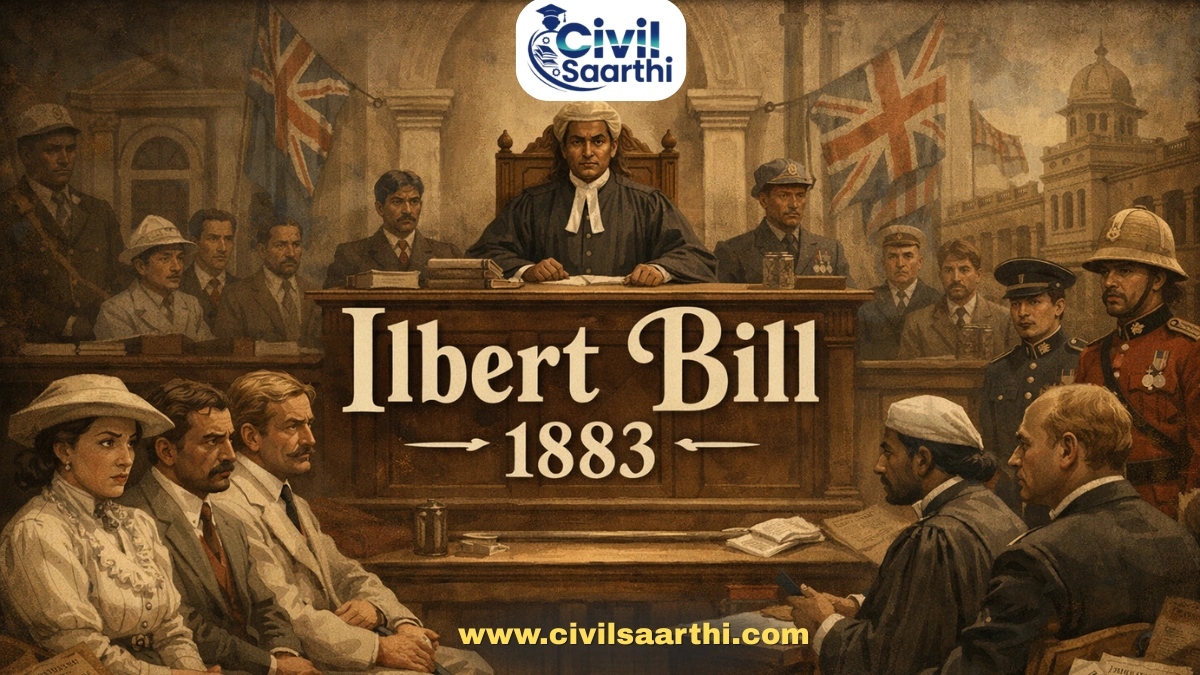
The Ilbert Bill Controversy of 1883 was one of the most significant events in British India’s colonial history, revealing the deep racial prejudices of the British administration. Introduced by Sir Courtenay Pergine Ilbert, a legal member of the Viceroy’s Council under Lord Ripon, the bill sought to allow Indian judges to try European British subjects in courts of law.
Also known as the Criminal Procedure Amendment Code Bill, the legislation sparked uproar among Europeans in India, leading to protests, propaganda campaigns, and eventual compromise. The controversy exposed racial tensions, strengthened Indian nationalism, and set the stage for the formation of the Indian National Congress in 1885.
Background of the Ilbert Bill
Before the introduction of the Ilbert Bill, British subjects in India were exempt from trial by Indian magistrates. In 1873, the law mandated that cases involving Europeans, especially those carrying death or transportation sentences, could only be heard by higher courts staffed by British judges. This system reflected the entrenched racial hierarchy of British colonial rule, placing Europeans above Indians in all legal matters.
The Ilbert Bill, introduced in 1883, challenged this racial imbalance by stipulating that senior Indian judges in session courts could try European defendants. The bill was part of Lord Ripon’s reformist agenda, aimed at increasing judicial equality and recognizing the competence of Indians educated under the British system.
Controversy Surrounding the Ilbert Bill
The Ilbert Bill quickly became a source of intense controversy. The mere possibility that a European could be tried by an Indian magistrate angered the European community, particularly the Calcutta business sector, which included tea and indigo planters. Many British officials secretly supported the opposition.
Key Reasons for Opposition
- Racial Prejudices and Superiority: Europeans considered themselves racially superior and believed Indian judges were unfit to preside over cases involving them. This deep-seated racism fueled protests and public outrage.
- Economic and Social Concerns: European planters feared potential bias in legal matters that could impact their financial interests. Additionally, propaganda suggested Indian judges were unsuitable for handling cases involving English women, heightening opposition.
- Gender-Based Arguments: English women opposed the bill, citing supposed ignorance among Bengali women. In response, Bengali women supporting the bill highlighted their educational achievements, noting that the University of Calcutta had admitted female graduates as early as 1878, earlier than many British universities.
- Fear of Losing Authority: Europeans were concerned about the growing authority of educated Indians, who could increasingly challenge British dominance in legal and administrative affairs.
Arguments in Favor of the Ilbert Bill
- Judicial Equality: The bill was seen as a necessary step toward ending legal discrimination. It symbolized recognition of Indian judges’ competence and challenged entrenched racial hierarchies.
- Promotion of Indian Rights: By allowing Indian magistrates to try Europeans, the bill reinforced efforts to build an educated Indian elite capable of taking part in governance and administration.
- Mobilization Challenges: Despite widespread support, Indian advocates were less organized than Europeans. However, their backing laid the foundation for political activism and nationalist consciousness.
Also Read: Foundation of Indian National Congress 1885
Resolution and Implementation
The European backlash forced Viceroy Ripon to amend the bill, resulting in a compromise:
- A jury trial of at least 50% Europeans was required if an Indian judge presided over a European defendant.
- Jurisdiction was granted to both European and Indian District Magistrates and Session Judges, but the defendant retained the right to request a jury composed of at least half Europeans.
- The Criminal Procedure Code Amendment Act was passed on January 25, 1884, coming into effect on May 1, 1884.
While this compromise preserved European privileges, it also enhanced Indian judicial authority and heightened political awareness among the Indian populace.
Impact on Indian Nationalism
The controversy had far-reaching consequences for India’s political landscape:
- It exposed racial discrimination and the limitations of colonial justice.
- It strengthened Indian political consciousness, as educated Indians rallied for equality.
- The agitation surrounding the Ilbert Bill paved the way for the formation of the Indian National Congress in 1885, marking a significant step toward India’s struggle for self-rule.
The Ilbert Bill Controversy thus acted as a prelude to future revolutionary movements, highlighting the link between legal reform and political awakening in colonial India.
Q. The Ilbert Bill controversy was related to the (UPSC Prelims 2013)
(a) imposition of certain restrictions to carry arms by the Indians
(b) imposition of restrictions on newspapers and magazines published in Indian languages
(c) removal of disqualifications imposed on the Indian magistrates with regard to the trial of the Europeans
(d) removal of a duty on imported cotton cloth
Select the correct answer: