 by
by 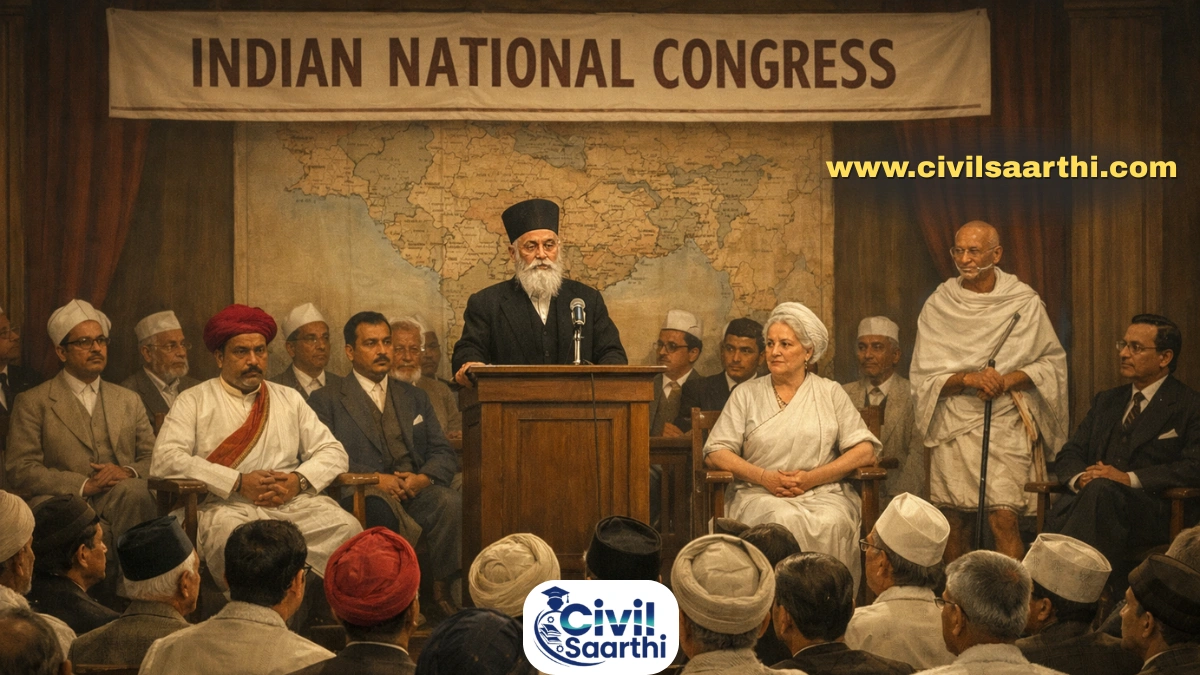
The Indian National Congress (INC) emerged as the principal platform uniting India against British colonial rule and played a central role in shaping the country’s freedom movement. It was founded in 1885, the INC began as a forum for educated Indians to discuss civil and political issues but gradually evolved into the driving force behind the nationalist struggle for independence. Over decades, the Congress guided the direction of India’s political aspirations, mobilized the masses, and became synonymous with the fight for self-rule.
Foundation and Early Years
The INC was founded on 28 December 1885 by Allan Octavian Hume, a retired British civil servant, initially to create a platform for civil and political discussion among educated Indians. The first session, held in Bombay, was attended by 72 participants, including journalists, lawyers, and social reformers. Early sessions focused on addressing administrative reforms, advocating political rights, and promoting unity among diverse communities in India.
Over time, the INC not only addressed moderate reform demands but also provided a platform for mass movements and national campaigns, including the Non-Cooperation Movement, Civil Disobedience Movement, and the final demand for Purna Swaraj (complete independence). The sessions of INC were instrumental in articulating the collective aspirations of Indians and shaping the country’s political narrative.
Also Read: Foundation of Indian National Congress (INC) 1885
All Sessions of the Indian National Congress
The table below provides a detailed overview of the all sessions of the INC, highlighting the year, venue, president, and the historical significance of each session:
| Year | Place | President | Significance |
|---|---|---|---|
| 1885 | Bombay | Womesh Chandra Bonnerjee | Inaugural session at Gokuldas Tejpal Sanskrit College; 72 participants including social reformers, journalists, and lawyers. |
| 1886 | Calcutta | Dadabhai Naoroji | Merger of INC and National Conference; Provincial Congress Committees set up across India. |
| 1887 | Madras | Badruddin Tyabji | Promoted unity; appealed to Muslims to join INC. |
| 1888 | Allahabad | George Yule | First English President of INC. |
| 1889 | Bombay | Sir William Wedderburn | INC’s British Committee established in Britain. |
| 1890 | Calcutta | Pherozeshah Mehta | Kadambini Ganguly, the first woman graduate of Calcutta University, spoke at the session. |
| 1891 | Nagpur | P. Ananda Charlu | — |
| 1892 | Allahabad | Womesh Chandra Bonnerjee | Congress criticized the Indian Councils Act of 1892. |
| 1893 | Lahore | Dadabhai Naoroji | — |
| 1894 | Madras | Alfred Webb | — |
| 1895 | Pune | Surendranath Banerjee | Significant increase in session attendance. |
| 1896 | Calcutta | Rahimatullah M. Sayani | “Vande Mataram” sung for the first time; blamed British for famine. |
| 1897 | Amraoti | C. Sankaran Nair | Condemned British arrest of Bal Gangadhar Tilak. |
| 1898 | Madras | Ananda Mohan Bose | — |
| 1899 | Lucknow | Romesh Chunder Dutt | Demanded end of ‘drain of wealth’ from India. |
| 1900 | Lahore | N.G. Chandavarkar | — |
| 1901 | Calcutta | Dinshaw Eduljee Wacha | Mahatma Gandhi appeared for the first time on Congress platform, advocating fight against racial injustice. |
| 1902 | Ahmedabad | Surendranath Banerjee | — |
| 1903 | Madras | Lal Mohan Ghosh | — |
| 1904 | Bombay | Sir Henry Cotton | Protested Lord Curzon’s Tibet policy and Bengal Partition. |
| 1905 | Banaras | Gopal Krishna Gokhale | Emergence of moderates vs extremists; Swadeshi resolution adopted. |
| 1906 | Calcutta | Dadabhai Naoroji | First declaration of Swaraj as Congress goal. |
| 1907 (Suspended) | Surat | Rash Behari Ghosh | Split between moderates and extremists. |
| 1908 | Madras | Rash Behari Ghosh | — |
| 1909 | Lahore | Madan Mohan Malaviya | Opposed separate electorates based on religion. |
| 1910 | Allahabad | Sir William Wedderburn | — |
| 1911 | Calcutta | Bishan Narayan Dar | “Jana Gana Mana” performed for the first time. |
| 1912 | Bankipore | Raghunath Mudholkar | — |
| 1913 | Karachi | Nawab Syed Mohammed Bahadur | — |
| 1914 | Madras | Bhupendra Nath Bose | Demanded higher positions for Indians in the army. |
| 1915 | Bombay | Satyendra Prasanna Sinha | Constitution amended to include extremist delegates. |
| 1916 | Lucknow | Ambica Charan Mazumdar | Moderates and extremists unified. |
| 1917 | Calcutta | Annie Besant | First woman President of INC. |
| 1918 | Delhi | Madan Mohan Malaviya | — |
| 1918 (Special) | Bombay | Syed Hasan Imam | Protested Montague-Chelmsford reforms; demanded Declaration of Rights for Indians. |
| 1919 | Amritsar | Motilal Nehru | Expressed sympathy for Jallianwala Bagh victims. |
| 1920 (Special) | Calcutta | Lala Lajpat Rai | Approved Non-Cooperation Movement (NCM). |
| 1920 | Nagpur | C. Vijayaraghavachariar | Intensified NCM; stressed non-violence. |
| 1921 | Ahmedabad | Hakim Ajmal Khan | Gandhi declared sole executive authority of Congress. |
| 1922 | Gaya | Chittaranjan Das | Debate on council entry led to formation of Swaraj Party. |
| 1923 (Special) | Delhi | Maulana Abul Kalam Azad | Members permitted to contest elections. |
| 1924 | Belgaum | Mahatma Gandhi | Only session presided over by Gandhi. |
| 1925 | — | Sarojini Naidu | First Indian woman to preside over Congress. |
| 1926 | Guwahati | S. Srinivasa Iyengar | — |
| 1927 | Madras | M.A. Ansari | Resolved to boycott Simon Commission. |
| 1928 | Calcutta | Motilal Nehru | First All India Youth Congress; Dominion Status resolution. |
| 1929 | Lahore | Jawaharlal Nehru | Declared Purna Swaraj as ultimate goal. |
| 1931 | Karachi | Vallabhbhai Patel | Passed resolution on Fundamental Rights and National Economic Program; endorsed Gandhi-Irwin Pact. |
| 1933 | Calcutta | Nellie Sengupta | — |
| 1934 | Bombay | Dr. Rajendra Prasad | Khadi adoption rule for elected members. |
| 1936 | Lucknow | Jawaharlal Nehru | Encouraged adoption of socialism. |
| 1937 | Faizpur | Jawaharlal Nehru | First rural session of Congress. |
| 1938 | Haripura | Subhash Chandra Bose | Rejected 1935 Government of India federal structure; formed National Planning Committee under Nehru. |
| 1939 | Tripuri | Subhash Chandra Bose | After Bose’s resignation, Rajendra Prasad became president. |
| 1940 | Ramgarh | Maulana Abul Kalam Azad | Objected to India being labeled belligerent in WWII. |
| 1946 | Meerut | J.B. Kripalani | Last session before Independence; focused on transfer of power plans. |
Importance of INC Sessions
- Policy Formulation: Every session provided an opportunity for leaders to discuss national issues and adopt resolutions that guided the political movement.
- Leadership Development: Sessions served as platforms for future leaders like Jawaharlal Nehru, Subhash Chandra Bose, and Mahatma Gandhi to assert their vision and influence decision-making.
- Unity and Mobilization: By bringing together leaders from across regions, religions, and communities, the INC sessions helped build a pan-Indian identity and coordinated action against colonial policies.
- Adaptability: The Congress held special sessions during critical junctures, such as approving the Non-Cooperation Movement in 1920, reflecting its dynamic approach to the evolving political situation.
Conclusion
The Indian National Congress was much more than a political organization; it was the heart of India’s nationalist aspirations. From its founding in 1885 to the eve of independence in 1946, the INC sessions reflected the evolving political strategies, ideological debates, and mass mobilization that eventually led to India achieving freedom in 1947. Each session, with its resolutions and deliberations, contributed to shaping modern India’s democratic and socio-political framework.
Q1. The 1929 Session of the Indian National Congress is of significance in the history of the Freedom Movement because: [2014]
(a) attainment of Self-Government was declared as the objective of the Congress
(b) attainment of Poorna Swaraj was adopted as the goal of the Congress
(c) Non-Cooperation Movement was launched
(d) the decision to participate in the Round Table Conference in London was taken
[A] attainment of Self-Government was declared as the objective of the Congress
[B] attainment of Poorna Swaraj was adopted as the goal of the Congress
[C] Non-Cooperation Movement was launched
[D] decision to participate in the Round Table Conference in London
Q2. Consider the following statements: [2015]
1. The first woman President of the Indian National Congress was Sarojini Naidu.
2. The first Muslim President of the Indian National Congress was Badruddin Tyabji.
Which of the statements given is/are correct?