 by
by 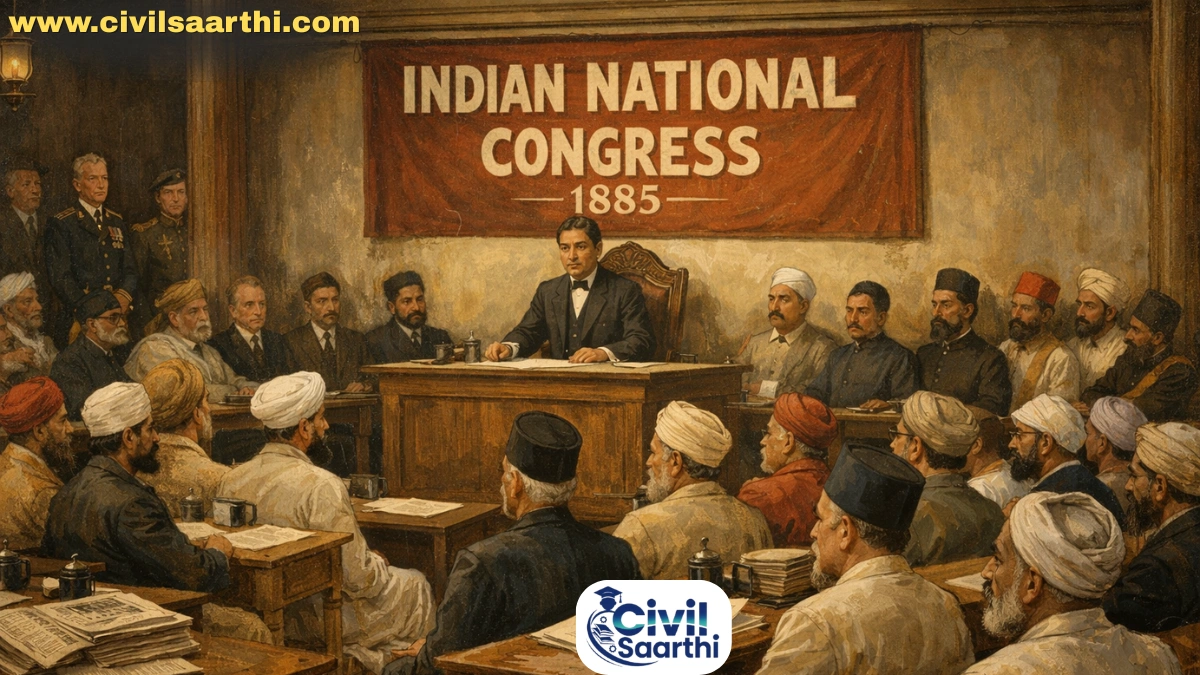
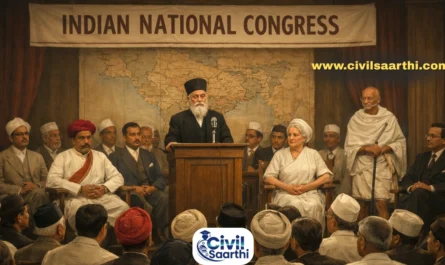
The Indian National Congress (INC), formed in 1885, was the cornerstone of India’s political awakening and played a pivotal role in the freedom struggle. Initially known as the Indian National Union, the INC was established by Allan Octavian Hume, a retired British civil servant, to provide a platform for educated Indians to express their grievances and demand greater participation in governance. Its formation was the result of decades of political consciousness and organized efforts by modern Indian intellectuals.
Indian National Congress Background
The foundation of the Indian National Congress was not an isolated event but the culmination of a growing political awareness among Indians during the 1860s to 1880s. By the late 1870s, modern intellectuals and politically conscious Indians were seeking a platform that represented national interests rather than regional or communal agendas.
- Preparatory groundwork: Several provincial associations and reform groups had emerged across India, setting the stage for a nationwide organization.
- Role of A.O. Hume: Hume envisioned a forum for dialogue and petitioning the British government. He wrote an open letter to Calcutta University graduates in 1883, expressing his desire to create a national body for educated Indians.
- Official permissions: Hume obtained the Viceroy Lord Dufferin’s permission to hold the first session. Originally planned in Poona, it was later shifted to Bombay due to a cholera outbreak.
- Women in the INC: In 1890, Kadambini Ganguly, the first woman graduate of Calcutta University, addressed the Congress session, symbolizing the commitment to include women in national politics.
The political awakening that led to the INC represented a shift from localized reform movements to a national platform, reflecting the aspirations of India’s emerging educated class.
Indian National Congress Key Features
The INC, in its early years, had several defining features:
- First national political organization: It aimed to involve more Indians in governance through dialogue and petitions.
- Moderate approach: Initially, it limited its methods to constitutional means, without demanding independence.
- Evolving goals: While early demands focused on increased representation in civil services and the army, over time, the party adopted more radical methods and demands.
- Moderates vs Extremists: By 1905, ideological differences led to a split between moderates, who preferred dialogue, and extremists, who favored direct action.
- Provincial activism: The Congress worked alongside provincial conferences, newspapers, and associations to spread nationalist ideas.
Indian National Congress Objectives
The INC was established with multiple objectives that shaped its role in India’s political landscape:
- Promote friendly relations among nationalist leaders across the country.
- Consolidate a sense of national unity, transcending caste, religion, and province.
- Formulate and present popular demands to the British government.
- Train and organize public opinion to create a politically conscious population.
- Serve as a “safety valve” to channel growing discontent with British rule.
- Establish a democratic, nationalist movement through a pan-India organization.
- Raise awareness about colonial exploitation and advocate for rights like increased council representation and Indianization of services.
Role of A.O. Hume
Allan Octavian Hume played a critical role in the formation of the INC:
- The idea reportedly originated from a private meeting of seventeen men after the Theosophical Convention in Madras (1884).
- Hume, son of the British radical Joseph Hume, brought his political experience and interest in reforms to India.
- He served in the East India Company’s civil service, promoted education, combated social evils, and encouraged agricultural progress.
- Hume’s pro-Indian stance often clashed with British colleagues, leading to his eventual retirement in 1882.
- After retirement, he focused on Indian politics, aligning more with the Bombay and Poona intellectual groups than with Calcutta leaders.
- Hume is often seen as a catalyst or “lightning conductor”, bringing together Indian nationalist forces in an organized way.
The First Session of the INC (1885)
The first session of the INC marked the formal launch of India’s organized political struggle:
- Date and venue: December 1885, Gokuldas Tejpal Sanskrit College, Bombay.
- Attendance: 72 delegates representing all major Indian provinces – 54 Hindus, 2 Muslims, and the rest were Jains and Parsis.
- First President: Womesh Chunder Bonnerjee
- Prominent leaders: Dadabhai Naoroji, Badruddin Tyabji, Pherozeshah Mehta, Surendranath Banerjea, Gopal Krishna Gokhale, Bal Gangadhar Tilak, and Motilal Ghosh.
- Annual sessions: After the first session, the Congress met every December, rotating locations across India.
The session established the INC as a national platform for discussing political, economic, and social issues in India.
Foundational Theories of the INC
Several interpretations exist regarding the purpose and origin of the INC:
Safety Valve Theory (Lala Lajpat Rai)
- Suggests Hume founded the INC to provide a “safety valve” for growing discontent with British rule.
- Some claim Hume got the idea from Viceroy Dufferin, though there’s no clear evidence.
Conspiracy Theory (R.P. Dutt)
According to Marxist historian R.P. Dutt, the INC was a conspiracy to suppress popular uprisings, with bourgeois leaders complicit.
Lightning Conductor Theory (G.K. Gokhale)
- The INC reflected the desire of politically aware Indians to form a national body.
- Officials would not have allowed Indians to form such an organization on their own; Hume acted as a catalyst or “lightning conductor” to unite nationalist forces.
Also Read: Advent of Europeans in India
Important Sessions of the Indian National Congress (INC)
The Indian National Congress (INC) held annual sessions from its inception in 1885, which played a crucial role in shaping India’s political landscape. These sessions provided a platform for debate, policy formulation, and the emergence of nationalist leadership.
| Year | Place | President | Significance / Outcomes |
|---|---|---|---|
| 1885 | Mumbai | Womesh Chandra Bonnerjee | First session of INC; 72 delegates attended (54 Hindus, 2 Muslims, rest Jain & Parsi); formal formation of the Indian National Congress; Viceroy – Lord Dufferin. |
| 1886 | Calcutta | Dadabhai Naoroji | Established Provincial Congress Committees across India, expanding the Congress network. |
| 1887 | Madras | Badruddin Tyabji | First Muslim president of the INC, promoting religious inclusivity. |
| 1888 | Allahabad | George Yule | First English president of the INC, indicating British engagement in early Congress activities. |
| 1889 | [Unknown] | Sir William Wedderburn | Adoption of the Congress creed, resolutions on education and agriculture, and consolidation of organizational objectives. |
| 1901 | Calcutta | Dinshaw Eduljee Wacha | First appearance of Mahatma Gandhi at Congress; main resolutions on drain of wealth and famine relief. |
| 1905 | Banaras | Gopal Krishna Gokhale | Expressed resentment against Partition of Bengal; proclamation of the Swadeshi Movement. |
| 1906 | Calcutta | Dadabhai Naoroji | Adoption of Swaraj as a goal and strong condemnation of the Partition of Bengal. |
| 1907 | Surat | Rash Behari Ghosh | Session split between moderates and extremists over Swaraj, boycott, and national education; Congress officially declared Swaraj as its aim. |
| 1916 | Lucknow | Ambica Charan Mazumdar | Unification of moderates and extremists; collaboration between INC and All India Muslim League. |
| 1917 | Calcutta | Annie Besant | First woman president of INC, highlighting women’s participation in politics. |
| 1920 | Calcutta (Special) | Lala Lajpat Rai | Discussion on post-Jallianwala Bagh and Khilafat Movement; resolution launching the Non-Cooperation Movement. |
| 1920 | Nagpur | C. Vijayaraghavachariar | Intensification of the Non-Cooperation Movement; urged merchants and government servants to support the national cause. |
| 1923 | Delhi (Special) | Maulana Mohammad Ali | Reaffirmed commitment to non-violent non-cooperation; allowed Congressmen to contest elections. |
| 1924 | Belgaum | M.K. Gandhi | Only INC session chaired by Mahatma Gandhi. |
| 1925 | Kanpur | Sarojini Naidu | Second woman and first Indian woman president of INC. |
| 1929 | Lahore | Jawaharlal Nehru | Passed historic ‘Purna Swaraj’ (complete independence) resolution. |
| 1931 | Karachi | Vallabhbhai Patel | Adopted fundamental rights, socio-economic principles, approved Irwin-Gandhi Pact, honored sacrifices of Bhagat Singh, Sukhdev, Rajguru. |
| 1936 | Lucknow | Jawaharlal Nehru | Focus on economic and social upliftment; passed a resolution demanding full independence. |
| 1937 | Faizpur | Jawaharlal Nehru | 50th INC session; first rural session; rejected GoI Act 1935; called for Constituent Assembly; emphasized agrarian reforms. |
| 1938 | Haripura (Gujarat) | Subhas Chandra Bose | Set up National Planning Committee; reinforced commitment to Poorna Swaraj and responsible government. |
| 1939 | [Unknown] | Subhas Chandra Bose | Bose elected president, defeating Gandhi-supported candidate; later resigned due to disagreements with Working Committee. |
| 1946 | Meerut | J.B. Kripalani | Accepted Cabinet Mission Plan, decided to participate in Constituent Assembly, formation of National Planning Committee. |
| 1948 | Jaipur | B. Pattabhi Sitaramayya | Paid homage to Mahatma Gandhi, adopted Objectives Resolution, and planned for general elections. |
Conclusion
The foundation of the Indian National Congress in 1885 marked the beginning of a structured and organized movement for India’s independence. While it started as a moderate platform for dialogue and reform, it eventually evolved into a mass-based nationalist movement, ultimately playing a central role in India’s freedom struggle. The INC’s establishment laid the foundation for a united national effort, bringing together diverse communities and creating a roadmap toward self-governance.