 by
by 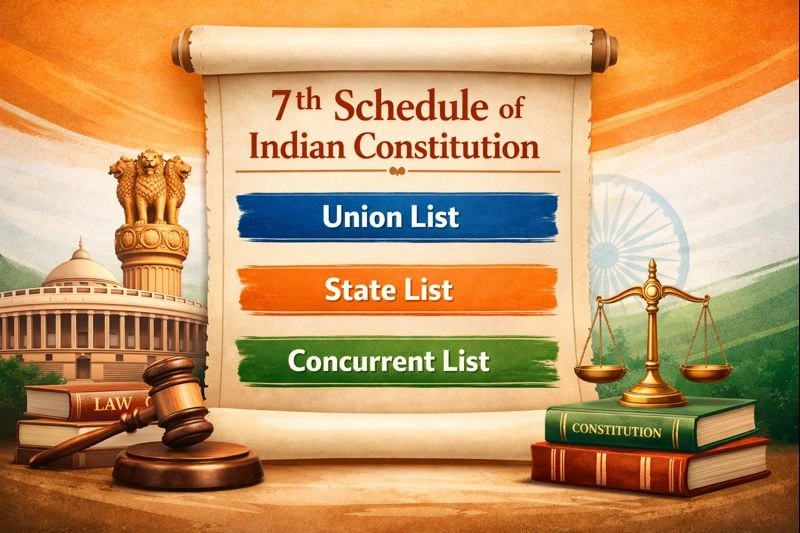
The 7th Schedule of the Indian Constitution is one of the most important parts of the Constitution because it explains how law-making powers are divided between the Central Government and the State Governments. India follows a federal system, which means power is shared between different levels of government. The 7th Schedule ensures that this power sharing is clear, balanced, and conflict-free.
This schedule is directly connected with Article 246, which defines legislative authority in India. Understanding the 7th Schedule helps students clearly understand Indian federalism, governance, and administration.
What is the 7th Schedule of the Indian Constitution?
The 7th Schedule contains three separate lists of subjects on which laws can be made. Each list specifies who has the authority to legislate on those subjects. The Three Lists Are:
- Union List (List I)
- State List (List II)
- Concurrent List (List III)
Each subject related to governance, economy, law, and public welfare is placed in one of these three lists.
7th Schedule of Indian Constitution Constitutional Provisions
Union List (List I)
The Union List (List I) includes subjects that are of national importance and require uniform laws across the entire country. Only the Central Government has the power to make laws on these subjects to ensure national unity, security, and economic stability. Matters related to defence, foreign affairs, and major national institutions are placed in this list.
List of All Subjects in the Union List (List I)
| Subjects 1–25 | Subjects 26–50 | Subjects 51–75 | Subjects 76–100 |
|---|---|---|---|
| Defence of India | Excise duties | Atomic energy | National libraries |
| Naval, military, and air forces | Corporation tax | Industries declared of national importance | Archaeological sites of national importance |
| Deployment of armed forces in any state | Taxes on capital value of assets | Regulation of mines and minerals | National museums |
| Foreign affairs | Estate duty | Oilfields and petroleum resources | Regulation of foreign trade |
| Diplomatic, consular and trade representation | Taxes on inter-state trade | Regulation of labour in Union-controlled industries | Trade with foreign countries |
| United Nations and international organizations | Taxes on newspapers and advertisements | Public services of the Union | Inter-state migration |
| War and peace | Census | Union Public Service Commission | Quarantine |
| Citizenship, naturalisation, and aliens | Postal services | All India Services | Epidemics crossing states |
| Extradition | Telegraphs, telephones, wireless | Union pensions | Central universities |
| Foreign loans | Broadcasting | Elections to Parliament | Institutions of national importance |
| Diplomatic privileges and immunities | Railways | Election Commission | Coordination of higher education |
| United Nations peacekeeping participation | National highways | Audit of Union accounts | Research institutions |
| Admission into and emigration from India | Shipping and navigation | Supreme Court | Regulation of professions |
| Pilgrimage outside India | Ports declared as major ports | High Courts | Shipping insurance |
| Entering into treaties and agreements | Lighthouses | Extension of jurisdiction of courts | Sea customs |
| Currency, coinage and legal tender | Airways and aircraft | Contempt of court | International waterways |
| Foreign exchange | Regulation of air traffic | Admiralty jurisdiction | Offshore resources |
| Banking | Aircraft manufacture | Inter-state trade and commerce | Territorial waters |
| Insurance | Carriage of passengers and goods | Regulation of monopolies | Exclusive Economic Zone |
| Stock exchanges and futures markets | Inland waterways | Patents and copyrights | Maritime zones |
| Weights and measures | Maritime shipping | Trademarks and designs | Union territories administration |
| Mint | Central Bureau of Intelligence and Investigation | Incorporation of national corporations | Elections to Vice-President and President |
| Public debt of the Union | Preventive detention | Standards of quality | Emergency provisions |
| Taxes on income other than agricultural income | Arms, firearms and ammunition | Geological surveys | Residual taxation powers |
| Customs duties | Industries regulation | Scientific and technical institutions | Any matter not enumerated in State or Concurrent List |
State List (List II)
The State List contains subjects of regional and local importance, where only the State Governments have the authority to make laws. It allows states to manage issues like police, public health, agriculture, and local governance according to regional needs.
List of All Subjects in the State List (List II)
| Subjects 1–15 | Subjects 16–30 | Subjects 31–45 | Subjects 46–61 |
|---|---|---|---|
| Public order (including police) | Land | Local government (Panchayats and Municipalities) | Pilgrimage |
| Police | Agriculture | Public health and sanitation | Markets and fairs |
| Public health and sanitation | Irrigation and canals | Hospitals and dispensaries | Trades and occupations |
| Agriculture | Land revenue | Primary and secondary education | State pensions |
| Fisheries | Taxes on agricultural income | Libraries and museums | State public services |
| Markets and fairs | Taxes on professions | Charitable institutions | State public works |
| Water supplies | State public debt | State universities | State forests |
| Local government | Port administration (other than major ports) | State lotteries | State monopolies |
| Prisons | State transport | Agriculture education | Weights and measures (within state) |
| Jails and reformatory institutions | Trade and commerce within the state | Economic planning within the state | Regulation of professions (within state) |
| State public services | State lotteries | State police forces | State gambling and betting |
| Public health and sanitation | State prisons | Regulation of markets and fairs | Fisheries and fisheries regulations |
| Agriculture and irrigation | State agriculture universities | Public health infrastructure | State taxes on goods and services |
| Entry into contracts by the state | Local government elections | Maintenance of public order | Minor minerals (within the state) |
| State roads and highways | Public works and buildings | Trade unions within the state | Local taxes and cesses |
Concurrent List (List III)
The Concurrent List contains subjects on which both the Centre and the States can make laws. In case of conflict, Central law prevails, and the list covers matters of common interest such as education, forests, criminal law, and labour welfare.
List of All Subjects in the Concurrent List (List III)
| Subjects 1–13 | Subjects 14–26 | Subjects 27–39 | Subjects 40–52 |
|---|---|---|---|
| Criminal law | Marriage and divorce | Population control and family planning | Economic and social planning |
| Criminal procedure | Adoption and succession | Prevention of cruelty to animals | Trade and commerce within the state (if regulated concurrently) |
| Evidence and law of evidence | Wills and intestacy | Prevention of human trafficking | Weights and measures (concurrent matters) |
| Contracts and contracts relating to contracts | Contracts relating to contracts | Bankruptcy and insolvency | Vital statistics and census (if concurrent) |
| Civil procedure, including limitation | Charitable and religious endowments | Education, including universities | Education (technical, vocational) |
| Trusts and trustees | Trusts relating to religion and charitable institutions | Adult and mass education | Standard of weights and measures |
| Registration of documents and property | Social security schemes | Scientific and technical institutions | Protection of monuments and archaeological sites |
| Newspapers and printing presses | Dangerous animals | Labour welfare and industrial disputes | Prevention of food adulteration |
| Bankruptcy and insolvency law | Prevention of cruelty to animals | Trade unions and industrial relations | Weights and measures (standards and regulation) |
| Prevention of cruelty to animals | Fisheries | Prevention of human trafficking | Regulation of professions (both Centre & State) |
| Education, including universities | Education boards | Essential commodities | Protection of monuments and archaeological sites |
| Economic and social planning | Economic development programs | Universities and research institutions | Town planning and housing (if concurrent) |
| Forests | Forest reserves and protection | Co-operative societies | Water supply (if concurrent) |
Residuary Powers
Residuary Powers are the subjects not mentioned in any of the three lists of the 7th Schedule (Union, State, or Concurrent). According to Article 248 of the Indian Constitution, the Parliament (Central Government) has exclusive authority to make laws on these matters. These powers allow the Centre to deal with new and emerging subjects like cyber laws, digital governance, and modern technologies. Residuary powers ensure that the Constitution remains flexible and adaptable to changing times.
Constitutional Amendments in the 7th Schedule
Several constitutional amendments have modified the 7th Schedule to improve governance and policy coordination. Major changes include moving Education and Forests from the State List to the Concurrent List to allow uniform national policies and cooperative governance.
| Amendment | Year | Change Made | Impact / Purpose |
|---|---|---|---|
| 42nd Amendment | 1976 | Transferred Education from State List to Concurrent List | Ensured uniform educational policies across India |
| 42nd Amendment | 1976 | Transferred Forests from State List to Concurrent List | Allowed Central-State coordination in forest conservation and regulation |
| 44th Amendment | 1978 | Clarified Centre-State powers in Concurrent List | Strengthened federal balance after 42nd Amendment |
| 86th Amendment | 2002 | Added provisions related to education in Concurrent List | Focused on compulsory elementary education and national education policy |
| 101st Amendment | 2016 | Added matters related to GST in Union and State lists | Enabled implementation of Goods and Services Tax (GST) uniformly |
| Other Minor Amendments | Various | Adjustments to subjects in lists | Addressed emerging areas like atomic energy, cyber laws, technology regulation |
7th Schedule and Federal Nature of India
The 7th Schedule is the backbone of India’s federal system, as it clearly divides legislative powers between the Centre and the States. It ensures cooperation, balanced governance, and national unity while respecting regional autonomy.
- Divides powers into Union, State, and Concurrent Lists for clarity.
- Protects state autonomy by assigning regional matters exclusively to States.
- Ensures national unity by giving supremacy to the Centre in Union and Concurrent matters.
- Supports cooperative federalism, allowing both Centre and States to work together on shared subjects.
- Helps maintain administrative efficiency and prevents conflicts between levels of government.
- Allows flexibility to adapt to emerging national and regional challenges.
Conclusion
The 7th Schedule of the Indian Constitution is the backbone of India’s legislative structure. By clearly dividing subjects among the Centre and the States, it ensures smooth administration, political stability, and effective governance. A detailed understanding of this schedule is essential for students and exam aspirants aiming to master Indian polity.