 by
by 
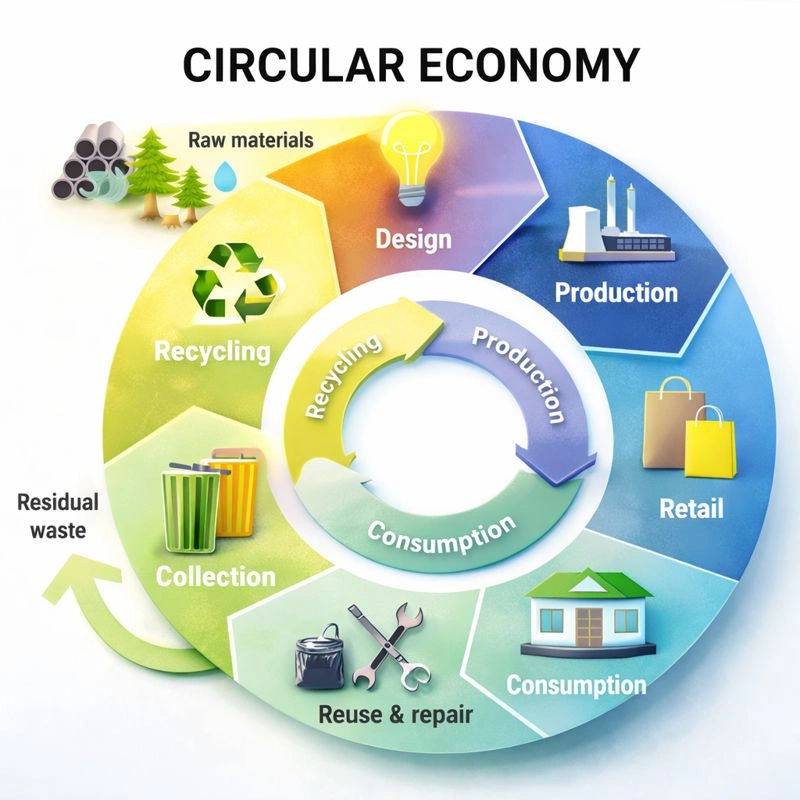
The circular economy represents a transformative shift from traditional linear production models, prioritizing resource efficiency, waste elimination, and ecological regeneration. Unlike the linear economy, which relies heavily on finite natural resources and generates massive waste, the circular economy keeps products, components, and materials in circulation for as long as possible, reducing environmental impact and promoting sustainability.
This model is gaining traction worldwide, including in India, as governments, businesses, and communities recognize the importance of sustainable practices. It also aligns strongly with the United Nations Sustainable Development Goals (SDGs), particularly those related to responsible consumption and production, climate action, and sustainable cities.
What is Circular Economy?
A circular economy is an economic system designed to eliminate waste and pollution by keeping products and materials in continuous use through maintenance, reuse, refurbishment, and recycling.
Key Characteristics:
- Closing Material Loops: Reduces resource extraction by keeping materials in use.
- Resource Efficiency: Focuses on using fewer raw materials and maximizing product utility.
- Ecosystem Regeneration: Incorporates practices that restore and preserve natural ecosystems.
Unlike the traditional linear “take-make-waste” model, the circular economy decouples economic growth from resource depletion, addressing climate change, biodiversity loss, and pollution simultaneously.
Core Principles of Circular Economy
The circular economy is guided by three fundamental principles:
Eliminate Waste Through Smarter Design and Production
Products are designed to reduce waste at every stage of the lifecycle.
Example: Biodegradable packaging or modular electronics that allow easy repair.
Extend Product Lifespan
Repair, remanufacture, refurbish, and share products to prolong their use.
Example: IKEA’s furniture buy-back program keeps products in circulation longer, reducing landfill waste.
Regenerate Ecosystems
Transition to renewable energy and practices that restore biodiversity.
Promotes sustainable use of natural resources while improving ecosystem health.
Circular Economy and Sustainable Development
The circular economy is strongly aligned with SDGs and broader sustainability frameworks:
- Responsible Consumption and Production (SDG 12): Reduces waste, encourages reuse, and promotes efficient resource use.
- Climate Action (SDG 13): Reduces carbon emissions through recycling, remanufacturing, and waste minimization.
- Sustainable Cities and Communities (SDG 11): Encourages sustainable urban planning and eco-friendly industrial practices.
It also addresses global challenges like climate change, biodiversity loss, waste generation, and pollution by breaking the link between economic growth and environmental degradation.
Seven Pillars of Circular Economy
The circular economy is supported by seven pillars that guide sustainable practices across sectors:
Materials Are Cycled at Continuous High Value
Materials are reused at their highest value with minimal loss or mixing.
Short transport distances and design simplicity help conserve natural and human-made complexity.
Protection of Biodiversity
Circular practices avoid habitat damage and prioritize ecological resilience.
Resource extraction decisions are made with consideration for environmental balance.
Sustainable Water Use
Efficient use of water and nutrient recovery from wastewater.
Reduces pollution and protects aquatic ecosystems.
Preservation of Human Society and Culture
Governance and business practices consider cultural well-being alongside economic goals.
Fair resource distribution supports social cohesion.
Human Health and Well-being Prioritized
Harmful substances are controlled or eliminated.
Unsafe practices, such as burning e-waste, are avoided.
Fair Use of Limited Resources
Focuses on maximizing societal value, including financial, ecological, emotional, and aesthetic value.
Avoids profit-centric exploitation of resources.
Integration of Innovation and Knowledge
Encourages the use of technology, research, and innovation to optimize recycling, remanufacturing, and product lifespan extension.
Circular Economy in the Indian Context
India is increasingly embracing circular economy practices across its manufacturing, agriculture, and services sectors:
Manufacturing: Companies use recycled materials, eco-design products, and implement modular production.
Agriculture: Organic waste recycling and sustainable farming practices reduce environmental impact.
Services: Digital tools like blockchain and AI enable traceability, e-waste tracking, and smart logistics.
These innovations help India scale circular economy practices efficiently and sustainably.
Examples of Circular Economy in Practice
Electronics Industry
Smartphones and electronic devices are designed for easy disassembly, enabling recovery of valuable metals and rare earth elements.
Used devices are refurbished or recycled, minimizing e-waste, conserving resources, and reducing production costs.
Furniture Sector
Companies like IKEA run buy-back and refurbishment programs to extend product life and minimize landfill contributions.
Fashion Industry
Brands such as Patagonia encourage repair, resale, and recycling of garments to reduce textile waste.
Food Industry
Food waste is converted into compost, animal feed, or bioenergy, reducing landfill waste and greenhouse gas emissions.
Benefits of Circular Economy
Environmental Benefits
Conservation of Resources: Reduces raw material extraction by up to 32% by 2030.
Carbon Footprint Reduction: Circular practices could cut global greenhouse gas emissions by 39% by 2050.
Waste Reduction: Diverts substantial waste from landfills and oceans through recycling, composting, and remanufacturing.
Economic Benefits
Operational Savings: Remanufacturing and recycling can reduce production costs by 10–15%.
Employment Growth: Estimated 6–7 million new jobs globally by 2030.
Business Innovation: Leasing, sharing platforms, and circular business models may generate $4.5 trillion in economic output by 2030.
Social Benefits
Broader Consumer Access: Affordable refurbished or shared products improve access to quality goods.
Healthier Environments: Reduces air and water pollution, improving public health and community well-being.
Roadblocks to Circular Economy
Despite its potential, the transition faces several challenges:
Regulatory Challenges
Fragmented and outdated policies hinder standardization.
International agreements may conflict with local circular practices.
Technological Barriers
Limited recycling innovation, data traceability issues, and conflicts between product functionality and circularity.
Infrastructure Gaps
Weak reverse logistics, inefficient collection and sorting systems, and limited scalability.
Financial Constraints
Higher upfront investments and accounting methods unsuitable for circular practices.
Organizational and Social Challenges
Resistance within organizations, complex supply chains, unclear performance metrics, and consumer habits impede progress.
Way Forward for Circular Economy
To successfully implement circular economy practices, multi-faceted strategies are essential:
Policy and Legislative Reforms
Unified laws and mandates for using recycled materials early in production.
Standardization of reporting and regulatory frameworks.
Circular Economy Framework
Simplified reporting systems, including Extended Producer Responsibility (EPR) certificates and fiscal incentives.
Support for businesses to achieve sustainable supply chains.
Technology and R&D Investments
Focus on recycling innovation, smart logistics, and renewable energy solutions.
Collaboration with global firms for domestic recycling and sustainable production.
Community Engagement
Urban composting centers and educational initiatives improve public participation and soil health.
Awareness campaigns to promote sustainable consumption habits.
Conclusion
The circular economy is a paradigm shift in economic thinking, moving away from the linear model towards a system that balances economic growth with environmental sustainability. By embracing principles of resource efficiency, waste elimination, and ecological regeneration, countries like India can achieve sustainable development, generate employment, conserve natural resources, and combat climate change.
Circular Economy and UPSC Perspective
UPSC Prelims 2025 Question on Circular Economy
Consider the following statements:
Circular economy reduces the emissions of greenhouse gases.
Circular economy reduces the use of raw materials as inputs.
Circular economy reduces wastage in the production process.
Which of the following is correct?
(a) Both Statement II and III are correct and both explain Statement I
(b) Both Statement II and III are correct but only one explains Statement I
(c) Only one of Statements II and III is correct and explains Statement I
(d) Neither Statement II nor III is correct
Answer: (a) Both Statement II and III are correct and explain Statement I
Statement I: Circular economy reduces the emissions of greenhouse gases.
This is true because the circular economy promotes reuse, recycling, and efficient use of resources, which reduces the energy and raw materials required in production. Less energy use often means fewer greenhouse gas emissions.
Statement II: Circular economy reduces the use of raw materials as inputs.
This is correct because the circular economy focuses on keeping materials in circulation for as long as possible through recycling, refurbishing, and remanufacturing.
By reducing the need for virgin raw materials, industries consume less energy in extraction, processing, and transportation, which directly contributes to lower greenhouse gas emissions (explaining Statement I).
Statement III: Circular economy reduces wastage in the production process.
This is also correct. Circular economy principles encourage efficient design, waste minimization, and process optimization.
Reduced waste means less landfill, lower incineration, and reduced energy use, all of which contribute to lowering greenhouse gas emissions (again supporting Statement I).
Therefore, both Statement II and Statement III are correct, and both explain Statement I, making option (a) the correct choice.
Circular Economy FAQs
1. What is a circular economy?
A circular economy is an economic system that minimizes waste and keeps products and materials in continuous use through reuse, repair, refurbishment, and recycling.
2. How does circular economy differ from a linear economy?
Unlike the linear “take-make-dispose” model, a circular economy keeps resources in use for as long as possible, reducing raw material consumption and waste.
3. What are the main benefits of circular economy?
The circular economy reduces environmental impact, lowers costs, promotes innovation, creates green jobs, and improves community well-being.
4. Which industries benefit most from circular economy practices?
Industries like manufacturing, electronics, fashion, food, and construction benefit most from circular economy practices.
5. How does circular economy help in reducing greenhouse gas emissions?
By reducing resource extraction, energy use, and production waste, circular economy practices lower greenhouse gas emissions.
6. What are the challenges in implementing a circular economy?
Challenges include regulatory gaps, technological limitations, inadequate infrastructure, financial constraints, and resistance to change.
7. How is circular economy related to Sustainable Development Goals (SDGs)?
Circular economy supports SDGs by promoting responsible consumption, climate action, sustainable cities, and decent work and economic growth.
8. Can circular economy work in India?
Yes, India is adopting circular economy practices in manufacturing, agriculture, and services, supported by digital tools like AI and blockchain.
9. Give an example of circular economy in practice.
In electronics, smartphones are designed for easy disassembly, enabling refurbishment and recycling to reduce e-waste and conserve resources.
10. What is the way forward for circular economy?
The way forward involves policy support, R&D investments, industry-government collaboration, and public awareness for sustainable resource use.