
 by
by 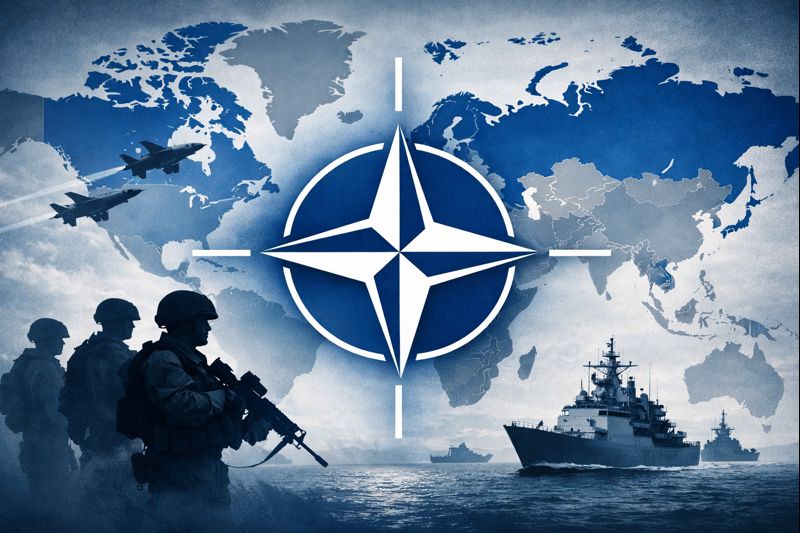
The North Atlantic Treaty Organization (NATO) is the world’s most powerful political and military alliance, established in 1949 to ensure collective security among its member states. It was formed in the aftermath of World War II, at a time when Europe was economically weakened and politically unstable, and the growing influence of the Soviet Union posed a significant security challenge.
NATO functions as a transatlantic alliance, linking Europe and North America, and operates on the principle that the security of one member is inseparably linked with the security of all.
Genesis and Formation of NATO
The North Atlantic Treaty Organization (NATO) was established in the aftermath of World War II, when Europe was politically unstable, economically devastated, and strategically vulnerable.
The ideological confrontation between capitalist democracies led by the United States and communist states led by the USSR soon evolved into the Cold War (1947–1991). This period was marked by mutual suspicion, military build-up, and the fear of communist expansion.
Factors Leading to NATO’s Formation
Here are the important factors that led to the formation of the North Atlantic Treaty Organization (NATO).
- After World War II, Europe was politically unstable and militarily weak, creating a security vacuum that required collective protection.
- The rapid expansion of Soviet influence and establishment of communist regimes in Eastern Europe created fear of further territorial expansion.
- Ideological rivalry between capitalism and communism intensified Cold War tensions, making cooperation between East and West impossible.
- The failure of the United Nations to prevent conflicts due to veto politics highlighted the need for a separate collective defence mechanism.
- The Truman Doctrine and Marshall Plan reflected the United States’ commitment to defend and rebuild Western Europe against communist influence.
- The Berlin Blockade (1948–49) exposed the vulnerability of Western Europe and demonstrated the urgent need for a military alliance.
- To ensure mutual security, deter aggression, and integrate Western military efforts under a common command, NATO was formed in 1949 based on the principle of collective defence.
NATO Membership and Expansion
NATO began in 1949 with 12 founding members and has gradually expanded through its “Open Door Policy” to include countries willing to contribute to collective security and democratic values. Over time, especially after the Cold War, NATO expanded eastward to include several former Warsaw Pact nations, reflecting shifting geopolitical realities and security concerns in Europe.
| Year | Countries Joined |
|---|---|
| 1949 | Belgium, Canada, Denmark, France, Iceland, Italy, Luxembourg, Netherlands, Norway, Portugal, UK, USA |
| 1952 | Greece, Turkey |
| 1955 | Germany |
| 1982 | Spain |
| 1999 | Czech Republic, Hungary, Poland |
| 2004 | Bulgaria, Estonia, Latvia, Lithuania, Romania, Slovakia, Slovenia |
| 2009 | Albania, Croatia |
| 2017 | Montenegro |
| 2020 | North Macedonia |
| 2023 | Finland, Sweden |
Eurpoean Countries Outside NATO
Despite NATO’s wide presence across Europe, a few European countries remain outside the alliance due to long-standing neutrality policies, constitutional restrictions, or strategic non-alignment.
| Country | NATO Status | Reason for Non-Membership | Security Alignment |
|---|---|---|---|
| Austria | Non-member | Constitutionally neutral since 1955 | EU member, neutral military policy |
| Ireland | Non-member | Policy of military neutrality | EU member, UN peacekeeping role |
| Cyprus | Non-member | Territorial dispute with Turkey (a NATO member) | EU member, limited NATO cooperation |
| Malta | Non-member | Constitutionally neutral | EU member, non-aligned |
| Switzerland | Non-member | Long-standing armed neutrality | Cooperates with NATO through PfP |
| Serbia | Non-member | Military neutrality, close ties with Russia | NATO Partnership for Peace |
| Bosnia and Herzegovina | Aspiring member | Internal political divisions | NATO Membership Action Plan (MAP) |
| Kosovo | Not a member | Not universally recognized | NATO peacekeeping mission present |
| Belarus | Non-member | Close military ties with Russia | Part of Russia-led CSTO |
| Ukraine | Applicant | War with Russia delaying entry | NATO aspirant (since 2022) |
Achievements of North Atlantic Treaty Organization (NATO)
- Maintained peace in Europe during the Cold War by deterring Soviet expansion.
- Strengthened collective defence among members through Article 5, invoked after the 9/11 attacks.
- Stabilized Central and Eastern Europe by integrating former communist states post–Cold War.
- Conducted peacekeeping and crisis management operations in Bosnia, Kosovo, Libya, and Afghanistan.
- Ensured maritime security through operations like Operation Sea Guardian in the Mediterranean.
- Provided humanitarian aid and disaster relief, including support to Türkiye after the 2023 earthquakes.
- Adapted to modern security challenges, including cyber threats, hybrid warfare, and emerging technologies.
Also Read: World Trade Organization
NATO’s Eastward Expansion
NATO’s eastward expansion refers to the process of including countries from Central and Eastern Europe and the Baltic region into the alliance after the collapse of the Soviet Union (1991). This expansion aimed to promote stability, democracy, and collective security in post-communist Europe while extending NATO’s influence closer to Russia’s borders.
- First Post-Cold War Expansion (1999): Poland, Hungary, and the Czech Republic became members, marking the beginning of NATO’s move into former Warsaw Pact countries.
- Major Expansion in 2004: Seven countries joined — Estonia, Latvia, Lithuania, Slovakia, Slovenia, Romania, and Bulgaria — significantly increasing NATO’s presence in Eastern Europe.
- Balkan Expansion (2009–2020): Albania and Croatia joined in 2009, Montenegro in 2017, and North Macedonia in 2020, enhancing security and stability in the Balkans.
- Nordic Expansion (2023–2024): Finland joined in 2023 and Sweden in 2024, ending Nordic military neutrality and strengthening NATO’s northern flank.
- Strategic Implications: Expansion improved collective defense and deterrence but increased tensions with Russia, which perceives NATO’s growth as a direct security threat.
- Open Door Policy (Article 10): NATO allows any European country that meets democratic, political, and military criteria to join, supporting gradual eastward expansion.
- Security and Political Impact: While expansion strengthened NATO, it also necessitated increased military spending among new members and created geopolitical friction with Russia, contributing to crises like the Ukraine conflict.
Major Challenges Faced by NATO
- Funding and Burden Sharing: Many member countries fail to meet the guideline of spending 2% of GDP on defense, leading to disagreements over financial responsibility.
- Russian Aggression: NATO faces growing security threats due to Russia’s actions in Ukraine, Crimea, and Georgia, which strain relations and test collective defense.
- Rise of China: China’s growing military, economic, and technological influence in the Indo-Pacific and beyond poses strategic challenges for NATO’s global interests.
- Right-Wing Nationalism and Populism: The rise of nationalist governments in Europe has led to skepticism about NATO and reduced political support for collective security measures.
- Uncertainty of U.S. Commitment: Past U.S. leaders questioned the value of NATO, creating doubts about the reliability of the alliance’s strongest military power.
- Cyber and Hybrid Threats: Increasing cyber-attacks, misinformation campaigns, and hybrid warfare pose challenges that require new strategies and technologies.
- Internal Divisions Among Members: Differences in strategic priorities, political interests, and threat perception among members can hinder NATO’s cohesion and decision-making.
Greenland Issue and NATO
Way Forward
- Strengthen unity among member countries to ensure cohesive decision-making and collective security.
- Enhance defense capabilities and ensure fair burden-sharing, with all members meeting defense spending commitments.
- Develop advanced cyber, space, and hybrid warfare capabilities to address emerging security threats.
- Expand partnerships beyond Europe while maintaining a clear strategy toward Russia and China.
- Focus on crisis management, rapid deployment, and military interoperability through joint exercises.
- Balance NATO expansion with diplomatic engagement to avoid unnecessary geopolitical tensions.
- Promote resilience and innovation in technology, intelligence, and strategic planning to adapt to future challenges.
- North Atlantic Treaty Organization (NATO) FAQs
North Atlantic Treaty Organization (NATO) FAQs
1. What is NATO?
NATO is a political and military alliance of 32 countries from Europe and North America, founded in 1949 to ensure collective defense against threats.
2. Where is NATO headquartered?
NATO’s headquarters is located in Brussels, Belgium.
3. What is the core principle of NATO?
The core principle is collective defense under Article 5, which states that an attack on one member is considered an attack on all members.
4. How many countries are members of NATO?
As of 2025, NATO has 32 member countries, including the United States, Canada, European countries, and recently Finland and Sweden.
5. Has Article 5 ever been invoked?
Yes, Article 5 has been invoked only once, in response to the 9/11 terrorist attacks in the United States.
6. Can any country join NATO?
Yes, under Article 10, any European country that meets NATO’s political, military, and democratic criteria can apply for membership.
7. What is NATO’s role in global security today?
NATO ensures collective defense, conducts peacekeeping and crisis management operations, counters terrorism, secures maritime routes, provides humanitarian aid, and addresses modern threats like cyber and hybrid warfare.
8. What is NATO’s relationship with non-member countries?
NATO maintains partnerships with over 40 countries through programs like Partnership for Peace (PfP), Mediterranean Dialogue, and the Istanbul Cooperation Initiative (ICI).
9. What are some recent challenges for NATO?
Key challenges include Russian aggression, cyber threats, burden-sharing disputes, rise of China, and internal political divisions among members.
10. What is the Greenland issue in relation to NATO?
The Greenland issue emerged when former U.S. President Trump proposed buying Greenland, a territory of Denmark, sparking debates on sovereignty, Arctic security, and alliance unity within NATO.