
 by
by 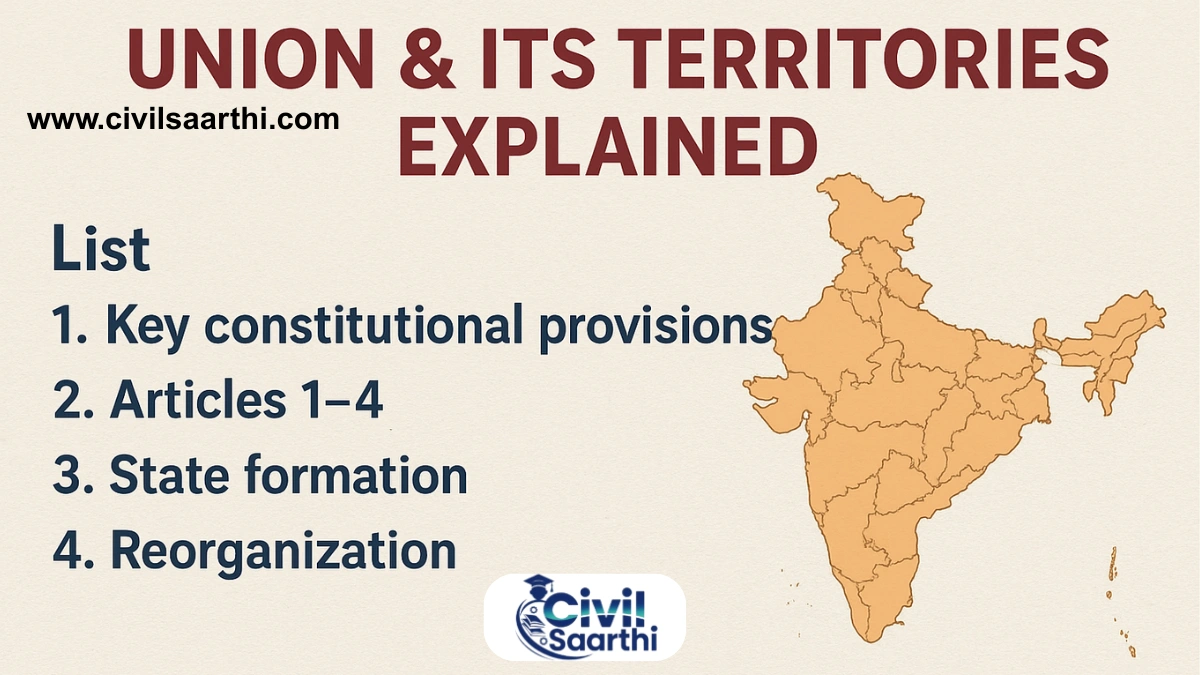
The Union & Its Territories explain the constitutional basis and structure of India’s Union Territories. It highlights key articles, evolution, and differences from states. The topic includes the list and classification of current UTs. This is crucial for understanding India’s federal setup for UPSC exams.
Union & Its Territories
The topic Union & Its Territories a fundamental part of the Indian Polity syllabus for UPSC 2025. Understanding the structure, evolution, classification, and features of Union Territories is essential for both Prelims and Mains. The Indian Constitution provides a unique federal framework, with certain areas administered directly by the Central Government as Union Territories.
Union & Its Territories Overview
The Overview of Union & Its Territories serves as a roadmap for structured study and quick recall during UPSC preparation. It outlines all key subtopics such as constitutional provisions, present UTs, their evolution, classification, and comparison with states.
| Union & Its Territories Overview | |
| Topic | Subtopics Covered |
| Union & Its Territories |
|
Union & Its Territories: Constitutional Provisions
The Constitution of India under Part I (Article 1 to 4) lays down the framework for Union & Its Territories. These Articles define India as a “Union of States” and provide the basis for its federal structure. The term “Union” signifies the indestructibility of the Indian federation, meaning states cannot secede from the union.
Key Provisions under Union & Its Territories
| Key Provisions under Union & Its Territories | |
| Article | Provision |
| Article 1 | India as a Union of States; Territories of India |
| Article 2 | Admission/establishment of new states |
| Article 3 | Formation or alteration of states and UTs |
| Article 4 | Laws under Article 2 & 3 not deemed as Constitutional Amendments |
What are Union Territories in Union & Its Territories?
Union Territories are those regions in India that are governed directly by the Central Government. Unlike states, which have their own elected governments, many Union Territories are administered by Lieutenant Governors or Administrators appointed by the President.
| Features of Union Territories in Union & Its Territories Polity Notes | |
| Feature | Explanation |
| Governance | Direct control by Central Government |
| Representation | Limited representation in Parliament |
| Legislature | Only some UTs have their own legislature |
| Purpose | Administrative, historical, or strategic reasons |
What are the Present Union Territories in India? (As per Union & Its Territories)
As of 2025, there are 8 Union Territories in India. This section of Union & Its Territories provides a list of current UTs and their capitals. The reorganization of Jammu & Kashmir in 2019 is an important event shaping the current UT landscape.
| List of Present Union Territories in India | |
| Union Territory | Capital |
| Andaman & Nicobar Islands | Port Blair |
| Chandigarh | Chandigarh |
| Dadra & Nagar Haveli and Daman & Diu | Daman |
| Delhi (NCT) | New Delhi |
| Jammu & Kashmir | Srinagar (summer), Jammu (winter) |
| Ladakh | Leh |
| Lakshadweep | Kavaratti |
| Puducherry | Puducherry |
How Did the Union Territories Evolve in India? (Union & Its Territories)
The evolution of Union Territories has occurred through historical events, political considerations, and constitutional amendments. This part of Union & Its Territories focuses on how different regions came to be designated as UTs. Many UTs were either princely states, foreign colonies, or strategically significant regions.
| Evolution of Union Territories in Union & Its Territories | |
| Union Territory | Origin/Evolution |
| Puducherry | Former French colony merged in 1954 |
| Daman & Diu | Portuguese colonies merged in 1961 |
| Delhi | Became NCT with special status in 1991 |
| Jammu & Kashmir, Ladakh | Bifurcated and reorganized in 2019 |
Differences Between States and Union Territories in Union & Its Territories
Understanding the distinction between states and UTs is crucial in Union & Its Territories . While both are parts of the Indian Union, their administrative setup, constitutional status, and powers differ significantly. States enjoy more autonomy, while UTs are under greater control of the Centre.
| Key Differences in Union & Its Territories | ||
| Feature | States | Union Territories |
| Autonomy | High, with elected legislature | Limited or no legislature |
| Governance | Governor + CM | Administrator/Lieutenant Governor |
| Source of Power | Constitution (7th Schedule) | Direct control by Centre |
| Creation | Articles 2 and 3 | Article 239, 239A |
How are the Union Territories Classified in India?
Classification of UTs is another relevant part of Union & Its Territories, as not all Union Territories follow the same governance model. They can be broadly divided into three categories based on the presence of legislature and type of administration.
| Classification Table in Union & Its Territories | |
| Type | Union Territories |
| UTs with Legislature | Delhi, Puducherry, Jammu & Kashmir |
| UTs without Legislature | Chandigarh, Ladakh, A&N Islands, Lakshadweep, Dadra & Nagar Haveli and Daman & Diu |
| Special Administrative Setup | Jammu & Kashmir (Article 370 revoked in 2019, yet with unique status) |
FAQs on Union & Its Territories
What is the significance of Article 1 in Union & Its Territories?
Article 1 establishes India as a “Union of States”, emphasizing unity and integrity. It defines the territorial framework of the Indian Union.
How many Union Territories are there as per Union & Its Territories?
As of 2025, there are 8 Union Territories in India.
Which Union Territories have a legislature in Union & Its Territories ?
Delhi (NCT), Puducherry, and Jammu & Kashmir have legislatures.
What is the difference between Article 2 and Article 3 in Union & Its Territories?
Article 2 allows admission of new states; Article 3 permits reorganization of existing states and UTs.
Why are Union Territories created according to Union & Its Territories?
UTs are created for administrative ease, cultural integration, strategic importance, or historical reasons.


One thought on “Union & Its Territories, List, Constitutional Provisions, Features”