
 by
by 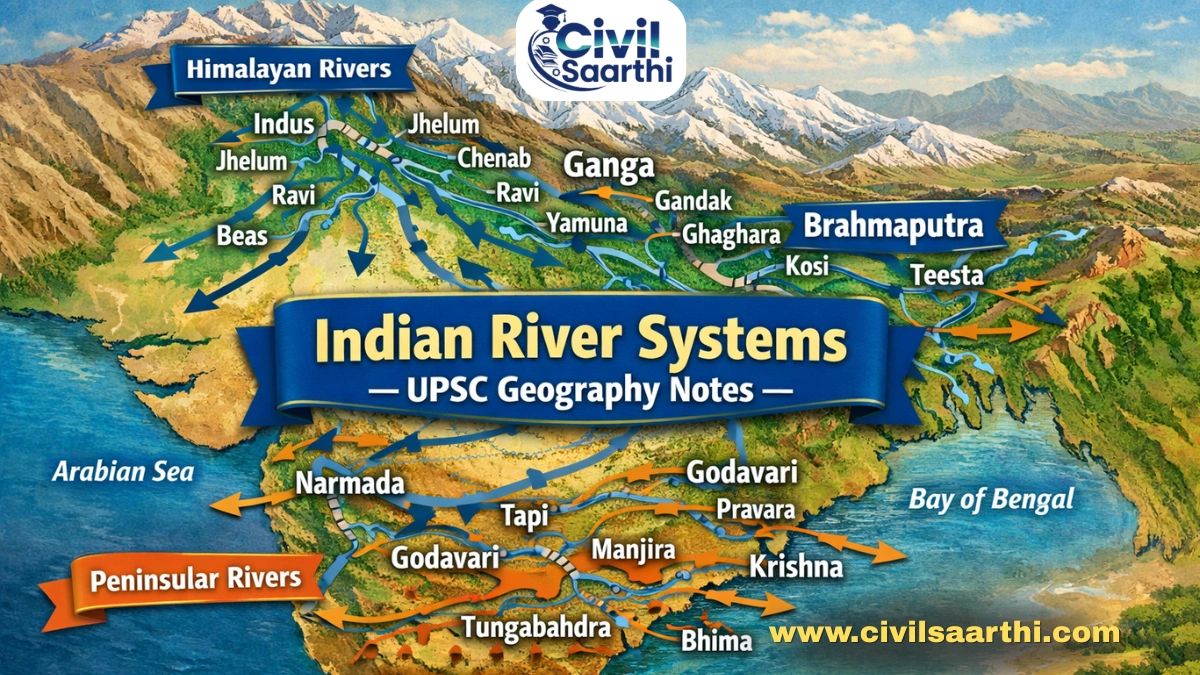
India’s rivers are the lifeline of its civilization, economy, and biodiversity. They shape the land, sustain agriculture, and are intertwined with the cultural and spiritual ethos of the country. For UPSC Geography aspirants, understanding Indian river systems, their classification, tributaries, and drainage patterns is crucial for both prelims and mains. This guide provides a comprehensive analysis of India’s rivers with detailed notes and key points.
Introduction to Indian River Systems
India has a complex network of rivers that drain into the Bay of Bengal, the Arabian Sea, or inland basins. These rivers support agriculture, hydroelectric power, and freshwater supply for millions. They also influence settlement patterns, trade routes, and cultural practices. From perennial Himalayan rivers to seasonal peninsular rivers, India’s rivers exhibit diverse characteristics.
Key Points:
- Rivers cover almost 12% of India’s land area.
- Classified based on origin, flow pattern, and drainage basin.
- Integral to agriculture, hydropower, and transportation.
Classification of Indian Rivers
India’s rivers are classified based on their origin, flow patterns, and drainage basins. They can broadly be divided into Himalayan rivers, Peninsular rivers, Coastal rivers, and Inland drainage systems. Each type has unique characteristics and significance.
Himalayan River System
Himalayan rivers originate in the snow-capped mountains and are perennial. Fed by glaciers and rainfall, they carry large volumes of water throughout the year. These rivers have extensive drainage basins and support fertile plains downstream.
Major Himalayan Rivers:
1. Indus River System
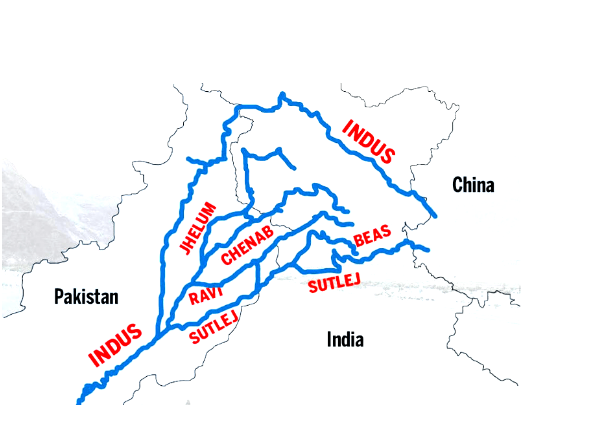
- Origin: Tibetan Plateau (Ladakh region, near Lake Mansarovar).
- Length: 3,180 km (1,114 km in India).
- Major Tributaries: Jhelum, Chenab, Ravi, Beas, Sutlej.
- Course: Flows through Ladakh and Jammu & Kashmir, enters Pakistan, and drains into the Arabian Sea.
- Characteristics:
- Perennial river with high sediment load.
- Vital for irrigation in Punjab and Sindh regions.
- Supports large-scale hydroelectric projects like Bhakra Nangal Dam.
- Significance:
- Cultivates fertile plains in north-western India and Pakistan.
- Important for transport and trade in ancient and modern times.
- Religious significance in Hinduism and Sikhism (e.g., confluence at Harike).
2. Ganga River System
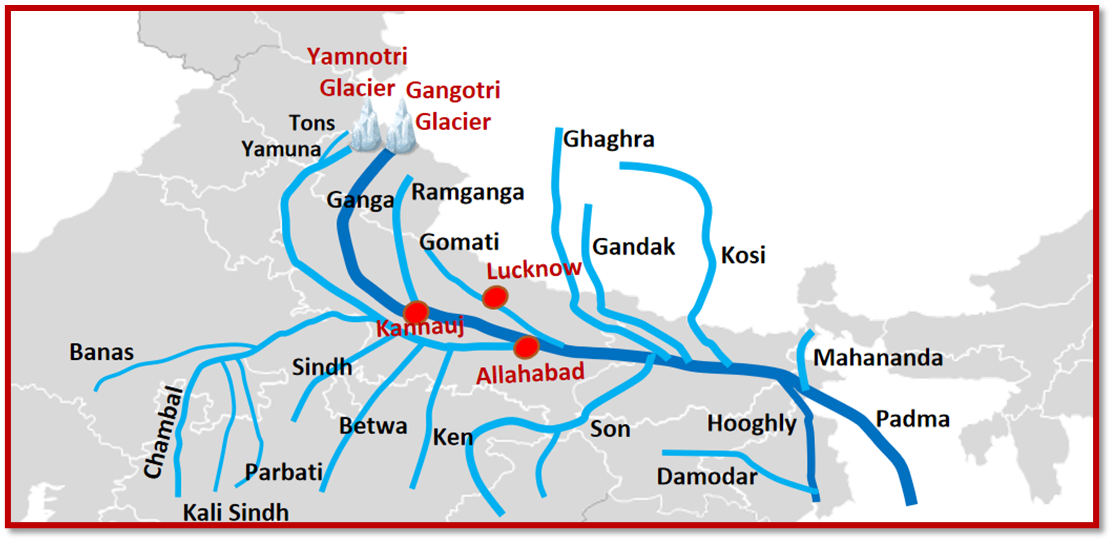
- Origin: Gangotri Glacier in Uttarakhand (as Bhagirathi).
- Length: 2,510 km.
- Major Tributaries: Yamuna, Ramganga, Ghaghara, Gandak, Kosi, Son.
- Course: Flows across Uttarakhand, Uttar Pradesh, Bihar, Jharkhand, and West Bengal, then into Bangladesh.
- Characteristics:
- Perennial river with a large drainage basin (over 1 million sq. km).
- Deposits fertile alluvium, creating the Indo-Gangetic plains.
- Subject to seasonal flooding, especially in Bihar and West Bengal.
- Significance:
- Supports agriculture of wheat, rice, sugarcane.
- Sacred river in Hinduism; major pilgrimage sites along its banks (Haridwar, Varanasi, Allahabad).
- Source for water supply and hydropower (e.g., Farakka Barrage).
3. Brahmaputra River System
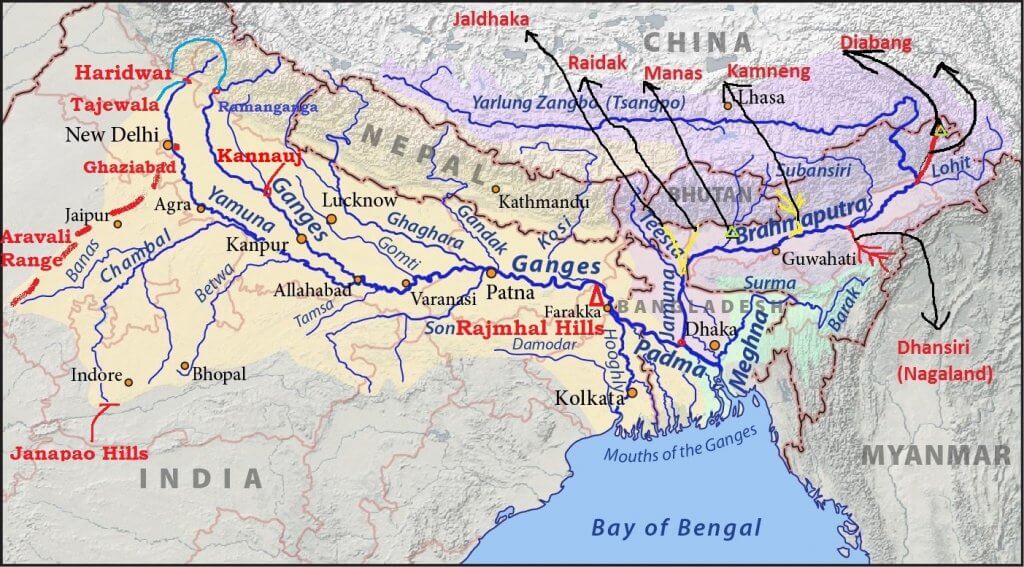
- Origin: Tibet (as Tsangpo River) near the Angsi Glacier.
- Length: 2,900 km (916 km in India).
- Major Tributaries: Subansiri, Kameng, Manas, Dibang, Lohit.
- Course: Flows through Arunachal Pradesh and Assam in India, then Bangladesh, where it joins the Ganga to form the Meghna River.
- Characteristics:
- Perennial with braided channels in Assam valley.
- High rate of flow and sediment transport; prone to annual floods.
- Strong monsoon-fed flow enhances fertility of Assam plains.
- Significance:
- Vital for Assam’s agriculture, especially rice cultivation.
- Supports biodiversity in Brahmaputra valley (national parks and wetlands).
- Important for inland navigation and hydroelectric projects (Siang and Subansiri dams).
4. Other Important Himalayan Rivers
- Yamuna: Originates from Yamunotri Glacier; tributary of Ganga; major irrigation source for western Uttar Pradesh and Haryana.
- Ghaghara: Originates in Nepal Himalayas; tributary of Ganga; known for flooding in Bihar plains.
- Kosi: Originates in Nepal; tributary of Ganga; called “Sorrow of Bihar” due to frequent floods.
- Sutlej: Originates from Lake Rakshastal in Tibet; tributary of Indus; site of Bhakra Dam.
Peninsular Rivers
Peninsular rivers are older, originating from the Deccan Plateau and the Western Ghats. Unlike Himalayan rivers, they are mostly seasonal and depend on monsoon rainfall. These rivers are crucial for regional agriculture and domestic water supply.
Major Peninsular Rivers:
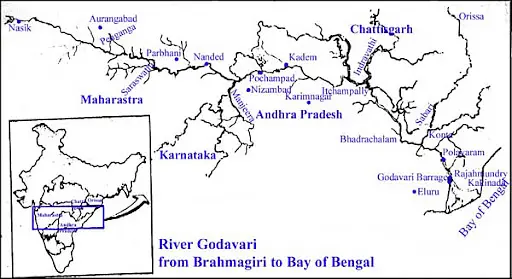
1. Godavari River System
- Origin: Trimbakeshwar (Nasik, Maharashtra).
- Length: 1,465 km (longest river in Peninsular India).
- Course: Flows through Maharashtra, Telangana, Andhra Pradesh, and Odisha before draining into the Bay of Bengal.
- Major Tributaries:
- Left bank: Indravati, Sabari, Pranhita (largest tributary).
- Right bank: Manjira, Penganga, Wardha.
- Characteristics:
- Known as the “Dakshin Ganga” (Ganga of the South) due to its large basin.
- Forms a wide delta in Andhra Pradesh, one of the most fertile in India.
- Significance:
- Supports agriculture in drought-prone regions of Telangana and Maharashtra.
- Major irrigation projects: Jayakwadi, Polavaram, and Godavari Delta system
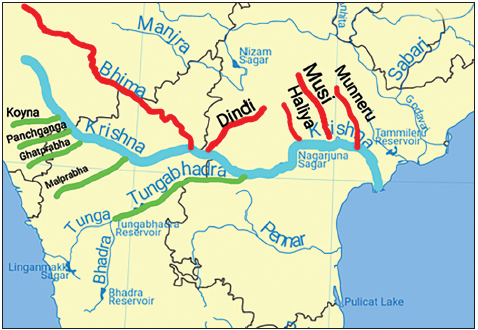
2. Krishna River System
- Origin: Western Ghats near Mahabaleshwar (Maharashtra).
- Length: 1,400 km.
- Course: Flows through Maharashtra, Karnataka, Telangana, and Andhra Pradesh before joining the Bay of Bengal.
- Major Tributaries:
- Left bank: Bhima, Tungabhadra.
- Right bank: Koyna, Musi, Ghataprabha, Malaprabha.
- Characteristics:
- One of the most water-abundant rivers of Peninsular India.
- Forms a large and fertile delta in Andhra Pradesh.
- Significance:
- Irrigation projects like Nagarjuna Sagar Dam and Almatti Dam.
- Provides water to drought-prone districts of Karnataka and Telangana.
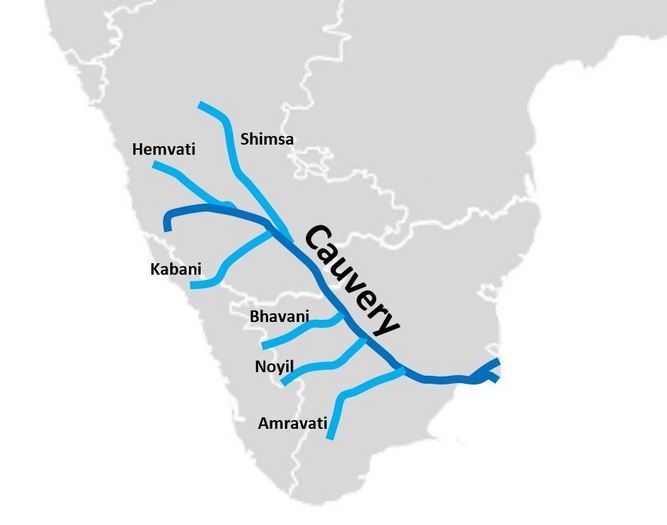
3. Cauvery (Kaveri) River System
- Origin: Talakaveri in the Western Ghats (Karnataka).
- Length: 805 km.
- Course: Flows through Karnataka, Tamil Nadu, and Puducherry before entering the Bay of Bengal.
- Major Tributaries:
- Left bank: Harangi, Hemavati, Kabini.
- Right bank: Bhavani, Amaravati, Noyyal.
- Characteristics:
- Known as the “Ganga of the South” due to its cultural and agricultural significance.
- Forms the Cauvery Delta, one of the most fertile in Tamil Nadu.
- Significance:
- Major irrigation and hydropower source.
- Sacred river in South India; worshipped in Karnataka and Tamil Nadu.
- Provides water to important cities like Mysuru, Bengaluru, and Tiruchirappalli.
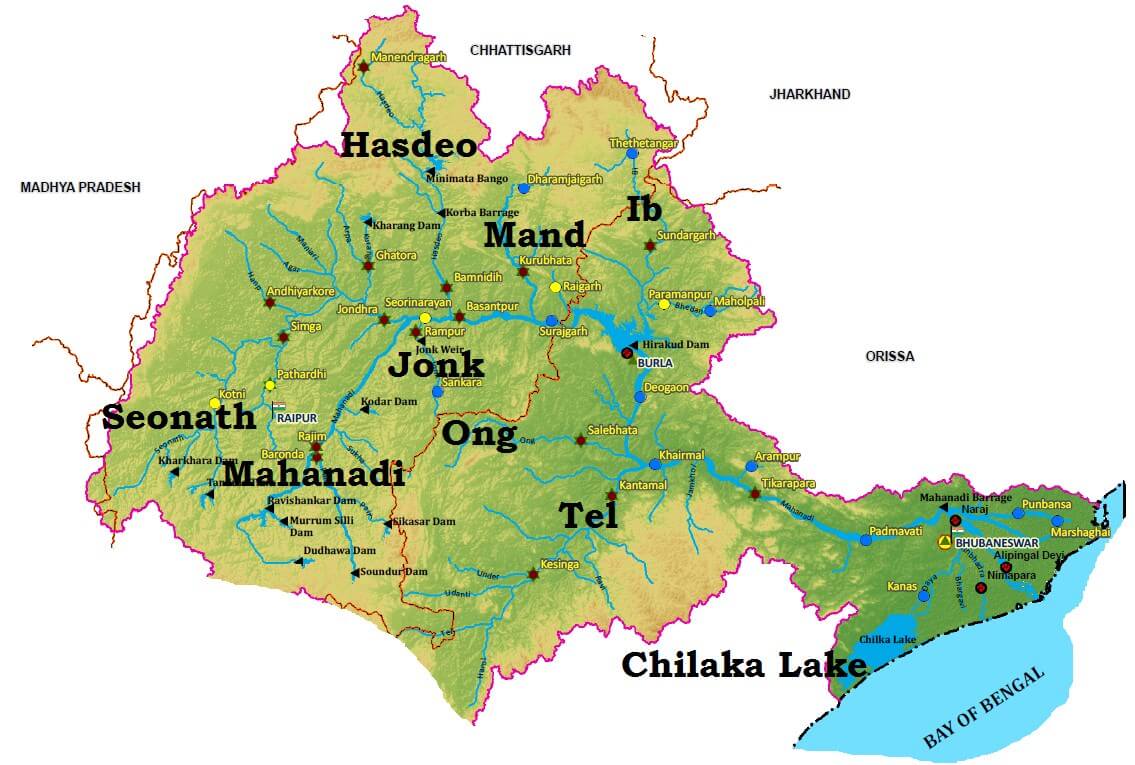
4. Mahanadi River System
- Origin: Sihawa Hills (Chhattisgarh).
- Length: 851 km.
- Course: Flows through Chhattisgarh and Odisha into the Bay of Bengal.
- Major Tributaries:
- Left bank: Seonath, Hasdeo, Mand.
- Right bank: Ib, Ong, Tel.
- Characteristics:
- Known for its vast delta in Odisha.
- Prone to flooding during monsoons.
- Significance:
- Hirakud Dam is one of the longest dams in the world.
- Provides irrigation and hydropower to Odisha and Chhattisgarh.
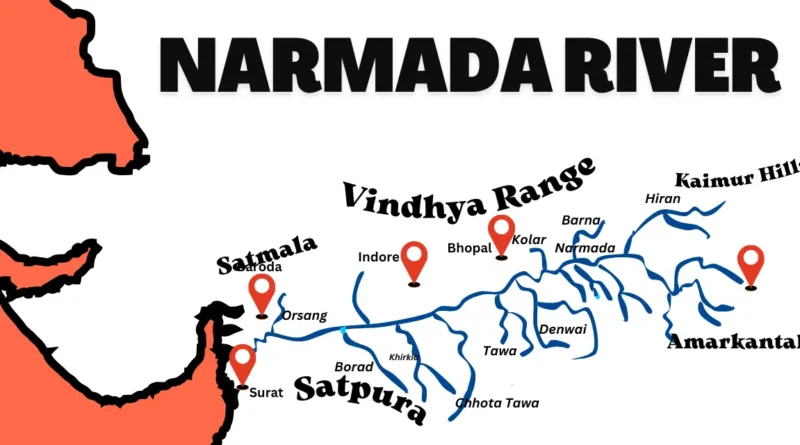
5. Narmada River System
- Origin: Amarkantak Plateau (Madhya Pradesh).
- Length: 1,312 km.
- Course: Flows westwards through Madhya Pradesh, Maharashtra, and Gujarat into the Arabian Sea.
- Major Tributaries: Tawa, Hiran, Barna, Orsang.
- Characteristics:
- One of the few west-flowing rivers of Peninsular India.
- Flows through the rift valley between Vindhya and Satpura ranges.
- Significance:
- Major irrigation project: Sardar Sarovar Dam.
- Supplies water to drought-prone Gujarat and Rajasthan.
6. Tapi (Tapti) River System
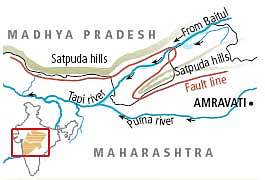
- Origin: Satpura Hills (Madhya Pradesh).
- Length: 724 km.
- Course: Flows westwards through Madhya Pradesh, Maharashtra, and Gujarat into the Arabian Sea.
- Major Tributaries: Purna, Girna, Panjhra.
- Characteristics:
- Flows parallel to Narmada.
- Also forms a rift valley.
- Significance:
- Important for irrigation in Maharashtra and Gujarat.
- Ukai Dam is a major hydroelectric project.
7. Other Important Peninsular Rivers
- Periyar (Kerala): Lifeline of Kerala; important for hydropower.
- Sabarmati (Gujarat): Flows past Ahmedabad; Gandhi Ashram is on its banks.
- Musi (Telangana): Tributary of Krishna; Hyderabad is located on its banks.
- Sharavathi (Karnataka): Famous for Jog Fall.
Coastal Rivers
Coastal rivers are shorter, steeper, and flow directly into the sea. They are categorized based on the coast into west-flowing rivers draining into the Arabian Sea and east-flowing rivers draining into the Bay of Bengal. They are crucial for local irrigation and small-scale hydropower.
West-flowing rivers: Narmada, Tapi, Mahi, Sabarmati, Periyar.
East-flowing rivers: Subarnarekha, Mahanadi, Godavari, Krishna, Cauvery.
Key Points:
- Shorter in length but often fast-flowing.
- Important for fishing and navigation.
- Provide seasonal water for irrigation and human consumption.
Inland Drainage Systems of India
Not all rivers in India reach the sea. Some rivers terminate inland in lakes, salt pans, marshes, or sandy desert tracts instead of flowing into the Bay of Bengal or the Arabian Sea. These are known as inland drainage rivers. They are usually seasonal, short in length, and found in arid/semi-arid regions where rainfall is scarce and evaporation is high.
Characteristics of Inland Drainage Systems
- Mostly found in desert and low rainfall regions.
- Rivers are seasonal, carrying water only during the monsoon.
- Often disappear into sand, salt lakes, or marshes instead of forming deltas.
- Water tends to be saline due to high evaporation and lack of natural outflow.
- Provide localized irrigation and groundwater recharge.
Major Examples of Inland Drainage in India
- Luni River
- Originates in the Aravalli Hills near Ajmer (Rajasthan).
- Flows through the Thar Desert and finally dissipates into the Rann of Kutch.
- Known for its saline water, especially in the lower reaches.
- Supports small-scale irrigation in western Rajasthan.
- Sambhar Lake Basin
- Largest inland saltwater lake in India (Rajasthan).
- Fed by seasonal rivers like Mendha, Rupangarh, Kharian, and Khandel.
- Water is highly saline due to evaporation, making it a hub for salt production.
- Ghaggar-Hakra River System
- Originates in the Shivalik Hills of Himachal Pradesh.
- Flows through Punjab, Haryana, and Rajasthan.
- Disappears into the dry desert sands of Thar Desert without reaching the sea.
- Believed to be part of the ancient Saraswati River system.
- Other Inland Lakes and Rivers
- Chilka Lake tributaries (Odisha): Some minor streams terminate inland during dry years.
- Pushkar Lake (Rajasthan): Fed by seasonal hill streams.
- Pangong Tso & Tso Moriri (Ladakh): Endorheic lakes fed by snowmelt streams.
Drainage Patterns in India
The drainage pattern of a region refers to the spatial arrangement of rivers and their tributaries as they flow across land. These patterns are shaped by geology, slope, rock type, relief, and structural controls of the terrain. Studying drainage patterns helps geographers and planners understand river behavior, flood risks, soil erosion, and irrigation potential.
1. Dendritic Drainage Pattern
- Description: Looks like the branches of a tree, with numerous small tributaries joining larger streams at acute angles.
- Formation: Found in regions with homogeneous rock structure where resistance to erosion is uniform.
- Examples in India: Most of the Indo-Gangetic plains and large parts of the Deccan Plateau.
- Key Features:
- Most common drainage pattern in India.
- Indicates relatively stable geological conditions.
- Efficient water flow system with minimal erosion obstacles.
2. Trellis Drainage Pattern
- Description: Tributaries join the main river at right angles, forming a lattice-like pattern.
- Formation: Found in regions of alternating hard and soft rocks or in folded mountains.
- Examples in India:
- Satluj and its tributaries in the Himalayas.
- Rivers of the Vindhyan ranges.
- Key Features:
- Typical of areas with differential erosion.
- Guides river courses along weak rock zones.
- Helps identify structural control of landforms.
3. Radial Drainage Pattern
- Description: Rivers radiate outward from a central high point like the spokes of a wheel.
- Formation: Seen in regions of conical hills, domes, or volcanic cones.
- Examples in India:
- Rivers from Amarkantak Plateau (Narmada, Son, Mahanadi).
- Rivers around Western Ghats and Nilgiris.
- Key Features:
- Indicates dome-shaped uplifts or volcanic origins.
- Ensures water dispersal in all directions from the center.
4. Centripetal Drainage Pattern
- Description: Opposite of radial; rivers converge into a central depression or basin instead of flowing outward.
- Formation: Found in basin areas, salt lakes, or inland depressions.
- Examples in India:
- Rann of Kutch (Gujarat).
- Loktak Lake Basin (Manipur).
- Key Features:
- Indicates inland drainage systems.
- Common in arid and semi-arid areas.
- Often associated with saline lakes and marshes.
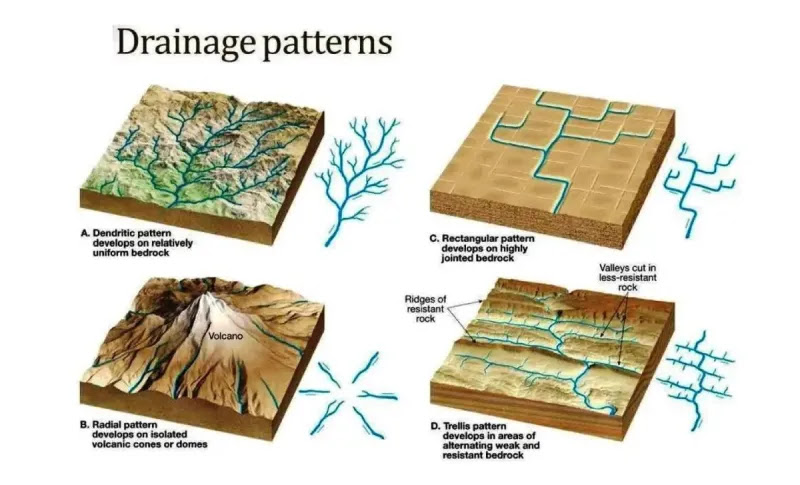
5. Rectangular Drainage Pattern
- Description: Streams meet at right angles, forming rectangular blocks.
- Formation: Occurs in regions with faulted or fractured rocks where streams follow lines of weakness.
- Examples in India:
- Vindhya Plateau (Madhya Pradesh).
- Regions of Chotanagpur Plateau (Jharkhand).
- Key Features:
- Reflects tectonic control.
- Found in jointed or faulted rock terrains.
6. Annular Drainage Pattern
- Description: Streams form a circular pattern around a central structure, resembling rings.
- Formation: Found in areas of eroded domes or structural basins.
- Examples in India:
- Nilgiri Hills (Tamil Nadu).
- Some parts of Himalayan foothills.
- Key Features:
- Indicates past geological uplifts and erosion cycles.
- Rare but important for identifying ancient structures.
Significance of Rivers in India
- Agricultural Importance
- The primary source of irrigation for crops like rice, wheat, sugarcane, and cotton.
- Fertile alluvial soil in river basins supports intensive agriculture.
- Canal irrigation from rivers like the Ganga, Krishna, and Cauvery boosts food production.
- Transform semi-arid regions (Punjab, Haryana) into the “Granary of India”.
- Transportation and Connectivity
- Rivers act as natural waterways, reducing transport costs.
- National Waterways (NW-1: Ganga, NW-2: Brahmaputra, NW-3: Kerala backwaters) boost trade.
- Facilitate movement of goods like coal, cement, food grains, and fertilizers.
- Reduce traffic load on roads and railways, cutting fuel use and pollution.
- Water Supply for People and Industries
- Provide drinking water to millions across urban and rural areas.
- Support industries such as textiles, paper, steel, cement, and refineries.
- Supply water for cooling and processing in thermal and nuclear power plants.
- Vital for combating groundwater depletion in over-exploited regions.
- Cultural and Religious Significance
- Sacred rivers: Ganga, Yamuna, Godavari, Narmada, Kaveri worshipped in Hinduism.
- Sites of major pilgrimages: Varanasi, Haridwar, Prayagraj, Rameswaram.
- Ceremonies like Ganga Aarti, Kumbh Mela, immersion rituals depend on rivers.
- Symbolize purity, life, and salvation in Indian culture.
- Hydropower and Energy Generation
- Himalayan rivers provide steep gradients for hydroelectric power projects.
- Major dams: Bhakra Nangal (Sutlej), Hirakud (Mahanadi), Tehri (Bhagirathi), Sardar Sarovar (Narmada).
- Hydropower is renewable, clean, and sustainable, reducing fossil fuel dependency.
- Supports rural electrification and industrial power needs.
- Industrial and Economic Role
- Rivers are lifelines for industrial hubs like Damodar Valley, Ahmedabad, Kanpur.
- Ports at river mouths (Kolkata, Haldia, Cochin) facilitate domestic & international trade.
- Promote fishing and aquaculture industries, supporting millions of livelihoods.
- Provide raw materials (clay, sand, sediments) for construction.
- Ecological Importance
- Sustain wetlands, estuaries, mangroves, and aquatic biodiversity.
- Support species like Ganga dolphin, mahseer fish, migratory birds.
- Maintain nutrient cycle by depositing sediments in plains and deltas.
- Recharge groundwater and regulate local climate and monsoon patterns.
Challenges Facing Indian River Systems
India’s rivers are under threat due to anthropogenic activities and climate change. Proper management is necessary to sustain these lifelines.
- Pollution: Industrial and domestic waste contaminates water.
- Over-damming: Affects ecology and natural flow.
- Encroachment: Urbanization reduces river catchment areas.
- Climate Change: Alters rainfall and glacier melt, affecting river flow.
- Floods & Droughts: Seasonal rivers are highly variable, leading to water scarcity or flooding.
Conclusion
Indian rivers are crucial for the country’s physical geography, agriculture, and socio-cultural fabric. Understanding river systems, tributaries, and drainage patterns is essential for UPSC preparation and water resource management. Sustainable utilization of rivers ensures ecological balance, economic development, and social well-being for future generations.