
 by
by 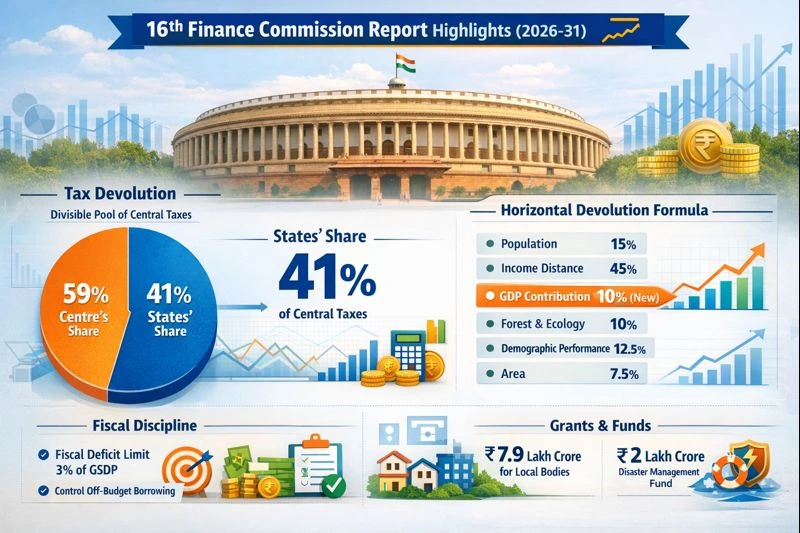
The Finance Commission of India is a constitutional body formed under Article 280 of the Indian Constitution. It is constituted every five years by the President to recommend how revenue should be shared between the Union Government and the States, and among the States themselves. The commission’s decisions play a pivotal role in shaping India’s fiscal federalism and state finances.
The 16th Finance Commission (16th FC), chaired by Dr. Arvind Panagariya, submitted its report in November 2025 and its recommendations are being implemented from 1 April 2026 to 31 March 2031. This article explains the 16th FC’s report and “criteria for devolution,” outlines its major recommendations with the latest data, and compares it with the 15th and 14th Finance Commissions.
What is the 16th Finance Commission Report?
The 16th Finance Commission Report makes recommendations on crucial aspects of India’s federal finances, with key areas including:
- Vertical devolution: What percentage of the Union’s tax revenue should be shared with states.
- Horizontal devolution: How that share is further distributed among the states.
- Grants-in-aid: Allocations for specific purposes like local bodies and disaster management.
- Fiscal performance standards: Guidance on deficits, borrowing, and fiscal discipline.
The 16th Finance Commission emphasizes fiscal discipline, transparency in tax sharing, efficiency of public spending, and outcome-linked fiscal incentives.
About Finance Commission of India
The Finance Commission is a constitutional body that recommends the distribution of financial resources between the Union and the States. It ensures balanced fiscal federalism by guiding the sharing of taxes, grants, and fiscal responsibilities.
Constitutional Provisions:
- Established under Article 280 of the Indian Constitution.
- The President constitutes the Commission every five years or earlier if deemed necessary.
- Its main role is to recommend:
- Distribution of net proceeds of taxes between the Centre and the States.
- Allocation of taxes among States based on principles of equity.
- Grants-in-aid to States in need.
- Measures to maintain financial stability and address revenue gaps.
Composition / Members:
- Chairperson: Usually an expert in public finance.
- Four other members: Experts in public affairs, finance, economics, or administration.
- Members must not hold any office of profit under the government.
Appointment Procedure:
- Appointed by the President of India.
- Selection is based on expertise in finance, economics, and public affairs.
- The Commission submits its recommendations to the President, who lays them before both Houses of Parliament.
Tenure and Functions:
- Usually serves a five-year term.
- Evaluates the resources and expenditure needs of States.
- Suggests principles for grants-in-aid and measures to balance state finances.
- Advises on fiscal policies to ensure equitable distribution.
16th Finance Commission Criteria for Devolution
Vertical Devolution
- The 16th Finance Commission has recommended that 41% of the divisible pool of central taxes be devolved to the states for the period 2026–27 to 2030–31.
- This percentage is unchanged from the 15th Finance Commission, ensuring continuity and predictability in fiscal transfers from the Centre to the States.
- By retaining the 41% share, the Commission aims to maintain a balance between national fiscal requirements and states’ spending responsibilities.
Horizontal Devolution (Distribution Among States)
To decide how the 41% share is distributed among individual states, the 16th Finance Commission has adopted the following detailed criteria:
- Population (Census 2011): The population criterion reflects the expenditure needs of states. States with larger populations require higher financial resources to provide essential services such as health, education, housing, and social welfare.
- Demographic Performance: This criterion rewards states that have successfully managed population growth over the years. It encourages population stabilization policies and promotes long-term human development outcomes.
- Area: States with a larger geographical area incur higher administrative and infrastructure costs. This parameter compensates such states for expenses related to governance, connectivity, and public service delivery over vast territories.
- Per Capita Income (Income Distance): Income distance measures the gap between a state’s per capita income and that of the richest state. States with lower income levels receive a higher share, helping to reduce regional economic inequalities and promote balanced development.
- Forest Cover and Ecology: This criterion recognizes the ecological services provided by states with significant forest cover. It compensates them for conserving forests and biodiversity, which often limits industrial and commercial land use.
- Contribution to Gross Domestic Product (GDP) – New Criterion: Introduced for the first time, this parameter assigns 10% weight to a state’s contribution to the national GDP.
16th Finance Commission Major Recommendations
The 16th Finance Commission’s recommendations stretch beyond tax sharing to several aspects of state finances:
- Maintain 41% share of central tax revenue for states.
- Introduce GDP contribution into the horizontal formula (10%).
- Remove revenue deficit grants to states, to strengthen fiscal discipline and encourage better revenue mobilization.
- No state-specific or sector-specific grants, ensuring neutrality across states.
- Grants for local bodies with a 60:40 rural-urban split.
- Disaster risk funds backed with a revamped index and higher allocation.
- Transparency in tax sharing, audited by the CAG.
- Stricter fiscal discipline:
- States’ fiscal deficit capped at 3% of GSDP.
- Call to bring all off-budget borrowings into the official budget.
Latest estimates suggest that in Budget 2026-27, the tax devolution to states is likely around ₹15.26 lakh crore around 3.9% of GDP significantly higher compared to the previous year.
Comparing 16th FC Criteria for Tax Devolution with 15th and 14th FC
The 16th Finance Commission retains the 41% vertical devolution like the 15th FC but introduces GDP contribution as a new criterion, replacing the earlier tax effort parameter. Compared to the 14th FC, which emphasized income distance and population, the 16th FC balances equity and performance, rewarding states for both need and economic contribution.
The 16th FC drops revenue deficit grants, unlike the 15th FC which included them as transitional support.
| Aspect | 14th FC (2015-20) | 15th FC (2020-26) | 16th FC (2026-31) |
|---|---|---|---|
| Vertical Devolution | 42% of net Union tax revenue | 41% | 41% |
| Population Data Used | 1971 & 2011 census mix | 2011 census | 2011 census |
| Income Distance | High weight (50%) | Still highest (45%) | Still significant but reduced for new GDP criterion |
| Population Weight | Moderate (1971) | Increased (2011) | Further increased emphasis |
| Forest / Ecology | Included (forest cover) | Included (forest and ecology) | Included (forest and ecology) |
| Tax Effort | Part of criteria | Included (2.5%) | Removed |
| New Criterion | — | — | GDP Contribution (10%) |
| Parameters | 14th Finance Commission (2015–20) | 15th Finance Commission (2020–21) | 15th Finance Commission (2021–26) | 16th Finance Commission (2026–31) |
|---|---|---|---|---|
| Population (1971) | 17.5% | 0% | 0% | 0% |
| Population (2011) | 10% | 15% | 15% | 15% |
| Area | 15% | 15% | 15% | 15% |
| Forest Cover | 7.5% | 0% | 0% | 0% |
| Forest and Ecology | 0% | 10% | 10% | 10% |
| Income Distance | 50% | 45% | 45% | 40% |
| Tax and Fiscal Efforts | 0% | 2.5% | 2.5% | 0% |
| Demographic Performance | 0% | 12.5% | 12.5% | 10% |
| Contribution to GDP | — | — | — | 10% |
Key Takeaways for States & Federal Relations
- Stable Devolution Rate: The continuation of 41% ensures predictable transfers, but many states had pushed for a higher share (~50%).
- Growth-Linked Incentives: Adding GDP contribution incentivises states to grow their economies and expand their fiscal base.
- Enhanced Local Governance Funding: Support to local bodies reflects a focus on grassroots development.
- Stronger Fiscal Discipline: Emphasis on deficit control and ending off-budget borrowings aligns with long-term fiscal sustainability goals.
UPSC CSE PYQs on Finance Commission
Q. Which of the following statements with regard to recommendations of the 15th Finance Commission of India are correct? [2025]
I. It has recommended grants of ₹ 4,800 crores from the year 2022-23 to the year 2025-26 for incentivizing States to enhance educational outcomes.
II. 45% of the net proceeds of Union taxes are to be shared with States.
III. ₹ 45,000 crores are to be kept as performance-based incentive for all States for carrying out agricultural reforms.
IV. Its reintroduced tax effort criteria to reward fiscal performance.
Select the correct answer using the code given below.
- I, II and III
- I, II and IV
- I, III and IV
- II, III and IV
Answer: 3 I, III and IV
Q. Consider the following: [2023]
1. Demographic performance
2. Forest and ecology
3. Governance reforms
4. Stable government
5. Tax and fiscal efforts
For the horizontal tax devolution, the Fifteenth Finance Commission used how many of the above as criteria other than population area and income distance.
- Only two
- Only three
- Only four
- All five
Answer: 2 Only three
Question 1) With reference to the Fourteenth Finance Commission, which of the following statements is/ are correct? [2015]
- It has increased the share of States in the central divisible pool from 32 percent to 42 percent.
- It has made recommendations concerning sector-specific grants.
Select the correct answer using the code given below.
(a) 1 only (b) 2 only
(c) Both 1 and 2 (d) Neither 1 nor 2
Answer: (a) 1 only
Q. With reference to the Finance Commission of India, which of the following statements is correct? [2011]
(a) It encourages the inflow of foreign capital for infrastructure development
(b) It facilitates the proper distribution of finances among the Public Sector Undertakings
(c) It ensures transparency in financial administration
(d) None of the statements (a), (b) and (c) given above is correct in this context.
Answer (d) None of the statements (a), (b) and (c) given above is correct in this context.
Question: How have the recommendations of the 14th Finance Commission of India enabled the states to improve their fiscal position? [UPSC Mains 2021]